For the Locksmith, Time Is Money
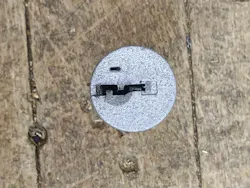
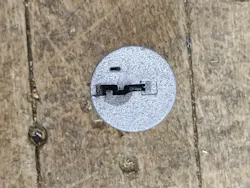
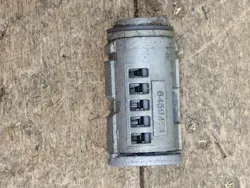
In our industry, there is one fact that stands almost as tall as the golden rule: Time is money. Wherever a shop or technician can find a way to save time, particularly on the common jobs he sees everyday, it is certain to make them more money. For many of us, residential lockouts are a daily call. For years, if a technician could reliably pick whatever knobs or deadbolts you can find at the Home Depot, they could be sure that they could handle most jobs. Lishi tools have made this even easier, and most of the time now residential lockouts are a piece of cake. However, today the Home Depot shelf is lined with Kwikset's SmartKey line, which is revered as impractical to pick (Figures 1-3 show the SmartKey lock).
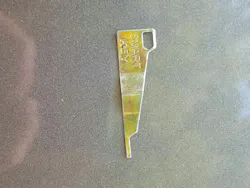
To understand how to defeat these locks non-destructively, you have to understand how they function. SmartKey works to prevent picking by using a sidebar mechanism within the lock. The locks also use a wafer-tumbler mechanism that can be reset for DIY rekeying without disassembling the lock (Figure 4 shows the SmartKey reset tool).
The locks have evolved through a few different generations over time, now on its fifth generation. This generation brought a handful of design changes, notably a rounded off sidebar (as opposed to the previously square one) which increases the security of the lock.
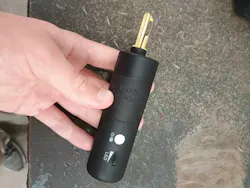
It is also beneficial to understand the brief history of defeat tools made for the SmartKey product line. A number of different techniques have been used to defeat previous generation SmartKey cylinders. For starters, it was discovered on previous generations that a shim could be fitted through the side of the plug to manipulate the sidebar. Additionally, a Kwikset Lishi tool could be used to decode cuts without picking the lock. Certainly the most creative of these belongs to LockTech, who originally developed a tool that used a small camera placed inside a milled-out Kwikset blank in order to scope the keyway and decipher all five cuts (Figure 5-6 show the LockTech Accureader).
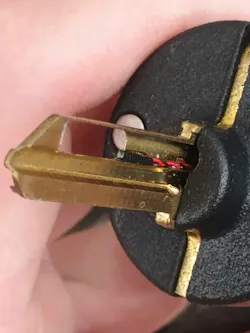
However, this would soon become obsolete. Starting on fifth generation SmartKey locks, a wafer reading a one, two, or three would appear to be identical. These ambiguous cuts meant progressing out the remaining possibilities. In some cases, you could get lucky and find that you have none or one ambiguous cut, and only have to cut one key. In other cases, you could get very unlucky, and get 4-5 ambiguous cuts, rendering progression impractical.
I made an effort to ask about SmartKey at conventions and trade shows in order to see how most people handle SmartKey in the field. Many locksmiths told me that they disregarded the tool after the change and have been drilling out the locks ever since. For a few reasons, they admit this hurts them and their business. For starters, they now complain that they have to stock replacement residential hardware for the customer. If they choose to stock more SmartKey, they are replacing the locks with exactly what they took off and cutting into their profit margins by having to give the customer a free lock. If they stock something better, the technician needs to worry about destroying an expensive electronic lock or rekeying the new lock so that the house remains keyed alike, which is not possible if whatever they stock is in a different keyway.
It also places them in a predicament when it comes to pricing. It is difficult to always obtain the brand of the lock over the phone when a customer is locked out. The customer will usually ask for a price quote and would be irritated to discover a price increase. Therefore, the shop is stuck either agitating their client or losing potential revenue. Also the affect this has on the customer’s opinion of their company is not negligible. They are told through what they hear about "locksmith scams" everywhere that the scammers all have the common attribute of immediately resorting to their power drill upon seeing the door. I have spoken to a few shops who tell me that at least 10 percent of their SmartKey lockouts are simply refused by the customer who insists that they do not want their lock drilled.
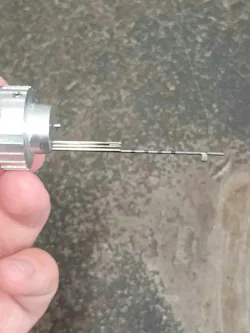
In response to the fifth generation design, LockTech developed an accessory that decodes the ambiguous cuts (Figures 7-8 shows the adapter). The tool works similar to existing automotive decoders. In my experience, it works very well. After the tool is inserted into the desired space, you are able to read the depth via a panel on the back of the tool. It is only necessary to use the tool to find the depth of ambiguous cuts. For the rest of the cuts, you can still use the camera. This means that on average, most of the cuts can be decoded quickly. I find that with practice, the tool works well and rarely has issues with accuracy. Despite this, however, I believe the tool is not widely used, and the locks are still drilled.
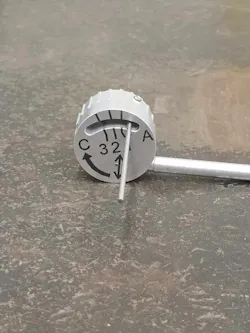
Combining the decoder and adapter, you are able to decode the full bitting from the lock in just a few minutes. The next logical conclusion is to return to your van or truck and cut the key. However, I have taken this a step further by bringing a punch to the door. In my market, I may have to park my van a small distance from the door, so it makes the job easier to cut the key at the door. With all three of these tools and a single key blank, I can reliably produce a key for any SmartKey lock in about five to ten minutes, and less if I get lucky and don't need the adapter. This, in my opinion, is about as efficient as it gets. There is no mess from drilling, no worry about stocking hardware, and no chance of the customer calling you a scammer.
Saving your costs on inventory and freeing your schedule quickly adds up. On a large scale and over the course of years, it is the locksmith that chooses to make his own life easier and invest in himself who succeeds in this industry. Whether it be in residential or anything else, always make an effort to find ways to make each job go a little quicker. As the old saying goes, "Time is money."