How Locksmiths Can Claim Their Share of the Booming Access Control Market
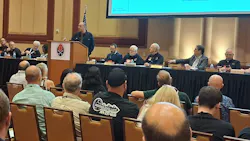
"Stop selling key cuts, start selling judgment, electronics, lock, credentials, identity, integration, longevity, and risk." That was the advice from ALOA keynote speaker Lee Odess, CEO of The Access Control Collective (TACC), on June 25. Odess’ core message was that the security industry is in the middle of a transformation unlike anything it has seen in the past 50 years — and locksmiths are sitting at the center of it, whether they realize it or not.
Access Control Market: From $10 Billion to $100 Billion
The core message was that the security industry is in the middle of a transformation unlike anything it has seen in the past 50 years — and locksmiths are sitting at the center of it, whether they realize it or not.
For most of its history, the electronic access control market operated as a relatively stable, slow-growth industry — worth roughly $10 billion, growing at 5–12% annually, with well-defined channels and pricing. Then 2020 hit. COVID accelerated the adoption of cloud-based, mobile-first, and AI-integrated systems. Odess noted that the market is now on its way to $100 billion, driven by a fundamental shift in the value proposition: from keeping bad people out to letting the right people in — and doing far more with access data along the way.
That $90 billion gap represents the opportunity. The question is who claims it, he said.
Where Locksmiths Fit
The speaker was direct: future-focused locksmiths are uniquely positioned to compete for a significant share of this growth — but only if they choose to. Unlike many integrators, locksmiths already hold the licensing, certifications, and hands-on credibility that the marketplace increasingly values. Trust is becoming a competitive differentiator, and locksmiths have it built in. The problem is that most aren't leveraging it.
Too often, the profession markets itself around the function — key cutting, lock installation, hardware — rather than the expertise behind it. Customers aren't really buying a lock cylinder; they're buying a trusted advisor who can tell them what system is right for their building, their risk profile, and their future needs.
Six Attributes of the Future Locksmith
The speaker outlined six priorities for locksmiths who want to compete in the next era:
- Move upstream into credential and software conversions
- Own mechanical and electronic security end-to-end
- Use licensing and certification as a marketplace differentiator
- Use AI as a business tool
- Take a position on open versus closed credential ecosystems
- Build their teams deliberately to fill skill gaps
Underlying all six is a mindset shift from reactive installer to proactive security advisor. "Are you a key cutter that happens to hold certifications, or are you a certified security advisor that happens to cut keys and install hardware?" Odess asked.
Three Questions to Take Back to Your Shop
The keynote closed with a practical challenge. Where in the customer's decision process are you showing up, and where do you need to be? What percentage of your current revenue could a key kiosk, big-box installer, or AI dispatch tool replace within three years? And does your team have the skills today to quote a job that covers the cylinder, the credential platform, and the software layer?
Editor’s note: We plan to publish a more detailed article from Odess online and in a future magazine issue and online.
This report was written with the assistance of Artificial Intelligence.