Growing Opportunities in Data Center Security
Key Highlights
- Data center capacity is expected to nearly triple by 2030, with over 40% of global investments occurring in the United States, highlighting the sector's rapid expansion.
- Effective security planning must begin early in the construction process, emphasizing the importance of integrating people, processes, and technology for success.
- Security challenges include human error, supply chain disruptions, phased construction risks, and securing both live and under-construction zones within large, remote sites.
- Hardware solutions like high-performance doors, access control systems, and smart locks are vital components of layered physical security in data centers.
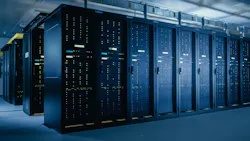
Data centers are springing up across the country, driven by artificial intelligence and cloud computing, wherever land and reliable power are available. These sprawling, high-tech facilities pose unique security challenges — and major opportunities for security professionals prepared to meet them.
Growth Forecasts
Though the numbers vary slightly between different forecasts, the investments being made in data center infrastructure are huge. Data center capacity is expected to nearly triple by 2030 and grow by about 50 percent by next year, according to the Goldman Sacks study, How AI Is Transforming Data Centers and Ramping Up Power Demand. McKinsey and Company projects that by 2030, companies will invest almost $7 trillion in capital expenditures on data center infrastructure globally, with more than $4 trillion spent on computing-hardware investments, and the balance going towards real estate and infrastructure. More than 40 percent of this spending will be invested in the United States.
Nearly 100 GW of new data centers will be added between 2025 and 2030, doubling global capacity, according to the JLL 2026 Global Data Center Outlook Report. By 2030, global data center capacity could reach 200 GW, JLL projected. The Americas is the largest data center region, representing about 50% of global capacity.
“The data center sector currently sits at the beginning of one of the largest infrastructure investment supercycles seen in the modern era. The interconnected nature of data centers means the AI-fueled expansion is reshaping a number of sectors including power, technology and real estate. The transition from AI training to inference will redistribute workloads from centralized clusters to distributed regional hubs, fundamentally altering capacity planning and geographic deployment strategies. Energy infrastructure has emerged as the critical bottleneck constraining expansion. Grid limitations now threaten to curtail growth trajectories, making behind-the-meter generation and integrated battery storage solutions essential pathways for sustainable scaling,” JLL reported.
ISC West Data Security Session
Planning security for the growing wave of data centers is about much more than fortified openings, guard forces and video surveillance. While one might think the greatest risks to data centers were posed by criminals and terrorists, that is not the case. Keeping the bad guys out might be the easier part of the data center security equation.
At ISC West 2026, the Security Industry Association’s (SIA) Data Center Advisory Board (formed in December 2025) sponsored a panel discussion about the security challenges facing today’s data centers and how data center leaders are leveraging technology solutions to safeguard their facilities and information. This was not a nuts-and-bolts discussion on hardening openings; it was focused on the importance of developing and integrating a security plan before and during the construction process.
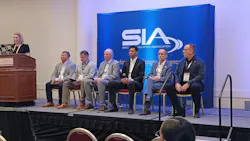
The panel included:
- Moderator Hannah Behnke, senior director of data center physical security, Microsoft
- Terry Browne, WMEA managing director, Northland Controls
- David Fortune, director of data center practice, Plugout
- Chris Hobbs, director, national accounts, ASSA ABLOY Opening Solutions U.S.
- Andrew Jimenez, data center technical sales, Wesco
- Glenn Lemke, data center and infrastructure security solutions, Pavion
- James Marcella, director, industry associations, Axis Communications
The speed and large scale of data center proliferation bring with it some serious challenges, noted Fortune. “The challenge is how we make sure security standards are upheld consistently in real-world conditions.”
Data centers need three things: land, power and connectivity. Panelists noted that two-thirds of data centers are being built in remote locations where larger portions of land are available. In those locations, the challenge is quickly meeting security standards in real-world conditions.
Data centers need three things: land, power and connectivity. Panelists noted that two-thirds of data centers are being built in remote locations where larger portions of land are available. In those locations, the challenge is quickly meeting security standards in real-world conditions.
Panelists answered some interesting questions in a roundtable discussion.
What breaks first when rapidly scaling: people, processes or technology?
Fortune noted that people break first, due to talent gaps in some areas, insufficient training and the lack of solid processes and guidelines to follow.
“Humans are the weakest link and humans are unfortunately the cause of most of the breaches,” Jimenez added. They agreed that the best defense against these human errors is implementing and maintaining solid processes and solid training procedures. Finding highly skilled workers can be especially difficult in these remote areas.
What are the top risks that data center security professionals should be concerned about today?
“I don’t see it as one big event that’s causing the risk. It can be made up of a lot of little things,” Lemke said, citing several smaller events.
First, supply chain breakdowns can cause problems in getting the products and equipment needed during the right stage of construction.
Second, gaps between the design and what is actually happening in the field can snowball. “You might do one thing wrong once, but guess what, that technician or subcontractor is now doing it wrong 60-70 times.” So installation errors can multiply throughout the project.
Third, there are operational risks, such as not enough available guards or access control badges remaining active in the system when someone involved in the build has finished their work.
In addition, the nature of the phased build-out of giant data centers creates some unique security challenges. Within the data center space, there are live, operational zones where data is running. Right next door, there are thousands of contractors trying to deliver the next phase. Half of the facility is live and half of it is under construction, so you are securing both the data center and its staff and outside contractors. This makes coordination much more difficult.
“Some of these sites are like small cities. You’ve got 5 to 7,000 workers on these sites and you’ve got people traveling in from all over the country. A really big risk, especially on the integrator side, is workplace safety on the site,” said Lemke.
Establishment and management of the security system’s installation throughout pre-construction, construction and post-construction amounts to managing “the intersection between people, processes and technology” and is vital to the system’s success, added Hobbes.
Artificial Intelligence?
Ironically, while AI is the driving force behind the proliferation of data centers, it is not yet a major component of data center security. A great audience question was: “Where do you see AI going as far as how we are designing the security for data centers?”
“I think it’s a very interesting dichotomy that you’ve got thousands of cameras being deployed along a fence line for example, protecting customer data that’s running all these workloads for tons of AI, but I haven’t seen much actual AI be deployed in protecting the data centers that are running the AI applications,” Fortune replied. A key question is “what AI applications are actually scalable that save time for the guard force, save time for responding to an alarm, responding to an event that’s happening? … I’m still not sold.”
Getting Started
Another question came from a smaller Midwestern integrator who asked for tips on getting into this lucrative vertical market. The advice started with follow the money. There’s a lot of private equity investment. Be aware of potential sites in your area with sufficient land and power.
“Coming from a small integrator that got bigger, we took the crawl-walk-run approach. Get in on small projects; a lot of times it’s break-fix work. Prove that you can do things consistently and then the opportunities become bigger and bigger. Going from zero to a full build – I would not recommend that to even my enemies. It’s really about showing consistency and what you can do and learning all you can about it,” Lemke advised.
This advice also resonates with locksmiths. There are plenty of integrators out there in need of partners to handle the nuts and bolts – installing the doors, locks, strikes and even cameras.
Nuts and Bolts: Doors and Locks
Here’s a rundown of some of the data center hardware on the market.
Allegion brand Krieger Specialty Products offers high-performance doors for data security centers with 40 ad 60 db radio frequency shielding and a 1-3/4-inch door panel thickness. Fire-rated models are also available.
The Innovative slip-in frame design makes installation quick. These doors also use rock wool instead of grouting for easier installation on the job site. The unique seal system with RF wire mesh perimeter does not bend or break providing superior durability over finger stock gaskets. Proprietary Cam Lift Hinge and adjustable door bottom ensure a tight sound seal, even on uneven floors in high-traffic areas.
Allegion recommends starting with their Architectural Consultants early in the process. “Allegion's Architectural Services provides complete design services starting with project requirement analysis working with you and the entire project team to select the best solutions for the building base on expert knowledge, code requirements, functionality, project schedule and budget. As an extension of your project team, our consultants provide innovative solutions that simplify the process throughout design and construction,” the company says
More info: https://us.allegion.com/en/solutions/by-market/data-centers.html
Explore ASSA ABLOY’s virtual data center at https://vimeo.com/1105806500?&login=true#_=_ The tour starts at the perimeter, with AMERISTAR Impasse II high security steel fencing. Moving onto the property, the next layer of protection is at the vehicle entrance: AMERISTAR barrier arms and the Control ID Lite Access Controller with UHF reader. Pedestrians can also enter through an AMERISTAR gate equipped with a HID Signo reader. The interior side of the gate is equipped with a Securitron M82 maglock and Sargent PE80 Series exit device. Adjacent to the vehicle entry is the guard house, secured by a HID Signo reader and Ceco/Curries forced entry bullet resistant doors with three-point locking.
Moving on to the data center entrance and interior doors between the entrance and the racks themselves, openings feature Ceco Imperial/Curries doors with thermally enhanced cores, McKinney hinges, Rockwood pulls, HID Signo readers, Norton Rixson 6300 Series low-energy operators and Sargent PE80 exit devices.
Once inside the lobby area, interior openings feature the same components along with DoorBird IP video intercoms. A Traka Touch electronic key cabinet is mounted on the wall. Leading from the lobby to the data center interior, a Curries door is equipped with a Corbin Russwin/Sargent SN10 access control mortise lock with a patented keyway. Once through that entrance, another similarly equipped door protected the LifeSafety Power power supply.
Further inside, HES KS-EM electromechanical server cabinet locks provide scalable, intelligent access. With integrated lock status monitoring and optional extended DPS sensor support, they ensure that cabinets are closed, locked, and secure. A mechanical SFIC override provides backup access, while its 4-wire setup simplifies integration. This lock is deal for managing a bank of cabinets from a single point of control. The KS-EM also pairs with the KS210-D OSDP cabinet lock to secure both the front and rear — making it a smart solution for IT, data centers, and beyond.
HES also offers the KS200 and KS210 Series server cabinet locks, designed to integrate seamlessly with existing access control systems and protect critical assets from intrusion and expensive downtime. Both install easily on most cam-activated swing-handle server cabinet doors with a 25 x 150 mm lock prep. The KS200 and KS210 come standard with locked state monitoring and utilize an SFIC (Small Format Interchangeable Core) mechanical key override. For high security applications, an optional extended DPS monitoring sensor can be connected to ensure that the cabinet is closed, locked and secure. With hard-wired KS200 (Wiegand) or KS210 (RS-485 OSPD) communication, both feature HID multiCLASS SE contactless card technology with NFC and BLE.
Securitech recommends multi-point door hardware, including its Auto-Bolt 8000 trigger-operated automatic deadbolt lock projection locksets, Auto-Bolt Max combined locks and exit devices and Multi-Bolt 5000 high-security mortise locks.
These are just a few of the data center security products on the market. The layered security approach also involves biometrics and sophisticated video surveillance. Security professionals should get ready to meet the high-security demands of this rapidly growing vertical market.