Servicing Schlage LFIC Systems
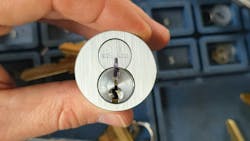
Schlage Large Format Interchangeable Core (LFIC) systems are one of the most common — and misunderstood — mechanical access control solutions in commercial and institutional environments.
This is a practical servicing guide that walks through real-world LFIC work, including picking the core, decoding it, creating both the operating and control keys, removing the core, servicing and rekeying it, and reinstalling the lock correctly.
This guide explains how Schlage LFIC systems use two separate shear lines, why the control key functions differently than the operating key, and how proper non-destructive techniques allow locksmiths to service these systems efficiently without removing door hardware.
Whether you’re refreshing your LFIC knowledge or looking to sharpen your skills, this article and accompanying video focuses on correct procedures, common pitfalls, and professional best practices that save time and prevent costly mistakes.
Getting Started
What do we do when we run into a lock that has this Figure 8 or little snowman-type figure (photo x)? This is a mortise housing with an LFIC.
If you remove the tailpiece, there is no way to access the cylinder. We have to be able to remove the core.
The difference between SFIC and LFIC is that LFIC takes the regular large format pins and small format requires the A2 pinning.
In order to pull this cylinder out, you’ll need a blank that looks like the standard SC4 but has an extra tip on the end. If you look at the lock, the first thing you’d assume is that there’s an extra pin back there and a standard key blank wouldn’t reach far enough.
That extra pin engages the control lug, which rotates the cylinder slightly, about 5 or 10 degrees. That will retract the control lug and allow the tip to engage with the control lug pin. Let’s go from there.
You’ve got two choices. You can go through the painstaking work of making a control key, picking the lock, finding out the bitting and the operating key and then cutting a control key, removing the cylinder, rekeying the lock, cutting your new keys and putting everything back together. The video shows how to do that.
There’s a second choice, if you want to get it done in a hurry. Swap the cylinders out.
Picking, Decoding and Cutting
Start by picking the lock with the Schlage Original Lishi and decoding it. Cut an SC4 6-pin blank, which can operate the lock. Then cut the control key that has the additional tip. Insert the control key perfectly vertical and rotate a few degrees to the right, and the whole thing can be pulled out. Now we can service this cylinder and rekey.
Basically, the bottom line is you’re going to have to pick and decode that lock so you can pull the cylinder from a specific position. Because of the housing, you can’t get to the back side.
Wayne Winton is the owner of Tri-County Locksmith Services, located in Glenwood Springs, Colorado, and President of the ALOA Security Professionals Association.
About the Author
 Wayne Winton
Wayne Winton
Wayne Winton, CRL, AFDI, CAIis the owner of Tri-County Locksmith Services, located in Glenwood Springs, Colorado, and the president of the ALOA Security Professionals Association.