Who better to talk to about the evolution of high security than Dale Bowman, director of Business Development, OEM, and International Sales, for Medeco Security Locks, who has spent the past 30 years helping push the industry to where it is today when it comes to securing these critically important entry points.
“After three decades with Medeco, I’ve seen the industry shift from purely ‘how hard is this to drill or pick?’ to ‘how intelligent can we make this opening?’” says Bowman, who has served as director of ALOA-AIL and as secretary of the Institutional Locksmith Association.
The following interview provides a glimpse into where high security has come from, where it is at today, and where it is headed.
Locksmith Ledger:What are some trends you are seeing around high security, especially as it pertains to locks and locking systems (whether mechanical or electronic)?

Bowman: Right now, the biggest trend I’m seeing is the convergence of mechanical strength and digital intelligence, specifically in the retrofit market. We aren't just selling locks anymore; we are selling intelligent endpoints.
For a long time, high security meant UL 437 physical strength and a patented keyway that nobody could duplicate at the local hardware store. That is still the bedrock — you absolutely need that physical barrier. But the trend is moving rapidly toward smarter, more intelligent key systems and access control.
End-users are realizing they don't always need to rip out standard hardware and run wires to every door to get audit trails, scheduling, or the ease of access management. They can swap an industry standard mechanical cylinder for an electronic one — like you see with the Medeco XT or CLIQ technologies — and suddenly that “dumb” door is part of a sophisticated access control system.
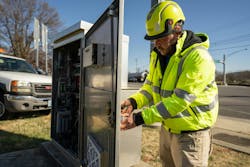
We are also seeing the trend of intelligent key systems with access control features moving into non-traditional applications like parking meters, vending machines, traffic boxes, and others where traditional access control just won’t fit or work. These applications typically lend themselves to a “route management” process where schedules and access can change quickly and usually involve some type of authorization. Intelligent keys with BLE capability access schedule changes and provide a digital audit trail. Customers want to know who went where and when, and they want that data in the cloud, accessible from their phone, not locked in a filing cabinet.
This is creating a new dynamic in route management operations as it’s allowing end users to capture data in places where data could not be captured before. And of course, as we know data is the “new oil” and this data is helping customers make better business decisions.
Lastly, patented key control is evolving. It’s no longer just about legal protection against unauthorized duplication; but also about the digitization of the entire key management process. Digital tools like SimpleK for managing master key systems and our latest tool, Fusion, digitizes the authorization process making it easier for customers to manage their authorization and request additional key copies or service.
LL: What are some of the top verticals where you see continued or increased demand for high security locks and ancillary high security door products?
Bowman: When you look at where the growth is coming from, it’s usually driven by two things: 1) regulatory compliance and 2) liability and risk reduction. It’s not just about keeping bad guys out anymore; it’s about proving you did everything right when an auditor walks in.
Based on that, there are a couple of verticals that are really driving the demand right now.
First and foremost, critical infrastructure. This has always been a stronghold for us, but the demand is evolving. These industries are dealing with North American Electric Reliability Corporation (NERC) Critical Infrastructure Protection (NERC CIP) standards (and increasing physical security mandates. They have thousands of remote sites that have no power. They are moving aggressively toward intelligent locks and keys, specifically padlocks, for these applications. They need to know who opened the gate at a remote substation at 2 am and they need to be able to grant access instantly without driving a physical key out to a technician.
Secondly, I’m seeing a surge in healthcare, specifically regarding protection of patient information and the storage and distribution of narcotics. We are seeing a lot of retrofit applications for cabinets as well as carts – which is one of those applications traditional access typically can’t fit into. Hospitals and pharmacies are under immense pressure to secure both. They need an audit trail that matches the specific nurse to the specific cabinet at a specific time, and they need it to retrofit onto existing hardware without running wires.
A third vertical gaining traction are data centers. Everyone worries about cyber security, but physical access to the server rack is the “last mile” of data protection. If you can walk into a data center and physically pull a hard drive, the best firewall in the world doesn't matter. These clients demand the highest level of key control and audit capability.
LL: What is driving this growth and demand?
Bowman: First and arguably the most powerful driver is regulatory compliance and auditability. In the past, security was a “grudge purchase” — something you bought because you had to. Now, it’s a compliance requirement. Whether it’s NERC CIP for utilities, HIPAA for healthcare, or PCI standards for retail, the “I didn't know” defense doesn't work anymore. Security Directors are under immense pressure not just to secure a door, but to prove it was secured. They need data. They need reports. An industry standard mechanical key can’t tell you who lost it or who used it. Intelligent keys can. That need for an audit trail is converting traditional mechanical openings to digital ones faster than anything else.
Second is operational efficiency and ROI. We must look at the cost of managing keys, not just buying them. In high-turnover industries, the cost of rekeying a facility every time a key is lost can be astronomical. When we show a business leader that an Intelligent Key system eliminates rekeying costs forever — because you simply are electronically “blacklisting” a lost key — the system pays for itself over time. The demand is being driven by the realization that intelligent cylinders and keys are actually less expensive in the long run than managing a chaotic mechanical key system.
Third is the convergence of physical and cybersecurity. For 30 years, I sold “locks.” Now, I’m selling “edge devices.”' Security Directors want their access control system to talk to their video surveillance system and their HR database, etc. They want a credential that grants access to the parking lot, front door, server rack, and the computer itself. The demand is for integration. The market is moving away from disparate silos of security toward a unified ecosystem. If our hardware can’t integrate with their existing access systems, we risk losing the seat at the table.
In short, it’s about compliance. It’s about saving money on operations, providing intelligence in places we couldn’t before, and it’s about integration. The lock is no longer just a piece of hardware; it’s a data collection point.

LL: Are there certain product innovations within the high security locking category that you would like to mention, either within mechanical or EAC?
Bowman: You know, for years people thought the 'innovation' in our industry was dead—that a lock is just a lock. But recently, we’ve released some technology that frankly changes the game.
On the mechanical side, the standout is Medeco 4 (M4). We had to address a modern threat that didn't exist ten years ago: 3D printing. It used to be that you needed a skilled locksmith to duplicate a high-security key. Now, someone can take a picture of a key to have a duplicate made. The innovation with M4 is a movable element right in the key blade — a tiny “shuttle pin.” It’s not just a static piece of metal anymore. When that key enters the cylinder, that movable element must interact physically with a lift pin inside the lock. A 3D printer can’t print a moving part inside a solid key blade. It neutralizes the threat of additive manufacturing. It’s the most robust mechanical key control I’ve seen in my career.
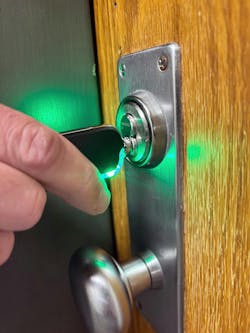
On the EAC (Electronic Access Control) side, the game-changer is our Bluetooth-enabled (BLE) Intelligent Keys. We have this feature across all our Intelligent Key platforms: CLIQ, eCLIQ, and XT. Historically, the problem with offline electronic locks was updating the key. You had to physically walk back to a wall programmer to update your schedule and dump your audit trail. Now, the key is the network. With BLE keys, a technician turns on their key's Bluetooth and it syncs with an app on their phone. They get real-time authorization from the cloud right there in the field. We’ve effectively turned an offline, wire-free cylinder into a real-time online access control point, just by using the computer we all carry in our pockets.
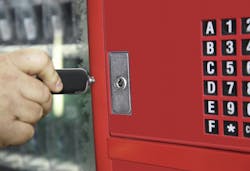
I also have to mention the ability to retrofit non-traditional openings. We are putting these cylinders in places we never dreamed of before — like parking meters, drug cabinets, and even cargo containers. The innovation here is the power efficiency. The key powers the cylinder. You can take a 50-year-old door or piece of equipment with no wiring, swap the cylinder out in two minutes, and suddenly you have full audit trails and scheduling. That isn't just a product update; it’s an infrastructure upgrade without the construction cost.
Lastly, is digitizing the key records and key management process. For too many years, important and critical key records and authorizations were stored or secured on index cards, 3-ring binders, and physical filing cabinets. At best, maybe you track everything in a spreadsheet. A key system is dynamic and needs more effective and efficient tools to manage it and maintain its integrity for as long as possible. Tools like SimpleK, Fusion, and even the Intelligent Key Cabinet help customers manage their key system better.
LL: How much of a factor do codes and regulations play within high security, especially in areas where you need to also provide egress during emergencies, for example?
Bowman: The biggest challenge we face in high security is balancing that “fortress mentality” with the requirement for single-motion egress. A facility manager might say, “I want a double-cylinder deadbolt on this back door so nobody can break the glass and unlock it.” And I have to say, “You can't do that. If there’s a fire, that door has to open with one push, with no special knowledge or keys.”
Where we see this play out most is in retrofit applications and school safety.
In schools, for instance, the demand for 'lockdown' capabilities is huge. But you cannot violate egress codes to achieve it. We spend a lot of time educating schools on Classroom Security and Intruder functions. These allow a teacher to lock the door from the inside to keep a threat out, but the lever on the inside always remains free for egress. We provide high-security cylinders that retrofit into those specific locksets to ensure that while the key control is tight, the code compliance is never compromised.
Also, we do a massive amount of business with exit devices. You see high-security Medeco rim cylinders and interchangeable cores on the exterior of panic bars everywhere. That is the perfect marriage of code and security: the hardware provides the legal, single-motion egress for the public, while our cylinder provides the UL 437 physical attack resistance, key control, and our intelligent capabilities from the outside.
LL: Overall, how has high security around the door evolved over the last five years and where do you see it going in the next 5 years?
Bowman: Looking back at the last five years, the story has been about democratizing access control. Five years ago, 'high security' meant a heavy mechanical key or a hardwired door that cost $3,000 to install. If you couldn't afford to run conduit, you were stuck with a standard mechanical lock. Since then, we’ve seen a wireless revolution take hold. With technologies like Medeco XT and CLIQ, and the broader adoption of wireless locksets, we brought audit trails and scheduling to doors that were previously “off the grid.” We moved the decision-making power from a server room to the door itself. Also, the shift to mobile credentials has been undeniable.
The next five years? I believe we are going to be seeing more about artificial intelligence and predictive analytics in locks, keys, and the access management process. We are done just logging events. “Who opened the door?” is a basic question. The future is about “Why is this happening?” and “What happens next?” I see access control systems using AI to learn behavioral patterns. If a janitor usually opens a supply closet at 8 pm on Tuesdays but suddenly tries to access the server room at 3 am on a Saturday, the system won't just deny access — it will flag the anomaly and alert security in real-time.
At some point, I also predict the death of the reactive service call. Future high-security and intelligent hardware will be self-diagnostic. A lock will ping the cloud to say, “My battery voltage is dropping,” or “My bolt friction is increasing, I need lubrication.” We will fix problems before the customer is even locked out.
Here is my last thought for readers: Despite all this digital dazzle, the mechanical base isn't going anywhere. In 2030, you will still need a piece of hardened steel to hold that door shut against a pry bar. The electronics will get smarter, smaller, and faster, but the need for physical, UL-rated toughness — the kind Medeco built its name on — will remain the foundation of everything we do. We are just building a smarter brain for the same strong muscle.
About the Author
Paul Ragusa
Senior Editor
Paul Ragusa is senior editor for Locksmith Ledger. He has worked as an editor in the security industry for nearly 10 years. He can be reached at [email protected].