Between a Rock and a Hard Place

For the apprentice automotive locksmith, learning how to sightread keys perfectly the first time is the ultimate goal. Most locksmiths, however, cannot be bothered to practice this skill throughout their career and rely on either a key machine or a dial caliper to do the work for them. Typically, when handed any high-security “sidewinder” key, you would load it into your key machine, trace it, then compare the results with a code software to check if the machine made errors. In my experience, the tracing software on most modern computerized key machines is too inaccurate to trust completely, and putting too much confidence in its decoding will leave you with a miscut key far too often. However, with basic knowledge and a few tools to assist you, you can get to the point where you can decode any auto key with 100% certainty through nothing but a picture.
For the sake of this article, most of what I will be saying is directed toward sidewinders and not standard security, because on average, we as locksmiths tend to code cut sidewinders and duplicate standard security when the customer has a key available already. Many people do things differently, but this is the most common practice. Most of the information, though, applies just as well to standard security keys, and if you code cut everything, then this information is even more useful when you consider standard security.
A Brief Explanation of Sidewinders
To understand sightreading well, you first need to understand the automotive key. In a very general sense and with a few exceptions, most auto keys for vehicles made in the last 25 years are incredibly simple. A lot of the common code series, especially American domestic keys, have between 8-10 spaces and 4-5 depths. The Japanese and Korean keys are more varied, but equally simple. The TOY48 40,000 series, for example, is two sets of five spaces, with three possible depths. Because of the low number of depths, it may very well be the easiest sidewinder to sightread.
The Basics
To start, observe the top row and count all the spaces. Once you have made sure that you know where each individual space is, look for the deepest and shallowest depths. Since we know there are three possible depths, if you can find 3 distinct heights on the key, then you know that you have everything you need. (Figure 1 shows a TOY48 key with 3 distinct depths.)
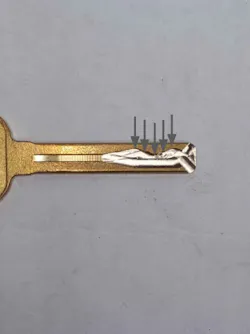
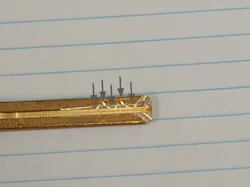
The difficulty in sightreading these would be if you had a key with only two of the possible depths. (Figure 2 shows a TOY48 key with only 2 depths.) In this case, you are faced with two options. You can either have enough practice and experience with this particular keyway to know the difference between a three or a five cut, or you can use your common sense. Look at the shallower of the two cuts. Could you fit another depth shallower than that without crossing into the center grooving? If so, you could be looking at the middle depth. If not, then you might already have the shallowest possible cut.
This is an oddball example, but it shows you how you can use your intuition to figure out which depth you have easily. In sightreading, comparison is everything, and having a known cut will give you the rest of the key easily.
Taking it up a Notch
My next example presents a bit more difficulty. Many people avoid sightreading the Honda high-security external key, but it can be read as easily as everything else with practice and knowledge. These keys tend to get more wear than many others, so paying close attention to the condition of the key is important. If it is worn, consider this when decoding, and consider that cuts closer to the tip may be shallower than they appear.
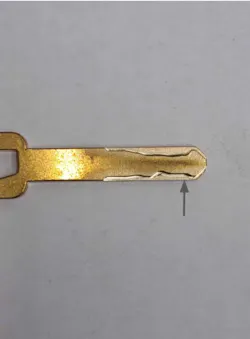
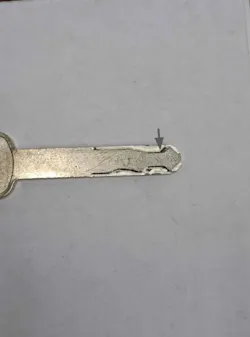
This key has 6 possible depths and technically 6 spaces on each side (totaling 12 cuts). However, the last space is always cut as a 1. Additionally, the 5th space is always a 3 or a 5 (Figure 3 shows a picture of a 3 cut in the 5th space. (Figure 4 shows a picture of a 5 cut in the 5th space.) Because of this, a good portion of our job is already done. We are now only solving for four spaces on each side, and we already have a known depth (as it is easy to tell a 3 from a 5, thus allowing us to use that to figure out the rest of the key).
From here, I would advise anyone who is just starting to use their code software to help them find the rest of the cuts. The easiest thing to do is to load your fill progression and use dashes for unknown cuts. Since we have 1 and then 3 or 5 as known cuts, it is also common that you will see those cuts again in spaces 1-4, so you can get a couple of free cuts since they are present more than once in the key. Let’s say on the top row you have a cut in the first space that is the same height as the known 1 on the last space, and in the 4th space you have a cut that is the same height as a known 3 in the 5th space. Your fill progression would look like ‘1 - - 3 3 1’.
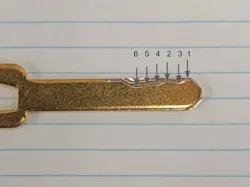
If the code software produces a long list of possibilities, you know that, at a minimum, what you have decoded is at least possible in the series. Do this for each cut as you decode it, and you will never reach a dead end without any idea what went wrong. (Figure 5 shows a Honda key cut to 654231). Focus only on the top row. You’ll notice that the depths ascend in height in almost a perfect staircase. This is not a valid code within the series but was cut to give you an idea of the increment between depths and how to recognize them. While it is uncommon to see a perfect staircase like this on any key, using a few known depths as a reference will give you the rest of the cuts.
Magic Tricks
There is another benefit of sightreading that is almost never utilized but is incredibly handy. On lockouts, it is not uncommon to run into problems getting the vehicle open, whether you are picking, using a long reach tool, or manipulating the lock underneath the window with a wire. Your only option when you are having trouble with your “old reliable” methods is to keep at it.
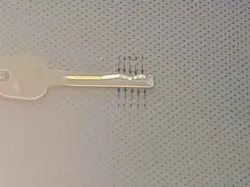
Using your phone’s zoom, you can see the key a little better through the window. We can observe all five depths in order on the top row and notice the flat row of cuts on the bottom row. Seeing this, we have everything we need to cut the door key and get the car open for the customer. Granted, this is an easier example, but in most cases with the key visible like this, it could easily take someone less time to sightread than to pick the lock. It sounds difficult, but due to the aforementioned simplicity of auto keys, it is not so hard if you already understand sightreading well. An 8-Cut GM HU100 blank has only four possible depths. If the key is in an easy to view place and it is not nighttime, it is trivial to sightread even a couple of feet away.
Like everything else in this industry, it’s best to practice in the shop instead of in the field. Have a backup plan for your backup plan, and you’ll never be stuck “between a rock and a hard place.”
Oklahoma locksmith Aidan Coates is an ALOA instructor and board member of the Oklahoma Locksmith Association.