The Front Door Takes Center Stage at CES

More than any other year, CES exhibitors had front doors top-of-mind, with a wide variety of companies making product introductions and announcements in the smart lock market that not only tout technological advances like battery charging, power generation, biometric expansion, and more, but also new ways for security pros to penetrate hot verticals such as multifamily, property management, and high-end residential.
Several locks were featured by the Z-Wave Alliance, which recently introduced the new Z-Wave User Credential Command Class (CC) — a key part of the Z-Wave protocol that standardizes how smart locks and security systems manage and communicate different user access methods, such as fingerprints, PINs, and passwords, enabling secure, interoperable access control and advanced automation, such as unlocking a door and disarming an alarm simultaneously with a fingerprint.
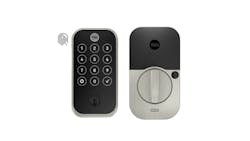
Yale and ADT displayed the Yale Assure Lock 2 Touch with Z-Wave 800 Series, which was the first-ever Z-Wave Credential Command Class smart lock (first introduced in April 2025). The lock features fingerprint access and integrates with ADT's connected security ecosystem through the ADT Base hub. The ADT+ app enables remote management of the lock, system arming and disarming, and control of other Z-Wave devices.
The Yale smart lock also includes Z-Wave Long Range (ZWLR) readiness for extended communication range — about 1.5 miles line of sight in ideal conditions — and improved signal reliability. This means devices far from a hub can stay connected without relying on repeaters.
Z-Wave Alliance chair Avi Rosenthal also pointed out another addition to the protocol around batteryless technology. “We altered our branch of Z-Wave to take advantage of batteryless technology,” Rosenthal said. “Sleeping devices are really difficult to deal with from an RF perspective, because RF networks like to check in on devices on a regular basis so that they know they're still alive. If the only time you activate a device is when it is touched, moved, or activated, the network throws it away because they think it's a dead node. We fixed that problem. Our system now recognizes when you are using a batteryless technology and actually enables that node to be sleepy on the network and not check in on a regular basis.”
WePower Technologies (recently renamed Gemns) and Southco demonstrated this batteryless technology and protocol at CES as well. The kinetic energy harvesting technology for electronic locks generates electrical power from the mechanical energy of normal door operation, converting the physical motion of opening and closing the door into stored electricity. The harvested energy charges a rechargeable battery that powers the electronic lock components, potentially eliminating the need for battery replacement over the lock's lifetime.
The company demonstrated integration of this energy harvesting system in electronic access control hardware — namely a Southco lock — showing how the technology can be incorporated into existing lock form factors.
Chamberlain Enters the Smart Lock Market
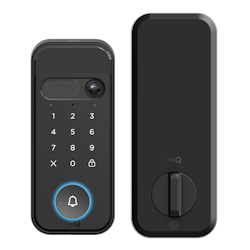
Chamberlain Group, a company many associate with garage door operators, announced its entry into the smart lock market at CES, with the launch of the myQ Secure View 3-in-1, combining smart lock, video doorbell, and intercom system functionality into a single integrated unit.
“All your favorite brands you know from the garage, we are taking you to the front door,” Chamberlain Group Sr. Corporate Communications Director Megan McClendon said during the Pepcom event at CES, where she also demonstrated the lock’s facial recognition functionality, which you can watch at https://youtu.be/jVLYftQ-1tI.
AI-powered detection algorithms identify and categorize faces, pets, and packages, sending differentiated real-time alerts to homeowners based on what the system detects, and a 7-inch indoor touchscreen serves as the control center, enabling two-way video calling with visitors, lock control, and video playback. In addition to its 3D facial recognition access, it also includes a fingerprint scanner and an NFC card reader.
Alternative Power Sources
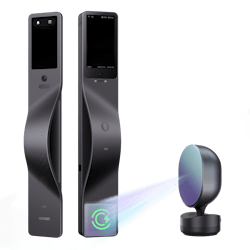
Beyond the Gemns/Southco kinetic energy harvesting demo, alternative battery charging sources were a highlight among CES smart lock exhibitors. Both were marketed in their booths as ready for market, and both have the potential to be a market disruptor.
Alongside the launch of its new V7 Max vein recognition smart lock, Lockin debuted “AuraCharge,” an infrared beam-based device that can remotely charge the batteries within the lock from a short distance.
“It can be wall-mounted or placed on a tabletop and plugged into the wall,” Lockin spokesperson Hannah Wilkinson explained at the Pepcom event. “It works within a 4-meter range with direct line of sight, and it uses infrared light beams [to recharge the batteries] that are completely invisible to the eye and safe for the whole family. As long as [AuraCharge] is on, your lock is always going to be charged.”
Another exhibitor, China-based DESLOC, claimed its new V150 Plus is the first consumer smart lock with an integrated perovskite solar panel. Perovskite solar cells are a newer photovoltaic technology that can generate electricity in low-light conditions more efficiently than traditional silicon panels, making them potentially viable for door-mounted applications that may not receive direct sunlight.
Targeting Multifamily and Property Management
Lockly’s expansion includes the Duet Series of smart locks, an elegant Lockly Styla Designer Handlebar Deadbolt, and the brand’s first indoor/outdoor smart security cameras, Sightline and Sightline Pro. Lockly’s Duet Series introduces motorized and manual thumb turns for added reliability, user confidence, and longer battery life. The locks offer up to 200 percent more battery life than the industry average, lasting nine to eleven months compared to the typical three to six months for locks with similar features. The Duet Series locks are easy to install thanks to the manual thumb turn option, which ensures that minor hangups with the deadbolt won’t impact the locking process. Also new to this Lockly series are intuitive and responsive LCD touchscreens, enhancing the user experience with modern, high-performance displays. With built-in WiFi, all Duet Series will also be accessible via Apple Home Keys, Google Home, and Amazon Alexa.
Alfred introduced the DB1 Pro Smart Door Lock with Z-Wave Long Range capability, ideal for property managers looking to scale deployments across single-family homes, rental properties, and larger multi-family buildings. It features multiple access methods and enterprise-level encryption for property-wide management applications, and Z-Wave Long Range reduces the need for mesh repeaters across larger deployments.
Premium Residential
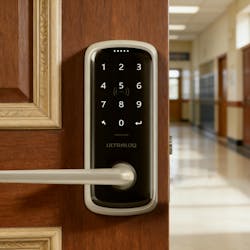
Xthings introduced two new smart locks at CES. The ULTRALOQ Latch 7 Pro latch-style smart lock will support Aliro, the Connectivity Standards Alliance’s new standard for digital keys. It will also support Matter over Thread and Z-Wave Long Range. The ULTRALOQ Bolt Sense, set for release in Q2 2026, combines 3D facial recognition with palm vein authentication for touch-free entry. This dual-biometric approach is designed to be more forgiving than fingerprints, and active approach sensing will eliminate the need to hunt for sensors or keypads.
In addition to the V150 Plus mentioned earlier, DESLOC introduced the K140 Plus, featuring contactless palm vein recognition and radar-activated gesture unlocking that allows homeowners to wave their hand to unlock without touching the device; as well as the S150 Max, which combines a dual camera system with video doorbell functionality and smart lock features to provide complete entryway visibility.
DIY Smart Lock
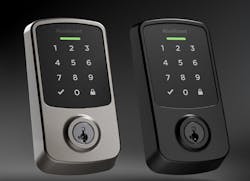
Kwikset debuted the Aura Reach, a DIY smart lock that combines Matter and Bluetooth. It features hands-free auto unlock, proximity keypad wakeup, and interactive guided installation via the Kwikset app. It works with all major Matter-enabled platforms, including Amazon Alexa, Google Home, and Apple Home. Its backlit keypad intelligently illuminates as users approach, while Bluetooth and geofence technology automatically unlock the door for a hands-free experience.
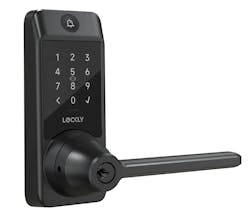
Lockly unveiled its Affirm Series, the company’s first smart locks with built-in Wi-Fi and Matter compatibility, alongside physical and digital NFC card access. Available in both deadbolt and latch versions (starting in Q2, 2026), it is ideal for homeowners and short-term rental owners looking for a simple upgrade.
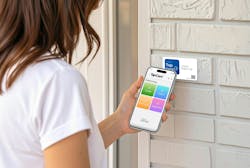
In addition to the smart lock, Lockly continued to target short-term rental owners and multifamily properties with its new TapCom wireless, app-free video intercom and access solution. When guests activate the system by tapping an NFC-capable device or scanning a QR code, they can check in to a property, unlock the door, talk to the host via video intercom, and get information about the property or local recommendations – even if the associated lock is not connected to the Internet. Watch a live demo of TapCom at https://youtu.be/3dRTD3QUhUg.