Access Control for the Taking
In the recent Locksmith Ledger webcast on Upgrading to Electronic Access Control (EAC), the roundtable discussion focused on strategies for converting entryways to the latest EAC systems, with an emphasis on how locksmiths are adopting these systems as an extension of the mechanical hardware they are already the trusted authority on when it comes to the door. The panel included: Wayne Winton, owner, Tri County Locksmith Service, Joshua Sands, owner, Key City Locksmith, David Latreille, Area leader, Northeast Region, Salto, Brenton Webb, Technical Product Specialist – System Design, Banner Solutions, and Wade Norman, Partner Channel manager, iLOQ.
Getting the Job
In terms of the types of EAC projects locksmiths are getting, Winton says it is a combination of new construction and retrofit jobs, and across many different verticals, such as commercial, healthcare, education and multifamily.
“Low voltage is treated no different than any other utility right now in my experience, just like plumbing, HVAC, and electrical,” he says. “The contractors are usually doing the wire runs. They're running the low voltage wire to every door and planning the access control in the new buildings that are going up and under construction now as a standard feature, much like you would assume a new car is going to have AC, the new buildings have access control already built into them.”
While locksmiths are initially brought in on the hardware side, many times it evolves into something much more.
“We get brought in for the hardware, but what they want on the access control side is usually a slight extension of hardware,” Winton explains. “We tell them we can do some of the electronic portions of it and they absolutely love that because it's hard to find somebody in that middle ground and the general contractor doesn't have to bring in an additional contractor into the mix if we can do that.”
On the retrofit side, locksmiths are often brought in to upgrade existing hardware or existing doors. “They're making it so easy that it's really just kind of taking off,” says Winton. “And there's a bunch of great products that even with whatever skill level you have, you can be doing access control. Even if it's just removing a key and knob cylinder or a mortise cylinder and installing an electronic cylinder – it can be that simple. It can be as advanced as doing a full-blown access control system and power supply all the way to everything in between.”
Sands agrees, adding that with so many access control products out there it is important to be a trusted advisor to your customers who are looking for guidance when it comes to picking the right system.
“To piggyback off what Wayne said, knowing your product is the most important because
unfortunately, many times we are brought in to fix their mistakes because the installer was not familiar with the product,” Sands explains. “So, they spec out something and I don't know where along the line the breakdown happened, but we're there telling them, no, this doesn't work with this, and you need to do it this way. And then as far as the existing stuff, everybody wants electronics. So, we're retrofitting and putting in new all the time.”
Latrille adds that many times that relationship leads to more business as the customer begins to trust your advice and work.
“I'm finding with a lot of our larger end users that it will be both [retrofit and new construction],” he says. “So maybe we went in with a retrofit in the first place and then because of that relationship, we're now working with them on the new construction side or vice versa. For example, we're working with a huge developer and they have 20 buildings. They're building another 10, so we're working with them on those 10 where we have the freedom and the luxury of being able to work with them on the complete design from locks to any integration that they're thinking of. And then once they see the value in our offering, they then will look at those 20 buildings and start to look at, okay, let's roll out the retrofit.”
Some of Salto’s core areas, he adds, include hospitality, education, commercial, residential, multifamily and critical infrastructure, which is a growing area.
“From a retrofit perspective, we have significant penetration in the critical infrastructure,” adds Norman, who is also seeing growth in this area. “And it's really due to the way that our product represents the opportunity to manage something offline remotely and have access capabilities through that process. So critical infrastructure has been good, and we do a lot of telecommunication, utilities and government. Our retail sector has really begun to pick up as well because the retailers that are involved in commercial access applications in strip malls and other facilities like that see the benefit of what we offer in the battery-free, cable-free technology at the door without having to replace existing hardware.”
He continues, “We came into the market as a retrofit product, but in the multifamily space, we see a lot more new construction opportunities and we're driving with partners in that direction.”
Mechanical and Electronic Convergence
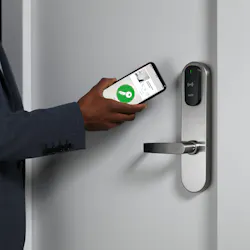
Looking at the types of access control systems being adopted today, the panel turned the conversation to how software is now beginning to control the hardware, as cloud-based systems with biometrics and mobile credentials become more prevalent.
“I would think mobile credentials and the cloud-based systems are the biggest things that I'm coming across nowadays with mobile offering the ease of convenience to not have the card or the fob and the customers don't have to worry about issuing new cards and fobs – you just have your phone,” notes Webb. “The cloud-based systems also offer a real convenience of allowing access from anywhere and making changes and you can do anything you need to do from the cloud, and it goes right back to mobile. So, on my side, the mobile credentials and cloud are at the top. And smart locks have always been common in my space.”
Norman adds, “The bottom line is mechanical locking systems and EAC are converging today. We all know that mobile credentialing is the way of the future, right? We happen to have our platform [which is] mobile credential enabled and the catalyst for us is leveraging the app both at the door and through the cloud. And that gives the capability of cloud management, with mobile credentials becoming standard. And what that produces is lower life cycle costs and maintenance. EAC is allowing customers to look beyond initial hardware costs and evaluating batteries replacement, labor, service calls, all the long-term costs that are associated with it.”
He continues, “I see it as evolving into more of an access management role, which is everything – keys, cores, smart locks, battery-free smart locks, battery-free technology, which is what we offer. But, more importantly, mobile credentialing and cloud software, networking and integrations … it's all going in that direction. And it's not hard; it's just getting used to seeing it and understanding how you can leverage it in the market space to bring value.”
Latrille points out that his time at Salto has taught him that the industry has “shifted from what goes on the door to who is going in and out of that door,” he says. “It was very traditional, as before you would secure the outer doors, and they were hardwired doors, and the inside was a luxury. Now, with technology expanding the way it has, and obviously with the offerings that we have, that has very much gone away. So, things like ID management, we have this product IDM and it does two things really – it is very easy to use for visitor management, but it also does multiple credentials. So, you have disparate systems and they're able to use one credential or multiple credentials on one card, things like that.”
Winton agrees with others on the panel about the rise of cloud-based systems and mobile credentials but points out that many times it comes down to what the customer wants and is comfortable with.
“We're getting to a point where one of the biggest challenges is there are some technophobic people out there and you can't really force technology on them,” he explains. “You can't really make employees carry a phone, and there are some people that are against that, and you must have a solution for those people as well. And that's where the biometrics come into play. So, if you have an option that will allow a biometric entry for people who do not want to carry a smartphone, or if you have an option that will offer that cloud-based access control system and Bluetooth option in case they cannot connect to the internet, for when they've got a remote location. You really have to understand how all three of those systems work and bring the correct application to the correct client.”
A Focus on Training
As the vice president of Education for the National Alliance of Security Professionals, Sands spoke about how the association covers everything from mechanical locking to electronic hardware, including some security camera and alarm system work. Classes range from basic electronic theory to more advanced EAC installation work.
“That basic electrical theory and introduction to electricity is so important because you need to understand what makes them power, what makes things go, as well as what's going to hurt you, what's going to hurt the device,” he explains, noting that locksmiths should look into getting a low-voltage license, as requirements can vary from state to state.
“And then once we get into the advanced course, we typically will gear that toward those that I know have already done the basic and we'll go and install something. We'll be a little bit more manufacturer-specific in some of the courses, and most of that training comes from manufacturers, and then I can present it down to the locksmith. You can also reach out to your distributor, which is your best point of contact to get in front of these manufacturers. Especially in the Kansas City area, if we see a big trend towards a certain product, we'll call that manufacturer and them to bring this in and show them how to wire it up. What are your options for it and stuff like that.”
Winton agrees, adding that as the president of ALOA he has been working with the organization to provide the right type of training as locksmiths continue to adopt EAC products and systems.
“Obviously, ALOA is embracing electronic access control as well. I'm working with Dave O'Toole and we're working with Lee Odess and just trying to get an actual subcategory directed exactly at access control to help the association adapt with the times as well,” Winton notes. “And we need to get brought up to speed and the entire association needs to be aware of this and helping the locksmiths. If this is going to be the largest growing sector in our industry, we need to pay attention to that. And we need to ask the right questions. We need to get the right training programs. And we need to address that so that we can add the most value to our members that we can possibly do.”
He continues, “Independently, I do my own on-demand training, the Locksmith Security Network. If you want an intro class, there's a beginner class, and there's an advanced class and you can literally watch that video and see, do I feel comfortable with this? Everything from something as basic as a standalone lock with batteries, right? So the very common ones all the way to understanding how full-blown access control works.”
Latrille agrees, noting that it really is about continuous education, “making sure that it's not just one person, that you don't just have one EAC Expert – you need to really dive in as a team. We have our two-day basic certification. If I told you that it's electronic locks, it's facial recognition, it's visitor management, it's cloud and on-prem, it's facial recognition, it's lock, it's building automation … that can be very overwhelming. So, you come, you walk away, then you work with us very closely and our entire team on your first project … start small. Again, you select a few products because they fit with the vertical. And then we just offer continuous training and support.”
Norman agrees, noting that understanding your manufacturer and the sales and technical training opportunities that they offer is so important.
“Those sales and technical trainings are so essential,” he asserts. “And we understand as manufacturers our products well, we need to support it and support our partners like yourselves out there. Hands-on experience builds confidence and capability. Just continue to get your hands on the technology that you think that you would like to start with. Learn one platform at a time, and start with a small first project, as David mentioned, and a 10-door project builds experience. And then, even a four-door, even a one-door, as we talked about. Then you can go into the 50s and the 500s and the 1000s and really see the business scale, right? Start small and succeed at scale.”
As Webb points out, “As far as training, start with your distributor. The distributors offer trade shows and training as well, with most of them across the country. Then we will probably, based on what you pick, point you toward the manufacturer from there.”
Recurring Revenue Strategy
As locksmiths continue to add more EAC work, earning recurring revenue is something that should be on their radar as they start to build out their business in this area.
“Everything that comes in, you have to put your business hat on when it comes to access control,” says Winton. “And this was one of the big fears I think that a lot of locksmiths had was if I install this electronic lock, I'm not going to get those rekeys anymore. And that may be true, but there's several ways that you can compensate for that to where it's 10 times more profitable. This is a new source of income. This is a new revenue source that is absolutely necessary and mandatory. Do you think that a company is going to spend $25,000 on access control and hardware and not re-up $2,000 a year service contract to keep that hardware up and running and to keep that cloud current? Of course they are.”
He adds that by having a subscription price for whatever access control platform that you've sold, “you're now making profit, and you've got your service schedule on top of that; it's there for the taking … you just have to open up your mind and you have to think about it in a different way. And you have to understand that those options are available.”
Sands agrees, noting that locksmiths need to look at all the areas from where they can earn recurring revenue.
“David from Salto and Wade from iLOQ – they both offer a cloud access service with recurring revenue. Why are you not capitalizing on that?” he says. “Again, back to the manufacturer, back to the training, know your opening, know your product. Reach out to either one of these two gentlemen here and they'll be happy to help you figure that out. And why are we not doing a maintenance contract? Tie that all in. Put your maintenance fee on it. Go out there and do the other stuff to tie in what Wayne was talking about – door closers, all that other stuff.”
Norman agrees, noting that locksmiths can evolve from maintaining locks to managing access and do it with recurring revenue model opportunities.
“You may be replacing keys, but just say you're going keyless with a system – you don't need keys – you have mobile credentials,” he explains. “You may say, well, I'm not cutting keys, I'm not doing this or that, but you're gaining a revenue stream for every single key or mobile credential that you have out there in the market space. My entire team at Convergint, for instance, we didn't go into an opportunity without presenting a quote that included a service agreement associated with every single quote, whether that was for one year, whether that was for five years, depending on the enterprise and who you were presenting to. They became very valuable, not just to the company itself, but to the end user.”
Latrille adds, “And just to piggyback off that, I think that more end users understand that in the EAC world, there is going to be some kind of OPEX that goes along with it. So again, it's making sure that you're prepared, and you know what those fees are and how you're going to present them. And then, any kind of service contract that software support. But, also, don't abandon the mechanical side of your business. It's still completely valid. You know, it's essential here. the combination of the two, in many ways, the EAC part at the beginning is going to complement what you do, not the other way around.”
About the Author
Paul Ragusa
Senior Editor
Paul Ragusa is senior editor for Locksmith Ledger. He has worked as an editor in the security industry for nearly 10 years. He can be reached at [email protected].