Key Highlights
- A layered security approach begins outside the school with perimeter fencing and extends inward to classroom and interior doors, enhancing overall safety.
- Lockdown systems should enable immediate, centralized control, allowing staff and law enforcement to restrict or grant access during emergencies.
- Code compliance is critical; schools must select security products that meet fire and safety regulations to ensure safety and avoid costly audits.
- Deadbolts provide significantly higher security than spring latch locks, making them vital in active threat scenarios and overall door security.
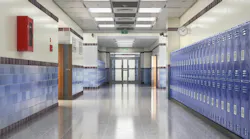

From K-12 to Higher-Ed, there is an increased national focus on improving school safety and security. This continued push to secure schools has brought about some advances and innovations within locking and electronic access control systems, as manufacturers work closely with security and school professionals to provide the types of solutions they need, and that empower and bring peace of mind to teachers and students.
The recent Locksmith Ledger webcast on the topic brought together subject matter experts for a roundtable discussion, including Wayne Winton, Owner, Tri County Locksmith Service; Jim Todd, Regional Sales Manager, Locinox USA; Steven McLemore, Regional Sales Manager, Banner Solutions; David Klein, Business Development Manager, Securitech; and Ron Shaffer, Industry Solutions Leader – Education, Salto.
From Layered Security to Lockdowns
The consensus among school security professionals is that a layered approach to security starts outside the school, with the goal of creating multiple layers of security as you enter the school and move through to the classrooms and other important spaces.
“We look at number one, what is the need for the perimeter doors, taking the layered approach we move to the classroom doors, and then in my vertical, the resident halls, and then how do we deal with the ancillary or random interior doors,” says Shaffer. “The first thing you want to do is set up your technology and your hardware for your primary doors, which could be your first layer of entry doors [which] is going to be your hardened area. Now if the classroom doors are on the exterior, like mobile classrooms, that is going to be your primary.”
Schaffer points out that before choosing any solution, several questions must be answered, such as, “What is the use case? Do I need to lock it down? How secure does it need to be? Does it need to be grade one or grade two [lock]? Does there need to be a panic bar? That's going to determine whether you’re wired or your wireless, because then you can determine what type of hardware goes on it based on the layer of security it falls in."

Winton adds that it is important to make sure that there is consideration of and coordination with first responders and law enforcement for when they do get into the building during an emergency or other incident.
“How can we access and allow them access to get to where they need to go to make sure everybody is safe along the way and along the path,” Winton explains, noting that on a recent project the school needed to do a door lock upgrade so they could lockdown classrooms from the inside. “We converted everything over from the old classroom function where the teacher literally used to have to go outside of the classroom, insert the key, rotate at 360 degrees, pull the key out, and then go back into the room.”
Ideally Winton says schools should have locks and an access control system that can lock down immediately. “Preferably something that can be locked down centrally by office personnel, if needed, and then they can cooperate with law enforcement to be able to give them access to certain areas or deny access to certain areas to basically keep everybody as safe as possible."

Todd agrees on the need to be able to lock down the classrooms, pointing out that the outside areas are equally critical to control and secure when possible.
“A trend that we're seeing is rings of security, starting with exterior fences and gates,” Todd says. “When we're talking about rings of security, basically stopping the threat before it enters the building is where we really come into play. It's been a very regional thing — it depends on what states place a priority on it. But we do see more school districts, universities as well that are creating these rings of security with fencing and having electronic access control at those entry points that can also be controlled. If that gate won't close and lock, you don't have a fence — you've got a very poor impediment to someone breaching that and getting into the areas that they're not supposed to be."

McLemore points out that he sees schools being a lot more proactive as opposed to reactive when it comes to security.
“But I also think that a question that you have to ask when you say lock down, what do you mean lock down?” he says. “What exactly do you want to lock down? Is that a single point of access? Is that a single button that's going to lock down everything or is that a separate area? Working with locksmiths and system integrators, they're very aware of asking those questions. And it makes it easier from a wholesale standpoint to kind of stand by those products and partner with the different manufacturers that we do. You don't have to really skip anything — you can get everything done without really overwhelming anybody and doing it with a proper rollout makes sure that the communication is very strong up front so that these upgrades can be meaningful."

From Layered Security to Lockdowns
The consensus among school security professionals is that a layered approach to security starts outside the school, with the goal of creating multiple layers of security as you enter the school and move through to the classrooms and other important spaces.
“We look at number one, what is the need for the perimeter doors, taking the layered approach we move to the classroom doors, and then in my vertical, the resident halls, and then how do we deal with the ancillary or random interior doors,” says Shaffer. “The first thing you want to do is set up your technology and your hardware for your primary doors, which could be your first layer of entry doors [which] is going to be your hardened area. Now if the classroom doors are on the exterior, like mobile classrooms, that is going to be your primary.”
Schaffer points out that before choosing any solution, several questions must be answered, such as, “What is the use case? Do I need to lock it down? How secure does it need to be? Does it need to be grade one or grade two [lock]? Does there need to be a panic bar? That's going to determine whether you’re wired or your wireless, because then you can determine what type of hardware goes on it based on the layer of security it falls in."
Winton adds that it is important to make sure that there is consideration of and coordination with first responders and law enforcement for when they do get into the building during an emergency or other incident.
“How can we access and allow them access to get to where they need to go to make sure everybody is safe along the way and along the path,” Winton explains, noting that on a recent project the school needed to do a door lock upgrade so they could lockdown classrooms from the inside. “We converted everything over from the old classroom function where the teacher literally used to have to go outside of the classroom, insert the key, rotate at 360 degrees, pull the key out, and then go back into the room.”
Ideally Winton says schools should have locks and an access control system that can lock down immediately. “Preferably something that can be locked down centrally by office personnel, if needed, and then they can cooperate with law enforcement to be able to give them access to certain areas or deny access to certain areas to basically keep everybody as safe as possible."
Todd agrees on the need to be able to lock down the classrooms, pointing out that the outside areas are equally critical to control and secure when possible.
“A trend that we're seeing is rings of security, starting with exterior fences and gates,” Todd says. “When we're talking about rings of security, basically stopping the threat before it enters the building is where we really come into play. It's been a very regional thing — it depends on what states place a priority on it. But we do see more school districts, universities as well that are creating these rings of security with fencing and having electronic access control at those entry points that can also be controlled. If that gate won't close and lock, you don't have a fence — you've got a very poor impediment to someone breaching that and getting into the areas that they're not supposed to be."
McLemore points out that he sees schools being a lot more proactive as opposed to reactive when it comes to security.
“But I also think that a question that you have to ask when you say lock down, what do you mean lock down?” he says. “What exactly do you want to lock down? Is that a single point of access? Is that a single button that's going to lock down everything or is that a separate area? Working with locksmiths and system integrators, they're very aware of asking those questions. And it makes it easier from a wholesale standpoint to kind of stand by those products and partner with the different manufacturers that we do. You don't have to really skip anything — you can get everything done without really overwhelming anybody and doing it with a proper rollout makes sure that the communication is very strong up front so that these upgrades can be meaningful."
Code Compliance When Choosing Products
One area where locksmiths can gain an edge in getting these jobs is helping schools understand the code compliance side of access control, which many can be unaware of until it is too late.
"Unfortunately, I do come across many schools who have purchased these products that are very inexpensive, but at the end of the day once installed, they're not code compliant, they put everybody's life in danger,” notes Klein. “Fire code is there for a reason. We must adhere to those rules. So, I do see a lot of times where these schools have done that and then they'll find out three or four months later when they get audited because they use state or federal grant money. The auditor sits there and says, ‘Well, give us some money back. It says clearly that you must use code compliant products.’ There's a reason fire codes are here, and we really need to adhere to that. Also, as mentioned earlier, we need to consider the first responders. Being a retired fireman, I keep that life safety and the fire code always in the back of my head."
Winton agrees on the need for code compliance education in the school setting and has seen it first-hand when he goes to work on projects.
“Everything needs to be life safety and code compliant in the event of an emergency situation,” he says. “And that's where service contracts can come into play — I think the locksmiths out there should also focus on that. You should be offering a service contract to come back once or twice a year and make sure all the hinges are working, make sure all the door closers are functioning correctly, make sure the doors are positively latching correctly. And then that way, that is the only way you're going to make sure that everything is functioning in the event of an event, whether it's a fire or whether it's an active shooter situation.”
He continues, “Constant maintenance is the only answer and the only cure for that. And I look and I see, well, this door has a $1,200 lock on it, that's great, but if it's left open with this little door stop then it means nothing. And if the door closer up above doesn't close the door into a fully closing latch position because it's blown out and it's leaking oil or the hinges aren't aligned properly or that door is not a healthy opening, if you're putting good hardware and good access control on an unhealthy opening — it still doesn't do the job that it's supposed to do."
Todd adds that the same holds true for exterior security products. “If you have a gate that won't close because you've got a substandard hydraulic closer, closing hinge or something that the oil leaked out of, that doesn't stand up to the elements and just wears out quicker. If that gate won't close and lock, you don't have a fence. You've got a very poor impediment to someone breaching that and getting into the areas that they're not supposed to be.”
What Todd sees quite often are indoor products, such as door closers, panic bars and locks, is that they are being used outside where they're susceptible to weathering, rust, and early failure.
“They're not as heavy duty as they need to be necessarily,” he explains. “I think a lot of that came from the fact that for many years there were not many products available that were rated for outdoor use. So those habits have developed and therefore that's what they continue to do. All our products are at least IP65 rated so everything is rated to be used outdoors. Some of our products are starting to be used indoors just because of their duty cycles and how difficult they are to damage and destroy.”
For schools and campuses struggling with choosing the right partner when it comes to access control products, Schaffer says, “Collaboration and communication — that's the biggest thing before you can choose any product. Collaboration, communication from IT, facilities, your admin staff, your public safety, and specifically in the area of technology and credentials.”
Schaffer says having a unified plan, especially when it comes to the types of technology stack you want to go with is essential to success. “Before we even get to any locking system, any hardware, which technology do we want to go with? Which credential do we want to use? And that involves process and planning, communication and collaboration. And when that doesn't happen you will have a failed system. You can have the best hardware on the planet but if you've got five different little kingdoms on a campus that all disagree with that solution and how it operates and the technology that has driven you to that direction, failure is imminent. If money is unlimited, great — wire every door, run conduit, run power supplies, do it all. But we all know that's not the case."
The Importance of Deadbolts
Looking closer at the door locks being used in a school setting, the panel all agreed that deadbolts matter more than people think. A properly deadbolted door has a significantly higher success rate in active threat situations than a standard spring latch, which can be compromised with minimal force or simple tools.
“When you look at it from a locksmith’s perspective, you need a deadbolt,” Winton asserts. “Why do you need a deadbolt? Because the lock on the bottom can be compromised easily. That little spring latch — a good kick, a good boot from a heavy-duty person can compromise that quickly. And so having additional measures, something that's ‘dead,’ meaning it can't be pushed back in or forced back in. You do have to realize, not only does every kid have a phone, they also have access to everything that comes with that phone. And that means that they're watching Lock Picking Lawyer, they're watching all these bypass videos and are watching how to bypass security online as well."
As Winton points out, too often he sees people putting “good hardware and good access control on an unhealthy opening, and then it doesn't do the job that it's supposed to do. So really, we need to look at it and encompass it as an entire ecosystem, not just focus on the lock itself. It's the whole thing — it's not just the lock; it's not just the hinges; it's not just the door; it's not just the opening. All of it has to work together in order to function correctly and long term. And, again, that's where service contracts come into play."
Klein agrees, noting, “There's great technology with all the electronics out there and our stuff works with everybody's electronics, but we still stand behind the deadbolting. Because at the end of the day, when you have great technology on a door and it's being secured by a cylindrical latch, that little latch is your entire security on the door itself. So that's where we're big proponents for the deadbolting."
Winton says he has worked hard to grow the consulting side of his business, which leads to jobs. “I probably take four or five classes every year to make sure that I understand the codes relevant to the door and I'm a certified fire door inspector,” he explains. “I get down to the nitty gritty to knowing the exact reveal for the gap that should be all around that door. Like my eyeball is a door problem magnet to the point where it's an obsession."
The panel also discussed the success locksmiths are having by teaming up with systems integrators on school and other projects.
"From a wholesale standpoint, I do think Wayne hit the nail right on the head with the integrators and locksmiths,” says McLemore. “We're seeing a lot more of them partnering together when it comes to projects because that allows people to essentially stay in their lane and be experts where they're experts and they're able to help out."
About the Author
Paul Ragusa
Senior Editor
Paul Ragusa is senior editor for Locksmith Ledger. He has worked as an editor in the security industry for nearly 10 years. He can be reached at [email protected].