An Inside Look at Healthcare Security
Key Highlights
- Over half of healthcare organizations report increases in physical assaults, verbal abuse, and unauthorized entries, prompting a shift toward more sophisticated security measures.
- Healthcare providers are prioritizing hybrid-cloud deployments, AI projects, and enhanced access control to stay ahead of security threats and streamline operations.
- Smaller healthcare facilities are increasingly adopting electronic access control, with innovations like Bluetooth locks and automated systems to enhance security while maintaining ADA compliance.

The stories are shocking, the statistics sobering. Hospitals are one of the most volatile environments for crime, unauthorized entries, and attacks on staff — from nurses to doctors — and patients. And because of nature of many of these healthcare facilities, which can be like sprawling campuses, the role of security is growing rapidly.
For example, looking closer at how hospitals and healthcare organizations are adopting better security measures to combat rising physical security incidents, healthcare-specific findings from Genetec’s 2026 State of Physical Security Report shed light on what exactly healthcare providers are seeing from the inside.
Key findings from healthcare respondents include:
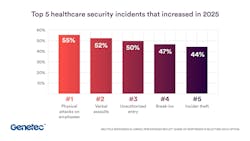
· 55% reported an increase in physical attacks on employees.
· 52% saw a rise in verbal assaults.
· 50% experienced more unauthorized entry.
· 47% reported more break-ins.
· 44% saw an increase in insider theft.
The data also points to a clear shift in modernization priorities:
· 59% favor cloud or hybrid deployments for continuous updates and upgrades
· 55% plan new access control projects in 2026
· 40% plan new AI projects in 2026
· 39% prioritize greater collaboration with HR and facilities teams
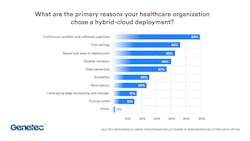
Based on insights from physical security professionals worldwide, including those working in or with the healthcare sector, the report shows healthcare organizations continuing to favor hybrid-cloud deployments while increasing focus on access control, AI, and cross-department collaboration. For example, hybrid-cloud deployments remain a preferred approach for healthcare organizations seeking flexibility, as respondents cited continuous updates and software upgrades (59%) as the top reason for choosing cloud or hybrid systems, followed by cost savings (46%), and speed and ease of deployment (42%). Disaster recovery (40%) and data ownership (37%) further reinforce the value of hybrid models in healthcare environments with complex regulatory and operational requirements.
In the report, healthcare organizations identified training and upskilling staff (42%), aging IT infrastructure (40%), and difficulty attracting and retaining talent (38%) as top challenges. These realities are influencing how healthcare organizations set their security goals and strategies.
Looking ahead, AI continues to gain traction, with 49% planning to leverage AI to streamline security processes. When asked about specific project areas for 2026, access control ranked highest (55%), followed by AI (40%), and video surveillance (39%). Collaboration with departments, including human resources (HR) and facilities management, was also cited as a priority by 39% of respondents, highlighting the increasingly interconnected role of physical security.
Healthcare organizations are also increasingly using physical security data to drive outcomes beyond traditional security functions, the report found. The top objectives include safety and security improvements (60%), operational efficiency within security teams (52%), regulatory compliance (49%), and improved employee and patient experience (44%). Many are also using security data to support occupancy management and broader operational efficiency across departments.

The Rise of Physical Security Incidents
As noted earlier, the rise in physical security incidents across healthcare environments is driving healthcare organizations to adopt stronger security measures and expand how security data is shared and consumed across the enterprise. More than half are sending access activity data from their security operations centers (SOC) to other systems, while many also share alarms, incident data, and video and audio information. At the same time, SOCs are ingesting data from cybersecurity tools, intrusion and asset monitoring systems, HR systems, and external threat intelligence sources.
“The trends are definitely more cameras, more AI-based cameras, and turnstiles, as well as weapons detection systems and metal detectors in the emergency room,” says Bernard J. (Ben) Scaglione, Associate Principal, Cerami & Associates. “And I think those trends are going to continue as long as workplace violence seems to be so active and becoming more of an issue. Right now, as we speak, the New York City nurses are on strike and that's one of their demands, is that they want better reductions in workplace violence, better working conditions to reduce these incidents, which includes better security measures and systems.”
Scaglione sees an increase in consulting requests as hospitals are looking to add the latest access control systems and products but need advice on how and where to install them, as well as which systems are best for their hospital, etc. “It can be a complicated process because the lobbies were never designed for this and hospitals have a ton of entrances,” he points out. “So, there's a lot of discussion and work that needs to be done in order to make it all work properly.”
Workplace Violence Prevention
Another key area Scaglione works with hospitals on is establishing a quality workplace violence prevention program. “It's now a Joint Commission requirement, but some hospitals just don't get it, and I think the majority are not good at this,” he says. “It's like with the New York City nurses’ strike — they're looking for more security, [but] more security officers aren’t necessarily the solution to the problem. I'm sure it's certainly part of it but having a security officer stand next to the nurse or doctor when they're trying to administer care is not the solution to the problem. I think the solution to the problem is really having committees and talking about it, training and all the other things that go with implementing such a program.”
While hospitals are getting better at adopting electronic access control options, many times it comes down to where and how those systems are installed.
“The way hospitals are set up is sometimes difficult, but it's really about securing all those areas that people walk through where they aren't necessarily authorized for them to open certain doors and to get to the patient care areas,” says Scaglione. “But it's also locking entrances and exits so that you know you're funneling people so they have to go through that weapons detection system or into a place where you know they are allowed.”
Scaglione says another important aspect to solving the hospital security dilemma is focusing on visitor management.
“Many other industries have separate employee entrances so that the two don't mix, so that's one thing we talk about,” he says. “The other key is visitor management and the technology that’s out there today is so sophisticated where the patients themselves can manage their own visitors. The process should be you see a person on your first day, they take your ID, they take your photo — whatever it happens to be — and they register you in the system. Your visitor management system is connected to the medical records system, and generally in Epic and some of the others out there, there's a discharge date for the patient, or an estimated discharge date. So, the next day that you visit, you should be able to just go to a kiosk which confirms your registration and prints out a new pass for that day. A good visitor management system will also flag a visitor who the patient has put on their restricted access list, for example.”

Smaller Healthcare Facilities and Doctor’s Offices
While hospitals present their own unique challenges, smaller healthcare facilities, such outpatient centers and doctor’s offices, are also rapidly adopting the latest access control technologies to protect themselves and their patients’ physical well-being as well as their private medical and personal data.
Wayne Winton, owner, Tri County Locksmith Service, tells a story of a visit he and his wife took to the doctor’s office, and like any good locksmith, Winton inspected the doors and locks.
“They had just done a renovation and had installed all these electronic strikes and access control,” he recalls. “And I just shook the door a little bit because, I mean this is my job, I can't help myself. And so, I feel a little shake in the door and I'm like they didn't set these up so that the dead latch is engaged and I always carry my little tool pouch here and so I had a little O-ring puller. And sure enough, I could open every single door, which is a major problem obviously.”
Winton goes on the find the head of security and shows him what he has found, noting that he is a security professional and showing him how he has the master key to the entire facility and “it's right here in this little tool,” he says. “And I opened all the doors and he's like, ‘why is it doing that?’ So, I told him whoever installed it, they didn't install them correctly.”
He continues, “They need to be set correctly so that the dead latch engages so that you can't use this technique to open these up. The contractors that put these in are not locksmiths, not security professionals and when that happens, they don't understand that important step. They just know that the door opens and closes, and when they present the credential that it opens — that's all they care about, and then they're done. There's a whole lot more to it. The door has to come closed all the way. The closer has to bring the door to a full and complete close; it has to have the dead latch engaged. In addition to making sure it is meeting any fire codes, do they have the proper egress and do they have the proper grade one hardware on there.”
As Winton and Scaglione point out, it is vitally important to make sure that everything is under lock and key because hospitals are required by HIPAA to make sure that everybody's information is private.
“And if you have access to computers, charts, or any kind of paperwork that has customers or client’s information on there, they could be liable for that,” Winton explains. “So, security is a huge factor in that setting. If they're not worried about their security, then they're not in compliance with the HIPAA requirements, it’s as simple as that.”
Demand for Access Control Growing
Overall, Winton is seeing an uptick in demand for more security at these smaller healthcare facilities, such as outpatient and other doctors’ offices.
“The facilities that don't have access control are definitely looking into it and we're getting quite a few calls on it,” he says. “We're not going to get the hospitals, but it is the smaller places, like buildings that have doctors’ offices, with dentists, chiropractors, general practitioners, for example, that are starting to install some kind of access control in the main building and then obviously restrict access within the different offices.”
He continues, “It's usually like a few to 10-door systems and sometimes they consult with us to ask what's the best thing for them because it doesn't make sense for them to put a $5000 access control package on every single door inside the building. It might make sense on that exterior door coming in, but the individual ones can have standalone access, which is still something we don't have to put a power supply on, and we don't have to run wires to it.”
Winton says he is also starting to pitch battery-powered electronic strikes, noting, “They have no wires and they are completely Bluetooth, so everything's through the phone and the most important factor in that is they get to keep their existing hardware. So, if they have hard keys, if they have grade one Schlage or Sargent levers, they get to keep all of that. It operates with egress, and it doesn't mess with any fire codes, building codes, or any of that. It's exactly what they have but it just adds access control into the frame side of the door. It's really beautiful how these new products that are coming out help to make that job easier and more affordable.”
Another area that is often overlooked by these types of facilities is the bathroom. “Many require handicap accessibility, so they are fully automated,” says Winton. “You come up and you wave at it with your hand, for example, and it has an automatic door operator, and it’s got an electronic strike and the latch all involved with it. So, it is communicating in several ways. And it will then unlock and open the door for you, and it will hold it open for an extended period for people on crutches and wheelchairs or anybody who's disabled. And when you go in, it'll automatically close the door, and then you wave to lock it, so they can have some privacy; it makes them feel very independent.”
Winton notes that an access control project like this with a power supply and motion to wave sensors on each side, an electronic strike and an electrified lever can be a big job for a locksmith.
“You’re talking like $10,000-plus to do that,” he says. “And it's one door, so it is extremely profitable from the from our point of view. And they know it's going to be expensive, but it's all ADA compliant. And when they're charging $80,000 for surgery, it's a drop in the bucket, you know what I mean?”
About the Author
Paul Ragusa
Senior Editor
Paul Ragusa is senior editor for Locksmith Ledger. He has worked as an editor in the security industry for nearly 10 years. He can be reached at [email protected].