From Pin Tumblers to Pixels: Mobile Credentials are Changing Locksmithing
Key Highlights
- The industry is gradually adopting mobile credentials across sectors such as hotels, healthcare, government, and small businesses.
- Mobile access solutions address common issues like lost or stolen keys, providing greater control and security for users.
- While physical keys will remain relevant, mobile credentials are poised to become the standard for future security needs.

The Start
I remember my first day as a locksmith. I had no clue what I was doing, why I was there, or that I even applied for the job. But I instantly knew I was where I belonged. Looking at the pinning kit and having no idea what any of it meant, was exciting to me. My mind immediately began looking for ideas on how to revolutionize this industry I found myself in.
At that time, I thought you had to just go buy a new gold doorknob at the store to change your locks. At the end of my first day, as I was getting in my truck to go home, I had a crazy thought: “What if my phone unlocked a lock? I have this wallet on my phone that holds my sensitive card information; why can’t I use that?” This was in 2017 when mobile key tech was just being publicized but was not readily available for most, especially in the residential space. When I brought this up to other locksmiths at trade shows, they said it would never work or that my phone was not secure enough. Throughout my career, I had hoped for this becoming a reality. Little did I know this was already being actively developed. As years passed by mobile credentials soon became a reality.
What Are Mobile Credentials?
Fast forward almost 8 years later, and I am working for a manufacturing company on a platform and products geared toward mobile credentials. Crazy how life works right? While physical keys will always have their place, mobile access is slowly becoming a new and promising reality. There are many types of mobile credentials. Let’s run through a few to give you some context:
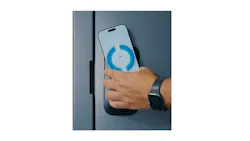
· NFC is a type of mobile credential that works in your phone’s wallet. With NFC, you usually have to open the wallet on your phone or the access control company’s app and touch it to the access device it’s registered to.
· Bluetooth is another form of mobile credential that typically lives on an access control provider’s app. Depending on the method of implementation, Bluetooth is generally regarded as a more secure technology. Why is that? Bluetooth often has layered encryption keys that are more resistant to credential sniffers (devices that read signals off access credentials) and hackers.
· Biometrics are growing in popularity. These are often access control devices at the door that read your face, palm, fingerprint, or other biometric data depending on the software’s capabilities. Biometrics are also often integrated into mobile credentials via your phone’s native Face ID, or fingerprint reader.
These are some of the most common credential types. But how do mobile credentials work?
How Mobile Credentials Work
Mobile credentials don’t all behave the same. Much of their personality comes from the access management platform powering them. Whether that platform lives on a local server, operates in the cloud, uses a mix of both, each approach shapes how credentials are issued, controlled, and used. These platforms serve as the hub for access management, letting administrators set schedules, define who can open which devices, see access history, administer both mobile and physical credentials, and more. As platforms progress and adapt, mobile credentials have become universally accepted across both commercial electronic security and consumer technology. There are a few ways mobile credentials work: open a wallet or app to tap the phone to a device, press a button in an app, or simply walk within range and let proximity do the work. Each flavor of mobile credential behavior depends on you AND your customer’s convenience vs. security balance.
How Do We Compare?
With so many exciting options and new technologies emerging, we see clear parallels between mobile credentials and the rise of smartphones. In 2008, when smartphones first gained notoriety, adoption was slow, but it was clear they were “the next big thing.” It took about 8 years for smartphone technology to mature with multiple product and feature revisions, but it was eventually adopted worldwide. Now, you might still use a flip phone —and that’s okay — but the point is this: we’re still in the early days of mobile credentials and we’re just getting started. Technology is emerging, and our industry is beginning to expect cutting-edge solutions.
The Evolution Is Creeping Up on Us!
It’s important to realize we’re just easing into the biggest change our industry may ever see. However, we haven’t even scratched the surface of what this technology can achieve. When smartphones were first invented, they were mainly for texting, calling, searching the web, and listening to music. Now, my phone is a flashlight, note-taker, video editor, and relationship-building supercomputer capable of almost anything. If mobile credentials evolve in parallel with smartphones, imagine the features we can look forward to — a credential that not only unlocks doors but also operates your car, works on your hotel door, and eliminates the need to download multiple apps or keys. It will take time, with plenty of bumps along the way, but I’m confident mobile credentials will become the next driver’s license, and we’ll see one that works for everything.
We Have a Lot to Be Excited About
Mobile credentials and biometrics are essential to access management. Being able to send an employee or guest an invitation with a mobile key brings convenience and peace of mind. The most common customer concerns — lost keys, stolen keys, unauthorized use, and key duplication — can all be solved by mobile credentials, which put control in the customer’s hands. This digital form of access is rapidly changing and growing in an industry built on physical locks and keys. Like an old dog learning new tricks, it’s hard for us to change our practices and views in this industry. I should know — I’ve held the same opinions about locks and keys for almost 8 years. But the ease of use, security features, and access schedules of mobile credentials and biometrics are proving to be the future of security for our children and grandchildren.
Mobile credentials are quickly being adopted in hotels, medical facilities, government buildings, apartment complexes, and especially small businesses. From my experience, small businesses crave this form of access as much as anyone. They’re cost-conscious and want to avoid rekeying expenses during employee turnover. If all these sectors are adopting mobile credentials, I’m excited to see what innovations are on the horizon. Long live the physical keys that made us locksmiths. They will never go away. But hey, we’re only 36 years away from The Jetsons! Let’s see how close we can get to them.
About the Author
Lucas Mason
Lucas Mason is Marketing Manager for Centrios, an access control solution for small businesses.