Sizing Up Multifamily Security
Key Highlights
- Multifamily properties are rapidly adopting smart building solutions, with 70% having access control systems and 92% equipped with intercoms in at least one property.
- Mobile credentials are transforming access control, enabling residents to use smartphones or smartwatches as keys, which increases convenience and reduces lockout incidents.
- Retrofitting existing properties with smart access solutions is a major trend, with an estimated $1.47B in revenue from in-unit tech amenities and $1.48B from internet services projected in 2025.
When asked which verticals show the most growth and demand for products, multifamily (MTF) continues to make most companies’ and locksmiths’ lists. Whether it’s new construction or retrofit jobs, locksmiths are starting to make traction in this area, as MTF owners want to provide the latest access control and tenant amenities as they compete with other rental companies to provide what renters want and demand.
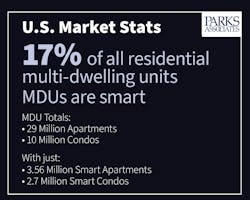
For example, 90% of multi-dwelling unit (MDU) owners and operators in the U.S. were planning to deploy, upgrade, or replace a smart building solution in 2025, according to research from Parks Associates. Other key data points from the firm include:
· 70% of multifamily companies have an access control system on at least one property, with 50% of those with systems reporting having one in their newest property.
· 70% have smart door locks on at least one property.
· 92% report having an intercom or callbox in at least one property.
“The vast majority of multifamily environments right now have access control and smart locks,” says Elizabeth Parks, president and CMO, Parks Associates. “Because of the way technologies have advanced and the different shifts now going from local to the cloud, new applications are available because of integration with mobile devices and that ability to control the environment.”
She says this leap in technology is emphasizing the “greater demand that we're going to see in the coming years to create more connectivity across the board through the broadband services, and then we'll get all these different devices and systems in not just the individual units that people are living in, but also those access points throughout the environment, which could be the gates on the outside, or be the gyms, etc.”
More Renters than Ever
While renters are younger than homeowners, the overall U.S. population, including renters, is aging, and household sizes are larger. Looking at the numbers, Parks found that roughly half of apartment renters are over 45 years of age, with 60% living in households with other people, commonly including a significant other and/or children or other family members, with roughly half owning pets. One quarter are remote workers, and a similar number have children living with them. “They need robust connectivity and amenities that support modern parenting,” say Parks.
The research firm has also been doing studies of MDU residents and speaking directly with key decision makers who own and manage multifamily properties. For example, in the firm’s 2025 study of multifamily residents, when those who are likely to move in the next six months (prospective residents) were asked to rate the importance of various amenities when choosing their next home, security cameras and access control were two of the top three most desired amenities in multifamily residents’ next home, behind only good insulation and soundproofing, and above even covered parking. “Modern solutions, such as AI-enabled smart cameras and app-controlled access systems, require robust property connectivity to operate and meet the needs and expectations of prospective residents,” says Parks.
In that same study, security cameras and access control ranked among the top three desired amenities for prospective residents. Additional data points from the research include:
· Properties with in-unit smart devices see a +32-point lift in Net Promoter Score (NPS) compared to properties without.
· Properties offering bulk internet experience a +26-point NPS boost, dependent on local ISP competitiveness.
· If residents are dissatisfied with smart technology, average NPS drops to –39.
· Residents who are satisfied with smart technology report an average NPS of 21 — a 60-point difference.
Renters Going Mobile
When discussing MTF access control solutions, the conversation invariably turns to the role of mobile credentials and how this is driving the renter’s experience and expectations in this space.
“We do see demand and interest from renters in mobile credentials and mobile access, which offers a variety of benefits to the resident as well as owners and operators,” says Kristen Hanich, Sr. Director of Research, Parks Associates. “I’d expect that trend to continue if not accelerate in the near future, especially for building access and public amenity spaces. Mobile credentials are becoming a centerpiece of the renter experience because they turn access control into a digital, self-managed amenity.”
She points out that Parks research shows that next-gen access control solutions increasingly support mobile credentialing, letting residents use a smartphone (or smartwatch) as a key for their unit and other secured areas and raising convenience and reducing friction compared to keys, fobs, or callboxes.
“This supports everyday expectations for ‘tap-and-go’ living and minimizes lockout events and key/fob replacement hassles,” she explains. “Mobile credentials also raise renter satisfaction by enabling remote access sharing. Residents can grant entry to guests and service providers (cleaners, dog walkers, delivery drivers) without coordinating with on-site staff, which the paper highlights as a major benefit of modern access control. Paired with guest access/management, mobile credentials make it easier to admit visitors than traditional systems.”
These expectations are accelerating because most multifamily inventory is older and being modernized through retrofits, meaning “digital access is increasingly how existing buildings compete with newer properties,” says Hanich.
Seamless Access Control is a Top Driver
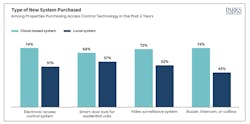
In the firm’s white paper, Modernizing Multifamily Housing: Retrofitting Access Control, developed with Kwikset, they found that for many looking to retrofit, access control is a top area of investigation and investment. Access control has a well understood value proposition for both decision makers and residents, with many companies already having similar mechanical systems in place and would benefit from upgrading, and next-gen access control solutions are necessary prerequisites for larger initiatives such as self-guided tours and centralized leasing, says Parks, noting, “For companies looking at Protech deployments, access control is oftentimes the first step on their journey.”
Parks Associates expects that retrofitting will be a major trend until 2027 and will continue to be highly impactful for many companies even after new construction activity picks up speed. “Companies with existing properties will increasingly need to compete not just with new construction, but also with neighbors that have taken the opportunity to retrofit solutions into their own properties,” says Parks.
Some key data points from the white paper include:
· The average MDU company works with 21 proptech vendors, which can create app overload — making unified, smartphone-based access especially valuable when integrated well.
· Only 4% of renter-occupied units are in properties five years old or newer, reinforcing why retrofittable mobile credential solutions matter for modernizing legacy stock.
The research firm estimates that in 2025, in-unit tech amenity fees and rental increases will generate $1.47B in total revenues for both properties and service providers. Deployment of bulk internet and managed Wi-Fi stands to generate an additional $1.48B.
“Investments in smart building, done properly, will generate and continue to generate returns for many years to come,” says Parks. “In the unique MTF environment, access control solutions may be composed of one or multiple parts, including a gate and intercom system in the case of gated communities, an intercom or buzzer on a base building, access restricted elevators, restricted amenity rooms, and smart door locks on residential units.”
Oftentimes, access control solutions are integrated with other solutions such as self-guided touring solutions, maintenance management platforms, and delivery services such as Amazon Key, or even smart concierge platforms.
Access control continues to be a desired resident amenity, and safety and security are of great interest to residents and prospective residents, with multifamily residents in a recent Parks Associates study rating the importance of security systems in their next home and community at the same level of importance as they rated a fitness center or gigabit internet speeds.
“Next-gen solutions that support mobile credentialing, allow smartphones – or even smartwatches – to serve as a key to residential units or to the property, providing great convenience to residents,” says Parks. “Guest access and guest management solutions also make it easier for residents to admit their visitors onto the property, compared to having to traditional callboxes or having to collect visitors in person.”
The white paper outlined the key benefits of MTF access control solutions, including:
· Enhance community safety and security by restricting access to authorized people.
· Remove the need for on-site staff to buzz in delivery drivers.
· Reduce incidents of residents locking themselves out of their units.
· Minimize key and fob replacement costs.
· Provide maintenance staff and contractors access to residential units or restricted areas, cutting down on the need to pull keys.
· Create a log of contractors and other workers entering and leaving the property or residential units.
· Allow residents to remotely grant access to the property or their units for services such as delivery drivers, cleaners, dog walkers, etc.
· Provide self-guided tours to prospective residents.
· Support centralized leasing efforts
“There are very real operational benefits as well for properties rolling out smart access and smart door locks – one of the key benefits is cutting down on the need for maintenance staff to go to the central office to pull unit keys. Instead, they can request access via a smart app,” says Hanich. “We’ve had companies report that they’ve been able to increase the average number of completes per day from an average of 10 to an average of 15-20.”
She continues, “Being able to access units through a smartphone also cuts down on the number of times a resident might be locked out, saving time and frustration there. I’d say resident expectations are also higher than in the past, especially among younger residents who may have grown up in homes with smart door locks. The story here is a bit more nuanced – residents want mobile access and mobile credentials, but they also want a fallback method so they can get in and out of their units and the property if they leave their phone at home or in the event of a power or internet outage.”
Opportunities for Locksmiths
Hanich also points out that there will continue to be a demand for security professionals such as locksmiths who are new to or are beginning to work in this area.
“There’s an opportunity,” she says. “New housing starts are still at a historic low in multifamily, but quite a few existing properties are interested in retrofitting to stay competitive with all the new builds that have recently come online. These installers need skilled professionals to do the work, especially ones who can make retrofitted locks look good with existing doors.”
Overall, Parks sees continued adoption of smart locks and electronic access control and other high-tech options on MTF properties as they compete with other properties for renters.
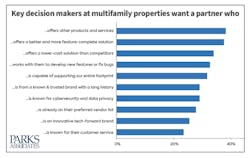
“We have been hearing anecdotally through our conversations with key decision makers that this has become a big part of companies’ strategies, especially among companies that want to reposition existing properties,” notes Hanich. “For example, when upgrading a Class B to a Class A property or even upgrading a Class C to a Class B property, smart locks and electronic access control go alongside other improvements.”
Looking big picture, the next five years in the MTF space “will be interesting ones,” adds Hanich. “Smart tech in new construction is largely a given in many markets at this point and retrofitting in these solutions have become easier than in the past. Internet service providers are working with property owners and operators to add in the connectivity needed to enable smart solutions, helping to smooth the way.”