Smarter ICU Workflow Starts at the Door
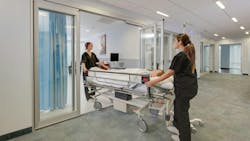
Few spaces in healthcare that demand more from doorway systems than intensive care units (ICUs). The threshold to an ICU room is a constant convergence point. Care teams move rapidly, patients are at their most vulnerable, families are seeking privacy, and complex mobile equipment must pass without friction or delay. It’s also a frontline for infection prevention and secure access.
As hospitals re-examine clinical workflows through the lens of patient dignity and safety, ICU door systems have become the starting point for better care. They function as extensions of the care ecosystem by shaping how safely, quickly, and quietly care can be delivered. It is through this lens that STANLEY Access Technologies’ ProCare Series doors have been engineered — with human-centric systems top of mind that deliver safety, privacy, and security at the entryway. Across the industry, manufacturers and healthcare designers are similarly recognizing that doorways are no longer passive architectural elements.
Human Centric ICU Door Design
Human-centric design means building door systems that address the needs of people, from patients to nurses to physicians — not just around materials and mechanics. In practice, that shows up in predictable movement, intuitive operation, quiet performance, and accessibility without compromise.
Enhanced visual privacy is one way to put the patient first. Electronic privacy glass, high-end integrated louvers (angled slats), and other available privacy features help shield patients from unnecessary visibility and support dignity during treatment and recovery. STANLEY’s ProCare series offers flexibility when it comes to visual privacy, with these options available for any part of the door, from a full panel to the upper part of the panel only.
Quiet, trackless operation is essential as a smooth transition from hallway to patient room will minimize disturbance to patients, which can be critical to patient rest and recovery. Smooth, trackless doors also eliminate floor tracks where germs can accumulate, improving both comfort and hygiene.
Accessibility is also a central component of humancentric engineering. ICU staff often navigate doorways while wearing PPE or handling equipment, beds, monitors, and IV poles. Door systems must offer wide, unobstructed openings without protrusions. Elements, such as catch-free, contoured handles and shielded latch mechanisms, eliminate snag points and help prevent accidental pullouts of tubing or cords.
Workflow Optimization: Engineering That Supports Critical Care
In ICU environments, speed and safety are necessities. Door systems must support rapid movement without compromising stability or predictability. The ProCare Series was designed specifically with these goals in mind. Through the elimination of unnecessary chokepoints, a door system becomes an enabler of care rather than an obstacle.
The ProCare products offer the widest clear door openings in the industry, allowing more maneuverability to move patients and equipment quickly, easily, and efficiently into and out of ICU rooms. This is especially valuable during rapid response events, emergencies, or code situations in which every second counts.
The ProCare push button is a patented feature that allows for one-handed breakout. This leads to faster breakout operation than traditional systems that utilize a breakout release latch mechanism. Traditional breakout mechanisms often require reaching up to the top of the frame; the ProCare push button keeps the release at the point of operation, making it faster, more intuitive, and easier to use under pressure. Just as important, a single staff member can reset the self-latching system one-handed restoring normal operation quickly in busy environments, thus saving time and energy.
In addition to intuitive breakout design, the ProCare automatic doors offer a range of flexible activation options to support diverse facility needs. Operators can choose traditional push-button activation, touchless wave sensors for improved hygiene, or integration with card readers to enable secure, credential-controlled access. These options allow facilities to tailor door activation to their workflow enhancing safety, infection control, and operational efficiency across clinical, administrative, and restricted environments.
Ensuring Long-term Reliability
A well-engineered ICU door must remain reliable through constant, demanding use. Regular upkeep ensures safety, preserves warranty coverage, and minimizes downtime. STANLEY recommends daily and weekly checks for smooth motion, sensor accuracy, and breakout functionality. These checks should be comprehensive — checking the door area for slipping or tripping hazards, checking the door panels for broken or cracked glass, and ensuring the swing out mechanism is properly re-engaged to allow normal slide operation.
Strict cleaning protocols are also recommended. STANLEY suggests cleaning glass with water or a mild detergent and alcohol based product; aluminum surfaces respond best to a 50/50 mix of Windex and Simple Green All Purpose Cleaner.
What This Means for Today’s ICUs
Human-centric ICU door systems have become essential tools for improving safety, privacy, and workflow in critical care environments. By providing broad clear openings, reducing snag risks, enabling one hand breakout, supporting both manual and automatic operation, and offering flexible privacy and security options, the ProCare 8300/8300A and 8500/8500A set a new standard in ICU door engineering. These systems translate to fewer bottlenecks, smoother transitions, quieter rooms, and safer passage—right at the threshold where care begins.
As healthcare facilities continue to modernize and expand their critical care spaces, door systems that balance durability, usability, and infection control performance will increasingly shape the environments in which clinical teams work and patients heal.
Brian Ha is a Senior Business Development Manager for Allegion plc’s STANLEY Access Technologies business with 7 years of experience in automatic and manual door products for healthcare, government, and retail projects. With a background in mechanical engineering, he spent 11 years in other industries developing and deploying complex systems prior to joining Allegion. Brian excels at working with cross-functional teams to deliver results for his customers.
About the Author
Brian Ha
Brian Ha is a Senior Business Development Manager for Allegion plc’s STANLEY Access Technologies business with 7 years of experience in automatic and manual door products for healthcare, government, and retail projects. With a background in mechanical engineering, he spent 11 years in other industries developing and deploying complex systems prior to joining Allegion. Brian excels at working with cross-functional teams to deliver results for his customers.