Today's locksmiths are governed by basic life safety codes. Just about every state, city, and local ordinance has adopted its own interpretations of the many regulatory agencies and associations.
The National Fire Protection Agency (NFPA.) is the authority of fire, electrical, and building safety. It was established in 1896 as an advocate of fire protection and life safety. The codes and standards established by NFPA are a consensus of trade and professional organizations. Basic life safety codes cover over 80 trades and all aspects of building construction. The NFPA has had sufficient influence as to affect a Uniform Fire Code™ that is primarily considered the model and is used by state, city, and local ordinances when designing their own codes and regulations.
Fortunately for locksmiths, the concern can be narrowed to door, locks and egress. This article discusses the basic concepts of the life safety codes relating to exit doors that locksmiths need to adhere to regardless of where they work.
Occupancy affects which locks will be used.
Occupancy relates to the purpose in which the building or part of a building is used or intended to be used. Occupancies are classified into groups that reflect the common purpose. One type of occupancy group covers: hotels, apartment houses and residences or other places where persons dwell. Another occupancy group covers: offices, businesses; and places where service-type transactions occur. Still another occupancy group covers: retail stores; and places where goods, wares, and merchandise are displayed and sold.
There are other occupancy groups that cover places of assembly, places with special hazards, places where products are manufactured, etc.
Exit doors must open from the inside without special knowledge or effort.
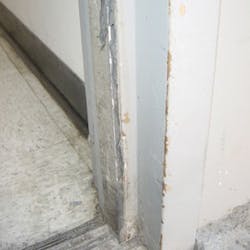
Exit doors are those doors intended to be used to egress out of a building or part of a building. Exit doors must be maintained in an operable condition. If the door is part of a fire assembly, the door must be maintained in accordance to the fire assembly requirements. Figure 1 shows a door that is part of a fire assembly, where the fire gasket needs to be replaced.
Exit doors are required to be openable from the inside without a key or without any special knowledge or effort. No key-operation from inside means no double-cylinder deadbolts. This includes surface-mounted key-operated bolts.
Special knowledge or effort can be subjective. It is often left up to the local ordinance or Local Authority Having Jurisdiction (LAHJ) to make a determination.
One example is the use of "secret locks" in a bank environment. This is a lock that is mounted to a half-height gate to separate the teller area from the public area. There is a button on the bottom of the lock that is "secret" and must be pushed in to operate the latch. These gates are oftentimes between the tellers and the exit doors. Some inspectors have had them removed, citing special knowledge, and some have required special signage alerting anyone in the area as to the "secret."
Sometimes the special knowledge or effort requirement can affect the industry to such a level that a new type of device is created.
A few decades ago, defense contractors in California were cited for non-compliant hardware on SCIF (Secured Compartmentalized Information Facility) doors. A SCIF is a "closed area" where a defense contractor can perform the "customer's" services in a controlled and secured manner.
A "customer" requirement is the entry to a SCIF be protected by a lock that eliminates a surreptitious entry. At that time there were but two options:
1. Install the S&G (Sargent & Greenleaf) SM182 Padlock-locking deadbolt with the S&G 8077 combination padlock. The padlock-locking deadbolt was a surface-mounted slide bolt that was mounted on the outside of the door; then the approved padlock would secure it. Figure 2 shows a padlock-locking deadbolt with combination padlock.
2. Install the S&G 8470XMP "Adjustoloc" on the inside of the door. This was a surface-mounted assembly consisting of a manipulation-proof safe lock linked with an automatic-retracting deadbolt. The bolt could either be retracted by dialing the right combination from the outside of the door, or by turning a knob on the inside of the door.
Inspectors contended that the first option could lock a person into the SCIF with no means to get out. The defense contractors contended that by the very nature of the work being performed, they required a thorough inspection to make sure all persons were out each and every time the room was used.
The inspectors rebutted that it was possible that the SM182 could be left unattended while persons were working in the room and someone could come by and slide it closed. Inspectors contended that option two required two hands to get out. One hand had to activate the Adjustoloc, while the other was used to activate the lockset below.
S&G worked closely with the defense contractors to satisfy both the governmental customer's requirements and the life safety codes. There was no hope for the SM182 as it couldn't be activated at all from the inside. Focus turned on modifying the Adjustoloc.
A "Day Button" was added to back of the safe lock case. This meant the automatic-retracting deadbolt could be held back for day use. The inspectors didn't like that as it required a person make the effort to turn the button (back to special effort).
The lock was further modified so that once the bolt was thrown back by turning the outside combination, the bolt was continually retracted. Before leaving for the night, a person would use the former "day button" to release the bolt.
The inspectors didn't like that as it still required special knowledge and it still took two actions out to open the exit door. It became evident that both options were unworkable.
S&G, working closely with life safety experts, introduced the 8470 high security exit device (Figure 3). This is an integration of the Adjustoloc and an approved exit device. The process took about 18 months to get right but finally both sides were satisfied.
It is important to note that during this time both S&G and the defense contractors appealed to the governmental customers to assist them with dealing with the local ordinances.
Each SCIF was regulated by a different "customer." Although the work performed in these areas directly related to national security, each customer's response consistently suggested that the local ordinance has to be satisfied, that is, life safety had to be fully addressed before the security needs could be met.
Clearly, life safety always takes precedence over security.
All locking devices are to be of an approved type.
Occupancy load determined by the purpose of the room and its size. Local ordinances have tables to determine what the occupancy load is in an occupancy group. If the occupancy load is minimal (usually less than 50), a lockset can be used on an exit door. If the occupancy is significant (usually 50 or more), exit devices are required on exit doors.
NOTE: If the exit door is part of a fire assembly, lockset or exit device must additionally be rated for fire protection.
Lockets rated for fire assemblies will be identified by the UL™ and F™ emblems on the latch assembly. Approved exit devices undergo testing to meet life safety criteria. Figure 4 shows approved markings which appear on the latch assembly of a lockset.
Push paddles and bars are tested to make sure that a maximum amount of force (usually 30 pounds) is required to activate the device.
Exit devices that are fire-rated are tested to make sure the device will continue to latch during a fire. This usually means the fasteners and latching mechanisms will survive the heat and the fire.
Exit devices that are fire-rated do not feature dog-down assemblies. The intention is to make sure the door will be latched during a fire. Keeping a door closed and latched limits the main fuel, air draft.
There are locking devices that cannot be approved by the very nature of the device. These devices are: door chains, deadbolts, slide-bolts, bars and removable bars and auxiliary locks and latches.
There are exceptions to the rules.
Some occupancy groups that are exempt from certain locking device restrictions.
Most local ordinances make exceptions to: businesses; storage facilities; mercantile facilities; places of assembly; and manufacturing locations.
These ordinances may have key-locking hardware installed on the main exit when the main exit consists of a single door or double door if there is a readily visible sign above the door stating, "These doors to remain open during business hours." Figure 5 shows the required sign above main exit door in a business shop.
This allows for the heavy traffic that occurs through the entries of stores, businesses, and other facilities, where the main exit is also the main entry.
Note that this exception is for "the main exit" and not "a main exit." This limits key-locking hardware to one "main exit" single door or double door. Figure 6 shows a main exit door with key-locking hardware. What is meant by key-locking hardware is a double-cylinder deadbolt.
These types of doors are usually storefront types (aluminum and glass). A deadbolt is necessary to keep burglars from simply breaking the glass and opening the door. Figures 5 and 6 show a deadbolt designed for aluminum and glass doors.
Because the code specifies key-locking hardware, the inference is that a t-turn would not meet the code requirements as it would require prior knowledge and two operations in order to open the door.
Another requirement to satisfy this exception is that both leafs of a set of double doors must be free to swing when the key-locking hardware is unlocked. This prohibits an additional lock or other latching device be used on the inactive leaf. The local ordinance reserves the right to revoke this exception for due cause.
Another exception that most local ordinances will allow is the use of night latches, deadbolts, and security chains on certain occupancies: hotel rooms, apartments, residences, or other places where persons dwell. This is usually limited to those areas with occupancy loads below 10 persons.
Manually operated surface or flush bolts are prohibited.
On exit doors, bolts that secure the inactive leaf of a set of double doors are strictly prohibited. This includes: manual flush-bolts, cane and slide bolts, decorative or cremone bolts or other surface-mounted bolts.
Figure 7 shows cremone bolts that were allowed because they were not on exit doors. Automatic flush bolts are acceptable when the inactive leaf of a set of double doors will not have any other locking hardware installed on it.
Some ordinances provide an exception to certain places where persons dwell, specifically dwellings and lodging houses.
Relating to these types of occupancies, a room that is not normally occupied but is used to move equipment, bolts can be used and a door closer need not be provided.
Single-action is out.
The unlatching of either leaf shall not require more than one operation. On exit doors, this means a deadbolt cannot be mounted above a lockset.
Mortise locksets with deadbolts and interconnected locksets are a good work-around. The bolt in these types of lockset are retracted when the inside knob or lever is activated. In Figure 8, the bolt in the mortise lockset retracts when the lever is pushed down.
Where panic devices are used, the means of activation (push pad, paddle, or bar) needs to be installed between 30 inches and 44 inches above the finished floor.
Where push pads or paddles are used, the length of the pad or paddle needs to be at least half the length of the door. The unlatching force of any panic device needs to be less than or equal to 15 pounds.
Although there are additional requirements that can be specified by the local ordinances, basic life safety concepts are common with all exit doors.
Locksmiths who pay attention to these concepts will never have to replace hardware at their cost and will limit their personal liability regarding any safety incidents.
This article deals only with the basic concepts. Every locksmith should investigate the codes and regulations that concern their jurisdiction, specifically those codes and regulations that are related to doors, locks, and egress.
Here is a quick list of things to watch for regarding exit doors:
- Make sure the door is in good working order.
- Make sure nothing obstructs the door swing from either side.
- Make sure the door can be opened at least to 90 degrees.
- Make sure the door swings towards the path of exit travel.
- Make sure the door is easily recognized as an exit door.
- On the inside, the door may not require a key, special knowledge or effort to open.
- The door cannot be locked with chains, bars, bolts, or auxiliary locks/latches.
- Make sure it takes only one operation to open the door or in the case of a double door to open either leaf.
- Make sure all locking hardware is of the approved type.
- If the exit door is part of a fire assembly, make sure the hardware is fire-rated.
- Exit doors that are part of a fire assembly must be self-closing (door closers installed).