Guide To California DOJ Gun Safe Requirements
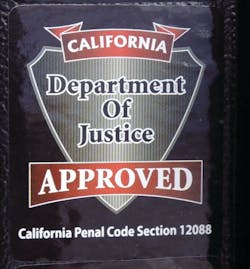
The purpose of this article is an attempt to help clarify mis-information regarding gun safes. The information has been obtained from various sections of the California Penal Code including 23655. Note that the author is neither an attorney nor an expert in California Department of Justice certification.
Beginning July 1, 2001, the California Department of Justice shall compile, publish, and maintain a roster listing all of the firearm safety devices (FSD) that have been tested by a certified testing laboratory, have been determined to meet the department's standards for firearm safety devices, and may be sold in this state (for storing pistols and long guns). Firearm safety devices used for random sample testing are obtained from sources other than the manufacturer.
The idea behind the DOJ certification for FSD was to protect children by keeping weapons out of their hands.
Since Jan. 1, 2003, Firearm Safety Devices, which include gun safes without either the UL RSC Listing or California Department Of Justice (CDOJ) certification, may not be sold in California for storing pistols and long guns.
If a locksmith sells a cabinet, gun cabinet, lock box, gun safe, long gun safe or wall safe for the purpose of storing firearms in California, it must have either a CDOJ certification which can be found on the Department of Justice Web Site, a label on the container or have a UL RSC Listing. DOJ approval enables safe manufacturers whose products do not meet the UL RSC Listing requirements to sell their lock containers including safes in California as long as they meet the CDOJ certification test.
The State of California Department of Justice Regulatory Gun Safe Standards are not burglary or fire rating standards, it is a construction standard. There are three options for a cabinet, gun cabinet, lock box, gun safe, long gun safe or wall safe for sale in California for the purpose of storing firearms, must pass one of three options.
Option 1:
- Shall be able to fully contain firearms and provide for their secure storage;
- Shall have a locking system consisting of at minimum a mechanical or electronic combination lock. The mechanical or electronic combination lock utilized by the safe shall have at least 10,000 possible combinations consisting of a minimum three numbers, letters, or symbols. The lock shall be protected by a case-hardened (Rockwell c scale 60+) drill-resistant steel plate, or drill-resistant material of equivalent strength;
- Boltwork shall consist of a minimum of three steel locking bolts of at least ½ inch thickness that intrude from the door of the safe into the body of the safe or from the body of the safe into the door of the safe, which are operated by a separate handle and secured by the lock;
- Shall be capable of repeated use. The exterior walls shall be constructed of a minimum 12-gauge thick steel for a single-walled safe, or the sum of the steel walls shall add up to at least .100 inches for safes with two walls. Doors shall be constructed of a minimum of two layers of 12-gauge steel, or one layer of 7-gauge steel compound construction;
- Door hinges shall be protected to prevent the removal of the door. Protective features include, but are not limited to: hinges not exposed to the outside, interlocking door designs, dead bars, jeweler’s lugs and active or inactive locking bolts.
Option 2:
- Is listed as an Underwriters Laboratories Residential Security Container;
- Is able to fully contain firearms;
- Provides for the secure storage of firearms.
Option 3:
- Pass the California Department of Justice (CDOJ) certification test that is designed to replicate the forces that would be exerted on Firearm Safety Devices (FSD) using common household tools for an approximate 10-minute period. Each test will occur in a Certified FSD Laboratory.
For the purpose of this article, we will discuss only requirements that relate to a cabinet, gun cabinet, lock box, gun safe, long gun safe or wall safe developed to store firearms.
Key Provisions
The following information is paraphrased.
- All "box" type devices (devices to fully contain and enclose a firearm e.g. pistol or gun safe) shall be tested with a small handgun having a primed case with the firing chamber closed inside the FSD. Lock boxes designed to accommodate long guns must be tested with at least one long gun placed within the container in addition to the small handgun.
- The picking or manipulating test to the lock cylinder in the FSD shall resist picking with the use of jumbo and #1 size paper clips, and small screwdrivers that fit in the keyway for two minutes each. Combination locks shall resist manual manipulation for two minutes. Time shall be counted only while hands are picking or manipulating the lock.
- Tests shall be performed by a tester with no specialized training or skills in lock picking or manipulation (e.g. locksmith training or the use of reference guides on lock picking or manipulation). Lock failure occurs if the lock mechanism can be disengaged during manipulation time (excludes the correct combination).
- The shock test uses a shock impact fixture. Drop a kilogram weight from one meter + one centimeter, five times to the top of the FSD body aligned to attack the keyway or combination lock using a chucked blade-type (screwdriver) tool.
- Failure occurs if the FSD is disabled by the shock test. Failure also occurs if following the shock test, subsequent manipulation of the gun safe with an eight- to 10-inch long screwdriver with a 1/4 to 5/8-inch flathead end for 15 seconds allows the tester to open the FSD.
- The plug pulling test attempts to dislodge the plug from the cylinder of the lock by drilling a hole to accommodate a tapping screw. This test does not test the lock's ability to withstand drilling
In addition to the above tests, the Laboratory shall perform the following tests on a model of each FSD. This requirement does not apply to any FSD that weighs more than 75 pounds or has a combined length and girth 110 inches or more.
The FSD shall be dropped from a height of one meter + one centimeter onto a slab of concrete. The drop distance shall be measured from the lowermost portion of the FSD. The FSD shall be dropped with the locking mechanism facing directly up, and with the locking mechanism facing directly down.
Failure of any test occurs if the FSD is disabled or the firearm contained within the enclosed container discharges. A failure of any test constitutes a failure of the complete test.
The CDOJ certification test changes from time to time. Safes that have already passed testing are not required to retest. I have been in contact with a gun safe manufacturer. According to the manufacturer, three boxes are sent for testing. Two are destroyed and one is kept.
According to the DOJ, a "long-gun safe" category has the additional restriction. If it does not satisfy the requirements of the CDOJ, it must carry a conspicuous and legible warning label in English and Spanish as follows:
“Warning: This gun safe does not meet the safety standards for gun safes specified in California Penal Code Section 12088.2. It does not satisfy the requirements in California Penal Code Section 12088.1, which mandates that all firearms sold in California be accompanied by a firearms safety device or proof of ownership, as required by law, of a gun safe that meets the Section 12088.2 minimum safety standards developed by the California Attorney General.”
This label requirement is for long-gun safes manufactured within California, kept for commercial sale or commercially sold. Failure to include the required warning with a long-gun safe is punishable.
If the FSD manufacturers want a label on the unit, they are responsible for the design.
Our chart list examples of cabinets, gun cabinets, lock boxes, safes and wall safes by manufacturer and model of FSD that are certified. At press time, 941 devices are in the database.
Those safe manufacturers and dealers who disregard the code are in violation, which increases from a civil fine up to $500 to a fine up to $5,000 and if a licensed firearm dealer, permanent ineligibility from selling firearms.
To obtain a list of the Department of Justice Roster of Firearm Safety Devices Certified for sale, go the DOJ Web Site: http://oag.ca.gov/firearms/fsdcertlist. For questions regarding CDOJ requirement and California Penal Code Section 12088.1 and 12088.2, contact the firearms division at 916-227-3703.
FSD Type FSD Revolvers Pistols Derringers Rifles Shotguns Caliber Specific
Cabinet Homak Manufacturing Inc. 3655 * * * * * -
Cabinet Sentinel GSXSG-24E * * * * * -
Cabinet Stack-On GC-18C * * * * * -
Gun Cabinet H.S. Cabinets HS12 * * * * * -
Gun Cabinet Sentry Safe G2215 * * * * * -
Lock Box ADG Sports 33018 * * * - - -
Lock Box AEGIS Industries APLB-10 * * * - - -
Lock Box Homak Manufacturing Inc. HS30103630 * * * * - -
Lock Box V-Line Desk Mate 2597-S * * * - - -
Safe American Security Products TF5924 * * * * * -
Safe Cannon Safe 5521F-B * * * * * -
Safe Liberty Safe Centurion 12 * * * * * -
Wall Safe Homak Manufacturing Inc. WS00018002 * * * * - -
Wall Safe Stack-On PWS-1522 * * * - - -
About the Author