Just How Well Can A Door Perform?
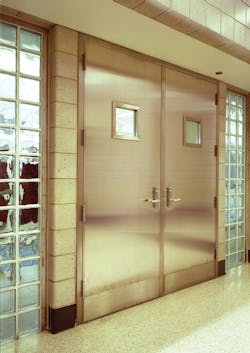
Building professionals face a variety of door requirements in their commercial and industrial building projects: high security exterior doors; power doors; interior office doors; even small cabinet doors. No matter what function the door has, making sure it functions and operates smoothly day in and day out is why most builders rely on the Performance Standards and Grades developed and tested by BHMA.
The Builder’s Hardware Manufacturers Association (BHMA) is the nationally leading trade association for the builder’s hardware manufacturing industry. BHMA is composed of U.S. manufacturers of builder’s hardware in categories such as cabinet hardware and hinges, sliding and folding door hardware, and power doors and components.
BHMA is the Sole ANSI Accredited Group for Builders’ Hardware Standards
BHMA is the only U.S. organization which is accredited by the American National Standards Institute (ANSI) to create standards for builder’s hardware. ANSI/BHMA standards are the written criteria which define the appropriate operation, test values, safety criteria, etc. of builder’s hardware products.
Many ANSI/BHMA standards assign 1 of 3 product grades to a particular item of hardware. The product grades – graded as 1, 2, or 3 with grade 1 indicating the highest level of performance - are defined by progressive levels of performance benchmarks in each applicable ANSI/BHMA standard.
The standardized BHMA numbering system also delineates other important classification information, such as the predominant material used, product category, and function of a specific hardware item. How products grades and other aspects of BHMA standards are determined and applied is the result of the rigorous testing applied to the products.
ANSI/BHMA Product Grades Are Based on Testing and End-Use Application
The tests used in the case of product grades are objective, meaning the products are not graded relative to one another. Rather, they are assigned a number grade based on meeting established and objective criteria. Testing is used to determine and judge many different characteristics of hardware; usually they focus on durability, strength, security, and finish.
As a commercial standard, the performance grades are generally assigned and applied with industrial applications in mind; such as deciding whether a lock is more suitable for a well-worn front door, a rarely used back closet which must be secured, or a side door which is not often used and does not need much protection. Each of these different door profiles demands a different product grade:
- A door that requires product grade 1 equipment generally has one of two characteristics: the door is either frequently trafficked or often used, or it protects essential goods and valuables and demands the utmost security.
- Each product grade below 1 flows down this ladder of use and security.
- A door that requires grade 2 products most likely is frequently trafficked but is not intended to provide essential security, and
- grade 3 is just an average door, that probably will not see much use.
These performance grades are allotted after the materials meet their specific performance requirements. Some examples of these are:
- Strength Testing: Almost all material undergoes a strength test. This test applies pulling pressure on a door. All 3 grades must meet 1200 pounds to pass this test. This assures that all hardware that is BHMA certified as having a product grade of 3 or better will at the least perform to this level.
- Mortise Lock Performance: Commercial doors are often equipped with mortise locks which has been certified and graded by BHMA. A Grade 1 for a mortise lock means that it was put through a million cycles, and continued to perform at a high level. Grade 2 and 3 are only graded as maintaining their performing through 800,000 cycles, with Grade 2 indicating a higher level than 3.
- Vertical Load Testing refers to materials that are graded on their ability to endure strength applied from above. A grade 1 product is tested to hold up under pressure of over 350 pounds, a grade 2 product 250 pounds, and a grade 3 product 150 pounds.
- Security Testing puts the lever into its locked position, and then tests to make sure it can withstand torque which is applied to the products to ensure that it will not open. Grade 1 items will withstand past 175 ft. of rotational torque force, Grade 2 will withstand 130 ft., and Grade 3 will withstand 55 ft.
These tests are some of the most common and make up the core of the essential tests which look at use and security, which is what the performance grade is most essential for determining. Again, the performance grade and tests are determined with commercial use and industrial applications in mind, which is why BHMA sets the performance standard so high.
BHMA performance grades are determined to benefit both manufacturers and installers. Manufacturers want to make products that effectively fit and match their customer’s needs. Likewise, builders and installers want, and through the BHMA performance grade, have a label to understand which product to select for their specific and varying applications and projects.
Looking forward, BHMA is working on grades specifically created as residential standards. This will help consumers better determine the hardware items they want to use for their residences, and will bring to them many of the benefits which industry already enjoys by utilizing BHMA performance grades and standards.
About BHMA
The Builders Hardware Manufacturers Association (BHMA) is an industry leader in building safety and security. BHMA is the only organization accredited by the American National Standards Institute (ANSI) to develop and maintain performance standards for locks, closers, exit devices and other builders hardware. The widely known ANSI/BHMA A156 series of standards describes and establishes the features and criteria for specific types of hardware products. In addition, BHMA sponsors third-party certification of hardware products, which is a requirement for a product to bear the ?BHMA Certified? mark — insuring that the product meets the ANSI/BHMA standard. For more information on BHMA, please write to BHMA, 355 Lexington Avenue, Suite 15th Floor, New York, NY, 10017 or visit the Web site at www.buildershardware.com.