Security System Grows with Colorado Mesa University
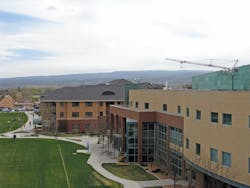
For the past several years, Colorado Mesa University (CMU) has been growing rapidly, and its access control system has continued to grow with it. What began as an effort to standardize and improve the way building security hardware met the changing needs of the campus has led to an integrated system that provides flexibility and grows with the University’s requirements.
Colorado Mesa University, which recently changed its name from Mesa State College, was founded in 1925 as Grand Junction Junior College. The school has grown to an enrollment of more than 3000, including almost 1,900 students who reside on campus. CMU has offered baccalaureate degree programs since 1974 and graduate degrees since 1996.
As with many colleges, CMU installed a variety of access control hardware types as buildings were built or renovated. Locksmith Preston C. Ellis says, “When I took over, we had a little bit of everything. I had to consolidate because the campus was growing, and I didn’t have enough space to store spares and parts for everything.”
Part of the concern, as at any public institution, was finding products that work together to fulfill the security and operating needs of the institution, yet are available from multiple sources to accommodate the competitive bidding process. Ellis notes that some products were only available through a single source or at a fixed price, which made it impossible to get comparative bids.
After identifying the products that met the University’s current and expected future needs and could be obtained through several sources, RFPs were issued, and a supplier was awarded a multi-year contract, based on cost and service considerations.
Because Grand Junction is located midway between Denver and Salt Lake City, support plays an important role. “It’s 250 miles in either direction,” Ellis says, “and you can’t buy anything here. I have to be able to get help over the telephone, because in winter, the pass may be closed, and we may have to do our own troubleshooting and repair.”
From Keys to Cards
Beginning with the key system, CMU has steadily upgraded its security and now is implementing the latest electronic security solutions. Where keys are needed, patent-protected keyways are used to prevent unauthorized duplication.
Ellis explains, “I still have two buildings on the original grand master, but we’re moving toward Schlage Everest keyways. We use Primus selectively where it overrides the perimeter of a building or in areas that are secured by card readers.” Because the Primus keys are needed only for overrides, they are kept in a lock box rather than being carried, to prevent possible loss.
Residence halls have followed a migration from keys to keyless access control. Initially, offline locks were used in most applications. One building uses offline Schlage Campus Locks on pod entrances, with SFIC Everest B locks on the four bedroom doors in each pod. The high-security keys prevent unauthorized duplication, while the electronic locks on the pods eliminate the need for multiple key levels and frequent re-keying.
As student preference for keyless entry increased, the Campus Locks were used exclusively on the next building. While access data is computer-managed with these locks, the actual credential resides on the card. This eliminates the need to update each lock whenever there is new data. Audit trails and other data still can be downloaded from the lock via a PDA and transferred to the computer. The offline locks can manage an unlimited number of cards and require no hard wiring.
In its latest residence halls and academic buildings, CMU is moving toward the newest generation of electronic locks. The recently introduced Schlage AD Series locks are designed so they can be changed easily to another configuration if needed by simply replacing a module instead of the entire lock.
Bunting Residence Hall is be equipped with more than 500 Schlage AD-250 locks, which perform the same function as the Campus Locks used in existing buildings. Both have access rights stored on the user’s card.
Perimeter access control for academic buildings generally is by card reader outside of normal operating hours. These are mainly hard-wired online installations, although a few are wireless. All are controlled by a Schlage SMS system, which also is integrated with the University’s one-card system. Ellis says CMU has one of the largest SMS installations in the state, with 15 or 16 panels.
Card access is especially beneficial in the large University Center building, which houses a wide variety of functions that include student government, the campus radio station, an art gallery and many others. When the building is locked, authorized students have access around the clock with their cards. Ellis says the cards eliminate the costs and time associated with keys that are lost or not turned in when a student leaves.
Currently, CMU is renovating its oldest classroom building, which made it necessary to move its offices to temporary buildings. To secure the temporary offices, Ellis used Schlage AD 400 wireless locks to simplify installation. Once the renovation is complete, he will use the locks on other buildings. One panel interface module (PIM) controls access to four of the temporary buildings.
Wireless access control also is used at the Hamilton Recreation Centerand El Pomar Natatorium. Here they solved a different problem. When the natatorium was built, conduits were not installed for access control, and the amount of concrete made it impossible to add them later. Instead, the Von Duprin WA993 access devices and trim were easy to install without wiring.
Other hardware solutions complement the access control products now being used across the campus. Ellis says LCN 4600 AutoEqualizer™ power operators are used extensively where needed for accessibility of convenience. For door closers, he prefers the non-handed LCN 4100 door closers because this reduces his inventory.
Growth continues at CMU, with a new residence hall or academic building springing up every 12 to 18 months. As the campus grows, access control solutions that have the flexibility to meet changing needs will make it easier to maintain security for people and property.
“The people are the most important part, but we have to look at the property as part of the package. If we lost a classroom full of computers, it would affect the people who need them,” Ellis states.