The Impact of Closers, REXs and Electric Strikes On Door Control
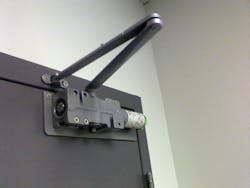
Door closers are extremely important to the safety and security of any door. They provide a means of controlling the door’s swing, which is necessary to be sure the door closes completely and operates so as not to injure individuals using the door.
Door closer operation is part of both NFPA 80 which addresses fire door assemblies, and the Americans With Disabilities Act (ADA) which addresses accessibility issues.
NFPA 80 says that a fire rated door must be closed and latched at the time of a fire. Therefore, the door must be closed unless someone is entering/exiting. If the building code permits the use of door holders interfaced with fire/smoke detection, the door should be closed and latched.
Note that latched doesn’t mean locked. Whether a door is locked from the outside is a security issue that does not involve Life Safety or ADA codes. Locking the door from the inside (protected) side is rarely permitted and well beyond the scope of this article.
ADA spells out the pressures required to open a door, the force allowed to close a door and the speed at which a door may travel. The door closer is the component which controls these parameters.
The door closer is just one component in a door system, and it is part of the locksmith and security practitioners’ responsibilities to be able to install, adjust and troubleshoot a door closer just like he or she would be able to service a lock or a hinge.
However the door closer may not be the root cause of a problem with a door, and therefore replacement or adjustment of the door closer may not always provide the solution to the problem
Issues which will affect proper door operation include:
Wind: grabbing the door and preventing it from closing or pushing on the door forcing it to shut
Latch Bind & Alignment: where the lock and strike are out of alignment, or otherwise not in harmony
Weather Stripping: gaskets, sweeps, etc. interfering with the clear swing and latch of the door and frame
Threshold Rub: cause by frame racking, the threshold rising, or the door dropping
Stack Pressure: When the buildings air handling system pushes out on the door
Door Frame Misalignment: caused by damage to the door, frame or hinges
If any of these conditions exist on a door, don’t expect the door closer to be able to overcome them.
And remember, if you are installing access control or a lock on a door, or even doing a rekey, once you touch the door, you own it from a liability standpoint.
First ask yourself:
- Will the equipment you are offering fit on the door?
- Once your equipment is installed, will the door actually work properly?
LCN 4040
The LCN 4040 is an excellent door closer for commercial applications. Although its installation is relatively straightforward, proper planning and careful execution is vital for a successful installation.
On a recent project I wanted to install a 4040 on the pull side of the door.
The critical dimensions of this type of install are arm and closer mounting locations. Since the closer is relatively heavy and subject to torque and pressure, through bolt (Sex bolt) mounting is preferred so the closer does not separate from the door and fall.
Take time to be sure the four holes required for mounting the closer located accurately on either side of the door so the pattern lines up with the closer, and the thru-bolts will align. Also be sure you have a clean shot for the holes through the door.
For example, my most recent door had a reinforcing channel at the top whose depth exactly coincided with where the 4041 template said the top mounting holes should go.
If I shifted the pattern up, my top pair of holes would be in the channel which would not adequately support the door closer. If I shifted the pattern down to clear the reinforcement partition, the arm of the closer would interfere with the top of the door since on the pull side mount the arm travels over the top edge of the door while it opens.
LCN has solutions for this, and the one I used was their drop plate.
LCN provides templates with every door closer, and plenty of tech support via phone or email. Contact them if you are having a problem.
The final step of the installation is the adjustment, which is the sweep, backcheck and latch settings for typical doors.
LCN has introduced the LCN 4040XP which combines tougher, bolder construction with proven LCN technology. The result is a closer that’s stronger, smarter and delivers remarkable value in a variety of applications.
The 4040XP is LCN’s most durable heavy duty closer designed for the most demanding, high use and abuse applications. The 4040XP can be used with all 4040 accessories.
Features and Benefits:
- 44 percent increased bearing load capacity
- Strongest pinion ever- at 3/4” journal diameter
- Widest bearing ever- at 5/8”
- Stronger pinion teeth
- New V-shield™ seal with 20 percent longer life
- Cast Iron
- Forged Steel Arm
- Double Heat Treated Steel Pinion
- All Weather Fluid
- Non-Handed
- LCN® Fast™ Power Adjust
- UL & cUL Listed
- Tested and certified under ANSI Standard A156.4, grade one
Specifications:
- Shipped with EDA arm, standard plastic cover, and self reaming and tapping screws
- Non-sized cylinder is adjustable for interior doors to 5’0” and exterior doors to 4’0”
- Closer can mount hinge side, top jamb, or parallel arm (with PA bracket) on either right or left swinging doors
- Closers to meet ADA requirements
- Standard or optional custom powder coat finish
- Optional plated finish on metal cover, arm and fasteners
- Optional SRI primer for installations in corrosive conditions is available with powder coat only
- UL and cUL listed for self-closing doors without hold-open
For more information, contact your local locksmith distributor or visit www.securitytechnologies.ingersollrand.com.
REX It Right
Motion sensors are used for Request To Exit functionality in electronic access control systems. The Request To Exit device sends a trigger to the electronic access control system to unlock the lock and also signals the control that the door is being unlocked to egress, rather than forced open in an unauthorized entry.
Without the REX device, the electronic access control system has no way of knowing whether the door opening is forced or a legal exit occurring.
How the electronic access control system handles the egress will vary between manufacturers, but there are typical characteristics of these systems. Of course it is up to the installer to verify how the particular system he uses needs to be wired and configured.
When the REX detects an egress, it sends a signal to the controller which then bypasses the door position sensor and triggers the internal door unlock timer in the controller. This shunting remains active for a preset time, or resets once the door position sensor senses that the door has been opened and reclosed. If the shunt times out and the door is still open, then the system may report a propped door alarm.
If the door is opened without either a valid card or PIN entered or the REX triggering first, the system interprets the door opening as a forced door.
A problem with REX motion sensors has been that they typically have a wide detection range. This is good for safety and the convenience of the users. But because if the wide pattern, REX motion sensors can be tricked by a variety of methods, thereby creating opportunity to gain entrance into the protected area.
The BEA R2E 100 Sensor has a controlled detection pattern designed to look only at the lock lever rather than the surrounding door floor and wall area, thereby reducing or eliminating the functional deficits suffered by traditional REX sensors.
The BEA R2E 100 has many other features and signal processing capabilities to suit it for many access control applications.
The R2E-100 is mounted on or above a door header so that its detection pattern is placed precisely in front of the door handle. In this scenario, when the user reaches for the door handle to exit, the electronic locking (EL) device is released, and the person can exit.
The active infrared detection curtain of R2E-100 is well defined to keep the door secure, while rejecting parallel traffic and objects slid under the door. The detection distance, or range, of the sensor is adjustable from 20 to 48 inches.
Re-lock Mode can be selected to run in timer mode or door position mode. In timer mode, the relay hold-time will control when the security device is re-locked, and it is adjustable from 1/2 to 60 seconds.
In addition, the timer mode features selectable sub-modes of operation, re-starting mode, where the relay hold time will not expire as long as the sensor is in detection or non-re-starting mode, where the relay will remain active for only the adjusted relay hold time.
In door position mode, a door position switch connected to the door position switch input on the R2E-100 will control when the door is re-locked. The door position mode also has an advanced re-locking feature that is selectable as 10 or 30 seconds, for the scenario that if the sensor has gone into detection but the door has not been opened, the R2E-100 will re-lock the door and become secure again.
The R2E-100’s relay output consists of two Form “C” contacts that can be wired as normally-opened or normally-closed. Also, with the R2E-100, there is no need for any additional surge protection in the wiring of the EL device to the relay, as surge protection already is built into the sensor. This built-in protection eliminates the need for any additional components.
The R2E-100 also contains an alarm that can be activated to sound when the door is open or when the El device is released, depending upon the sensor’s mode. The alarm’s volume can also be adjusted or turned off.
The R2E-100 provides for 3 auxiliary inputs: an external push button; a card reader or other entry signal, and connections for a door position switch.
For more information, contact your local locksmith distributor or visit www.beasensors.com.
Electric Strike
The Rutherford Controls 5 Series Strike With Optional Latch Monitor installs easily in an ANSI prepped metal frame, eliminating the need to cut the face of the frame for the latch gate.
It is UL Listed, designed for commercial duty. This strike is intended for use with cylindrical locksets with ½” to 5/8” latch projection. This strike has a very shallow (less than an inch) mechanism body which will frequently fit inside the frame’s shadow (dust) box without alterations.
The device is furnished with a full set of mounting hardware, offset tabs and shims. Proper vertical and horizontal alignment of the strike and latch is critical for smooth operation. The strike has an integral means of vertical adjustment to optimize the latch/strike vertical alignment.
Things to observe on the door and frame which may complicate the installation include:
- Shallow or distorted shadow box
- Poorly aligned or bent flanges
- Vertical misalignment of the latch and strike center line
- Twisted frame or distorted hinges which introduce bind or loading of latch and strike in the closed position.
These issues need to be addressed for most electric strike installations.
Electrically this strike has all the filed selectable features we have grown to expect: 12-24 VDC/VAC, and field configurable for Fail-safe or Fail-secure.
For more information, contact your local locksmith distributor or visit www.rutherfordcontrols.com.
About the Author
Tim O'Leary
Tim O'Leary is a security consultant, trainer and technician who has also been writing articles on all areas of locksmithing & physical security for many years.