Working with and understanding Life Safety & Building Codes is part of being a security professional. While understanding these codes is critically important, it is also challenging for the following reasons.
- Several different codes are used throughout North America and these codes are revised periodically.
- Code requirements vary according to occupancy types.
- Municipalities determine which codes they use and when they will adopt revisions.
- Code interpretation is subject to approval by the local authority having jurisdiction (LAHJ). Some premises are not subject LAHJs and some premises are subject to multiple LAHJs.
- Violations represent a substantial liability to your company.
- Most importantly, inappropriately deployed locking hardware endangers lives.
Building codes have a long history. It is said the first building code was in the Code of Hammurabi. The Code of Hammurabi states that if a builder builds a house for someone, and does not construct it properly, and the house which he built falls in and kills its owner, then that builder shall be put to death.
Even in modern times, being the messenger about code requirements does not make you popular. Frequently when I share observations with clients I get replies like: “That doesn’t apply to us; we’re grandfathered” or “The Fire Marshal has been through here many times and never mentioned that.”
My favorite client reply is: “The Fire Marshal just left; he threw the book at us and if you don’t come over right away and get us into compliance we’re going to get shut down. HELP!”
Locksmiths are there to support the intent of the law and we must accept that ultimately the LAHJ will prevail. When I need expert guidance, I call my attorney Ken Kirschenbaum. The following is his advice.
“Any type of security device, equipment, system or service, and I include lock work, will subject the professional installer to exposure when the security device is perceived to fail and loss occurs. Keeping track of the myriad of trade practices, manufacturer's specification, UL and other regulatory agency requirements, building codes and of course AHJ requirements can be challenging. But violation of statutory requirements carries the most severe consequences because it may subject you to absolute liability or establish negligence per se.”
“In a perfect world I would suggest knowing the requirements and insisting on strict LAHJ compliance. When customers, for budgetary or other reasons, insist on what you believe to be substandard installation, and you don't want to lose the business, you must document the deficiencies and have the customer sign off. The disclaimer needs to be clear, thorough and precise. It should include indemnification for all claims. It should, in fact, be drafted with the goal of forcing even the most insistent customer to permit you to install a legal compliant system so both you, and the customer, can be best protected against the loss the equipment is designed to detect or protect against.”
For more information, visit www.KirschenbaumEsq.com.
Since locksmithing and access control systems involve doors, and fire doors are essential elements of passive fire protection in buildings, the more you know about them the better you will serve and protect your clients. Fire barriers play an integral role in managing a fire by interrupting the spread of smoke, toxic gasses, and flames.
Passive fire protection is different from Active Fire Protection such as fire suppression systems (sprinklers) and fire detection systems (smoke detectors).
The Fire Door, the basic component of passive fire protection is an assembly or door system comprised of the door, the frame and the hardware.
Remember that Fire Doors serve four main purposes:
1) They are a door;
2) They are an emergency egress;
3) They are a fire and smoke barrier
4) They protect life and property.
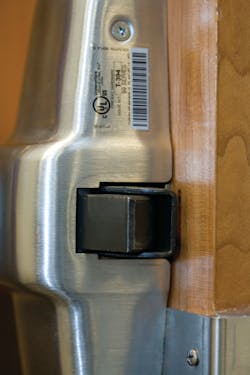
Fire doors must be certified by recognized testing laboratories (such as UL) and must have the laboratory’s certification label.
However, there are situations where even if a door has a label, it may not be fulfilling its intended purpose as a fire door.
When a fire door is open, ajar, or being prevented from closing due to a bad hinge or other obstruction, or if it is closed but not latched, it is no longer a barrier and not fulfilling its intended purpose
When a fire door is damaged so that it does not open, it is an obstruction and a Life Safety hazard.
When the design of the Fire Door assembly has been compromised by alteration or a non-functioning component, it is a life safety hazard, not fulfilling its intended purpose and constitutes a liability to your company.
Fire doors must be self-closing; have proper latching devices, and cannot have been altered by you or anyone else in such a way as to violate the door’s listing in order to provide as much resistance as possible to the spread of fire, smoke, and toxic gasses.
Fire Door Ratings
The location of the wall in the building and prevailing building code establish its fire rating; and the fire rating classification of the wall into which the door is installed dictates the required fire rating of the door.
Typically he door’s fire rating is three-quarters of the wall’s fire rating classification. However, a door with a higher fire rating than the opening requires may also be used.
Steel fire doors are “rated” by the length of time (measured in minutes or hours) that a door can withstand exposure to fire test conditions.
Three-hour (180 minute) doors are the maximum rating for a swinging door.
1-1/2-hour (90 minute) doors are commonly located in stairwells.
One-hour (60 minute) doors are used in walls between rooms.
3/4-hour (45 minute) doors are in walls of corridors and room partitions.
1/3-hour (20 minute) doors are used for corridor applications and in other applications where smoke and draft control is a primary concern.
Twenty-minute doors tested without hose stream have successfully passed a 20-minute fire test, with the omission of the hose stream test, and bear a label that specifically states “Twenty-Minute-Rating Tested Without Hose Stream.”
Temperature rise doors are fire doors with the additional temperature rise rating shown on the label. Temperature rise ratings are 250°F, 450°F, and 650°F. The 250°F temperature rise designation is the most stringent rating as allows the smallest rise in temperature.
Basic Fire Door Requirements
1. A fire door must have a label attached.
2. A fire door frame must have a label.
3. A fire door must be self-latching.
4. A fire door must be self-closing.
5. If a fire door is held open, it must be with a listed hold open device which is connected to the AFP so it releases the door upon alarm.
6. A fire door must be free of any obstructions which could prevent the door from operating properly, i.e., wedge door stops, chains, hookbacks, furniture, inventory, etc.
7. Only listed fire door hardware can be installed on a fire door.
8. A fire door must have steel bearing-type hinges. (Exception: Non-bearing plain steel hinges may be used if they are part of a listed assembly)
9. Doors swinging in pairs that require astragals shall have at least one overlapping astragal. Pairs of doors within a means of egress shall not be equipped with an astragal that inhibits the free use of either leaf. A coordinator or open-back strike should be used to ensure proper closing.
10. Louvers are not permitted to be installed in doors with fire exit hardware or in stairwells.
Every swinging fire door must have a labeled automatic latching device to engage the strike.
Doors which are in the means of egress may have deadbolts only if they are interconnected with the latchbolt. Deadbolts may not be used instead of latch bolts. The required latch bolt length that must be used for any given door is indicated on the fire door label.
Latch vs. Catch: A “push” and “pull” function may be allowed on certain openings. This push/pull function does not include a self-latching device and does not allow a fire door to perform its vital function. Without a latching device the door will not remain closed during a fire.
A catch is a roller ball or similar device which holds a door in a closed position, and is used in conjunction with a pullplate, pushplate or dummy trim, like on a linen closet or pantry.
A latch is a spring loaded device which engages in a strike plate in the door frame. A push pull function is a specialized family of locksets often used in hospitals or health care.
Do not confuse a roller latch which is used with rim exit devices, with a roller catch.
Fire doors must be only equipped with fire listed hardware but not all fire doors may be used with Exit Hardware. Exit devices may be used on labeled doors provided the door labeling specifically states “Fire Door To Be Used With Fire Exit Hardware.”
Doors that are designed to be fire exit doors can only be held open if they automatically release when building fire alarms are activated. Electromagnetic release devices are the only ones which will close quickly enough to prevent the passage of the toxic gases and smoke. These devices are connected to the AFP systems and release their hold upon alarm.
Proper hardware selections can be verified by consulting the current editions of:
“Building Materials Directory” published by Underwriters Laboratories Inc..
“Directory of Listed Products” published by Intertek Testing Services
“Hardware for Labeled Fire Doors” published by the Door and Hardware Institute.
The National Fire Protection Association’s publication, NFPA 80, entitled, “Standard for Fire Doors and Fire Windows” provides guidance for installing fire doors and frames and hardware in the openings of a building.
It is my experience that ongoing study is mandatory in order to maintain an adequate working knowledge and understanding of building and life safety codes. The more you learn, the more you realize you don’t know. This article only scratches the surface of the topic of Fire Doors, and is not intended in any way to represent a complete discussion or final word on the topic.
About the Author
Tim O'Leary
Tim O'Leary is a security consultant, trainer and technician who has also been writing articles on all areas of locksmithing & physical security for many years.