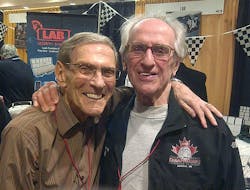
Time has a funny way of bringing you down to earth. I turned 55 this year and suddenly realized I have been working full time for the same locksmith distributor for 33 years and even more if you count when my dad brought me, the little kid, to work to “help him.” I am one of many in the locksmith industry who worked for their fathers and lived through the turbulent changes of the last few decades.
My dad started in the locksmith distribution business seven months after he was married, in February, 1956, almost a year before I was born. Like so many men in the locksmith distribution business, he started as a young man and I eventually did the same. My father, now 80, has lived almost his whole life as I have mine, tethered to the locksmith industry.
Fifty-six years ago, Milt Goldman wrote an ad in the Detroit Free Press in the “Situation Wanted” section, announcing that a “Young Veteran, 24, seeks position, is willing to learn and advance.” On a Sunday in February, 1956, a phone call came from Joe Falk, owner of Hardware Sales and Supply Company, a wholesale distributor of locksmith supplies. He asked my dad to come to his house that day for an interview. Desperate for help, Joe hired my dad immediately. My dad started in the back of the small Detroit warehouse, in shipping, and after a week, got a $5 weekly raise, which was a sign of respect and gratitude and the last raise he got for a very long time.
Hardware Sales and Supply was a small distributor in the 50s and 60s, selling builders’ hardware, key blanks, night latches, die cast rim cylinders, padlocks, door checks, key machines, and hardware specialties from Independent Lock Company, Lockwood Hardware, and others.
My dad told me that locksmiths, before Bill Zipf Sr. introduced .005 pins and pin charts, used pins in nine different lengths and filed them down. He remembers when locksmiths, covered in black graphite, were just repairmen who didn’t charge much for service calls and rarely suggested security upgrades. It was a major change in security, years later, when Kwikset introduced a high quality deadbolt with a 1” throw and reinforced strikes.
My dad was an intense, dedicated, hard-working employee who really cared about Joe and his company. Joe, intelligent, creative (he was also a jazz saxophonist), classy and kind, became a second father to my dad. Joe felt the pressures of keeping the company afloat and once suffered a heart attack right at his desk. He, his wife Hortense, and daughter Nancy, escaped the stress of business by spending winters in Florida. My father was willing and able to run the business and Joe depended on my dad.
Hardware Sales came close to declaring bankruptcy in the 1960s, barely surviving from one customer payment to the next. My father learned the importance of opening the mail, hoping there were orders and checks to keep the bank away. Hardware Sales wasn’t my dad’s company then but he worked as if it were. Joe had saved my dad from unemployment and my dad worked as many hours as necessary to save Joe from bankruptcy.
The business was floundering but Joe found a run-down but larger building close to three expressways that he thought might help. It was on Grand River, one of the major avenues of Detroit, next to the Wonder Bread factory. The year was 1968, one year after the Detroit riots, the same year of Robert Kennedy and Martin Luther King’s deaths, during the same week as the Detroit-St. Louis World Series which Detroit won, four games to three.
I spent some time as a child at Hardware Sales, once when I was three years old, helping to publish its first catalog in 1960 which required stacking each copied page together. I was directed to walk around the room, holding each page in sequence, so it could be stitched together into one binder. A few years later, I worked part-time, putting stock away, picking orders, and shipping them out. I didn’t know where anything went but my dad directed me to find keys, padlocks, latches, or anything a customer needed. I remember organizing the key blank shelves, placing boxes of Ilco, Taylor, and Dominion keys in their right places on the shelves. Often, I’d go to a room filled with keyblanks and pull a case of Ford ignition keys or General Motors A and B.
Steve Dyson, Dominion Lock rep then and now president of IDN-Canada, remembers my dad in those days, roaming the warehouse with his 50 foot telephone cord, waiting on the counter while talking to a customer on the phone, the cigarette smoke drifting from his lips (he smoked 3 ½ packs a day then). These were Steve and my dad’s “mad men” memories.
My father became even more important to Hardware Sales when Joe, the owner of Hardware Sales, died of a heart attack in 1974 while our family was on vacation in Mackinac Island. My dad had to return back to work to face the future, directing its few employees, Ralph, Christine, John, Edie, and the outside salesman, Ramo Belletini. The ownership now fell unto Joe’s wife, Hortense, an eccentric lady who had a canny ability to collect. She pestered past-due locksmiths until they couldn’t take it anymore and finally succumbed to pay.
Hortense wanted to sell the company but she was leery of selling to my dad, who would have to pay her back over many years. Yet, she wasn’t reluctant to sell to my father if he had successful partners. So my father became one of the first partners of Al Hoffman of H. Hoffman Company in Chicago and Virl Mullins of Armstrong’s Lock and Supply in Atlanta. This was the first year of LSDA, the Locksmith Distributors of America, which eventually became IDN. Within a year, there were five distributors linked up in a network, focused on helping each other manage, market, become automated and efficient, eventually buying a computer system when computers were mammoth, slow, had little memory, when Microsoft was a dream in little Billy Gate’s eyes.
When I went to college, I worked part-time for Hardware Sales to bring in extra cash. When I graduated in 1979 with a liberal arts degree, majoring in English and Psychology, my dad asked if I would work full time until I was able to find another job. I wanted to move out of my parents’ house so I agreed but I interviewed at other companies, including Kmart, headquartered in Michigan and the largest retail company in the world. I didn’t want to work for massive companies and so I continued to help Hardware Sales move out of Detroit to the suburbs, to Madison Heights on the northeast side of Detroit.
My friend, Rob, who’d graduated from Wayne State University with me, wagered that I would stay at my dad’s company rather than get a job somewhere else. I bet Rob that I would get a “real job”… and lost.
At first, I was bored by the lock business, wanting to write instead but eventually, I was picking orders, putting away stock, answering phones, taking orders, writing advertisements, ordering stock from vendors and calling to get the orders shipped. I thought I worked hard but never worked as hard as my dad, who started at 6 a.m. and worked all day, a model of hard-charging, high-intensity sales and management. He had a volatile temper at times, scaring some employees and many of the manufacturer’s reps and sales managers. There were many legendary stories about his angry reactions after a manufacturer rep didn’t do what he promised or when a manufacturer’s sales manager was caught in a bare-faced lie.
I worked with my dad after 1979 as did his brother Sid, nephew Fred, and years later, his niece and my cousin, Maureen, a CPA who started in the early 1990s. My father was sometimes tough on employees, especially family, expecting us to be there every day, on time, work hard, be smart, and do the right things. My dad became disappointed if my Uncle Sid said something embarrassing or if Fred gave an extra discount or traveled too much. He got mad at me when I bought too much of a new product that didn’t sell, spent too much time with a rep, or discounted a slow-moving item when it should have been sold at “regular” price. He and I sometimes had arguments that employees could hear throughout the building. Often, when my father overreacted, he would return to apologize, knowing he shouldn’t have reacted so emotionally.
My father believed that locksmiths had great potential to be good businessmen. He preached to them that they needed to be more professional, to present themselves well, inside and out. They should focus, he said, on selling the highest quality products, not the cheapest. “Believe in what you sell,” he told them, “and sell the best locks and door hardware.” He watched the market change as home centers emerged and locksmiths began to sell lower priced, low quality locks and deadbolts, exactly like the big box mass merchants they feared.
Hardware Sales and Supply eventually became IDN-Hardware Sales. My dad retired in 1994, and I took over as president, trying to lead the next generation to survive and thrive in the locksmith industry. Like my father, I witnessed generations come and go as the security hardware industry went through its abrupt changes.
Today, locksmiths and their distributors face intense competition from the Internet, companies like Amazon, Home Depot and Lowe’s, direct sell manufacturers, large integrators, as well as local contract hardware distributors and sometimes lock distributors. It’s a virtual free-for-all in our industry in which small locksmiths and small distributors face huge uphill battles. If you think about the large companies of the past such as Kodak, Xerox, and Borders, you might question if the typical locksmith is going the way of Kodak. We can certainly ask ourselves if the high-tech, high-security, electronic world is passing both the locksmith and locksmith distributor, like digital books did to Borders.
Do we need to analyze history to succeed in the next decades? During the last 55 years, my dad saw extreme changes in the locksmith industry and he knows the future is scary. Yet to this day, he still believes that high quality locksmiths can survive and grow if they act and dress professionally, focus on the best products, give excellent service, and become trusted security consultants to their customers and potential customers.
My father has witnessed generational changes since the early days of Hardware Sales, ALOA and NLSA (later known as SHDA.) Joe Falk of Hardware Sales was a member of both organizations and helped start MMLA (Michigan Master Locksmiths Association). The older generation of Joe Falk, Harold Hoffman, and Ben Silver led to Milt Goldman and Al Hoffman and Bill Silver. Leaders from the older generation such as Sid Schwartz of Security Lock Distributors and Dick Clark of Clark Security Products gave way to the next generation. Today, Ron Weaver from Accredited Lock Supply has his children ready to take over his company and Dan Floeck of H.L. Flake works with his son, Jeff, a young member of SHDA. Al Hoffman passed on IDN-H. Hoffman to his family and now Karen is president, a board member of IDN, as well as president of SHDA. I can only wonder if her two sons and daughter will join her company sometime in the next decades.
Like so many others who ran family businesses, my dad has faced both the joys and tragedies of families. He and my mom celebrated when their daughter, Leslie, married Bruce and when I married Judy in the 1980s. But they also weathered the deaths of my dad’s youngest sister, Shirley, his father, and was struck with tragedy after going to a Detroit Tigers baseball game in July, 1982. Less than a half mile from his home, a young driver slammed into the passenger side of his car, and my brother Kenny died a few hours later. Like Sam Solomon of Hugo Solomon and Sons and Jack Laufer of IDN-Canada, my parents had to face the death of a child, the bitterest of losses. We would never know if Kenny would have worked for IDN since he was only 13 at the time but my brother had the right instincts to be a very good businessman. A few years later, my father also survived the loss of IDN-Hardware’s 50 year outside salesman veteran, Ramo Belletini, as well as his brother, Sid, whom he worked with for many years.
Although my dad was only 63 when he retired in 1994, his leaving the intense stress of full-time leadership may have extended his life. He was able to enjoy spending time with his four grandchildren, Kyle, Ilana, Marlee, and Karenna and didn’t have to worry much about IDN-Hardware Sales. Still, he periodically visits and walks around the company and bursts a few blood vessels, becoming aggravated at the sloppiness and mistakes that still happen too much. Yet today, he is wiser and when he gets too angry or frustrated, he can go home to my mom, the real boss of his household.
My father and I have witnessed a lot in our years in the locksmith industry and have lived through many ups and downs. But I am grateful that he gave me a chance to work with him and succeed on my own. The economic environment was pretty lousy in 1978 when inflation was high and optimism low but that didn’t stop him from allowing his son to join him. We had many arguments, didn’t agree on much, and I caused him much aggravation. Yet, we deeply respected each other and made me eventually realize that love and respect is what is most important in a family business.
Today, I take my dad to kidney dialysis twice a week and because he is not supposed to drive, I sometimes bring him to work with me. He understands how the business has changed, hears about the prevalence of “locksmith scammers,” and talks to some of the old-timers he hired, the locksmiths he knew, and the young ones he never met.
My father still has a gleam in his eye when talking about the locksmith industry. He talks about his old friends, Al and Jerry Hoffman, both who died last year, and his good friend, Dick Tway from Wilson Bohannon, who died many years ago. He remembers legends like George Vilwock, past president of Master Lock, and Aaron Fish of Ilco. And he will never forget his mentor, Joe Falk.
My dad has many friends left in the industry, such as Fred Knoche, owner of Fred’s Key Shop, still in the half-deserted Cass Corridor of Detroit, a mile away from downtown Detroit. Almost every year, Fred, my dad, and I drive around the city, hashing over what it was like when they both worked a mile apart, when the city was alive with people, over a million and a half (now less than 800,000.) People from all over the Detroit metropolitan area worked in downtown Detroit in the 1960s before the ’67 riots decimated the streets of Detroit. Fred and my father talk about the biggest locksmith shops then and the first meetings of the MMLA in the early 1960s, held at Hardware Sales in the Elks Building on Cass Avenue, right on the outskirts of downtown Detroit. We drive around the half-empty streets and witness what had once been thriving storefronts, churches, and synagogues. I can barely imagine the hustle and bustle of a vibrant world that has disappeared.
Fred, my dad, and I go out to eat at a few remaining legendary restaurants and reminisce about old keys and locks and the manufacturers, distributors, and locksmiths who are gone. My dad and Fred talk with nostalgia about the days when they were as young as the locksmith industry. With the help of my dad’s service at Hardware Sales, Fred’s Key Shop started nearly 50 years ago, when Detroit was still strong. It is partly because of their friendship and mutual respect that the locksmith-locksmith distributor relationship held on so much better than the declining economic environment around them.
As a son to a father in the locksmith distribution business, I can only wonder what will become of our industry. Family businesses aren’t as prevalent as they used to be. Kids go to college and become professionals or join tech companies or move away to other states, just to find work. My son works in Chicago as a business consultant and my daughters have no interest in our business either. Still, I hope the threads that kept companies and families together in the last half-century will still be prevalent in the next.
Last year, I wrote about eight great men in our industry who died, some of them friends of my father, passing on businesses to their families. Before that day eventually comes, I wanted to honor my father. He was (and still is) a great husband to my mom, a caring father to Leslie and me (as he was to Kenny,) a wonderful father-in-law to Bruce and Judy and an even better grandfather to Kyle, Ilana, Marlee, and Karenna. Like so many fathers of his generation, first generation locksmiths and locksmith distributors, my dad worked hard most of his life to provide for his family so that there would be something meaningful to give to the next generation…and the next.
We owe so much gratitude to our fathers and mothers for what they have given us. In my case, it wasn’t just my life itself but the opportunity to work and thrive with my father in a relationship industry that is fighting for its own life.
It is our time now to give what we have learned and what we cherish to our children. It is our time.