Powering Up Your Access Control System with Command Access
OK, you have to install a single door electromechanical access control system. You have decided upon the lock hardware and the credential reader/controller or standalone. Most of these products require direct current (DC). Electric strikes depending upon the solenoid will operate on either AC or DC or both. Electric strikes that are operated on AC buzz when power is applied, notifying the user when the door can be opened. However, this buzzing eliminates the possibility of operating an AC electric strike as Fail Safe.
You need a power supply to complete the package. The wire run has been determined in order to calculate the total amperage requirements. What is the output current required? What size and type of power supply do you need? Aren’t all power supply pretty much the same and only vary by the amperage? The short answer is no. There are different types of power supplies better suited for specific applications.
This article will provide answers for a better understanding of power supplies and their differences in relationship to lock hardware and locksmiths. We will start with the basic: “What is a power supply?” For the purpose of this article, we will base our discussion on direct current power supplies mounted into enclosures that provide filtered and regulated power.
A power supply takes the basic input power and converts the voltage and current characteristics to provide continuous power output at a specific amount in order to accommodate the operation of the electromechanical equipment. Most electromechanical locks, readers and keypads and 99 percent of all electric latch retraction operate on 24 Volts Direct Current (VDC), the voltage of choice for most companies supplying access control hardware. Some products operate on 12VDC or 12 to 24 VAC/VDC. Alarm companies more commonly use 12VDC, as their products require very little current.
Note: There is an advantage to using 24 volt access control hardware. It requires roughly half the amperage of operating using 12 volt hardware. Low amperage cooler, more efficient operation.
Power supplies provide specific voltages at different amperages. For example, filtered and regulated power supplies are available with usually a minimum of one Amp to five Amps or more.
When designing an access control system, there are a number of considerations regarding the power supply. Most power supplies have a fixed output. Some power supplies have a potentiometer to adjust the output voltage to about ten percent over rated. Some power supplies with battery backup have two channels, one that output the specified current and a second that has outputs upwards of ten percent above the specified in order to charge the batteries.
An improper power supply can result in a mal-functioning or inconsistent functioning system, as there is not sufficient amperage provided to properly operate the locking mechanism(s). Even worse is the early demise of sensitive electronic components resulting from too much voltage. This can result from a power supply whose output voltage is not within the tolerances of the components, or by a single output power supply where battery backup is required and the components are sensitive to voltages above twenty-four.
This can also result when a power supply does not provide “filtered and regulated” current, which many components require for optimum operation. An unregulated power supply will output its rated voltage and current only when under load. With no load (power off), the unregulated power supply’s output will be greater (when power is turned on), resulting in possible damage to sensitive electronic components.
Sensitive active components are electronic devices that require a certain minimum voltage or current, to perform a function, such as controlling the flow or direction of current. These devices include relays and are very sensitive and susceptible to damage from overpowering during start up, static discharge or kickback voltage that can occur when powering down.
Electrified lock mechanisms require different amounts of amperage. Electrified mortise locks, cylindrical locks, magnetic locks, electric strikes usually require low current DC, requiring almost no surge (inrush) current. The same is true for keypads and readers.
The reason is the size of the solenoid and operation of the electronics. Most electrified locks are controlled by a solenoid that either locks (prevents) or unlocks (allows) the mechanism by moving the locking bar/tail piece into or out of a stop position. The solenoid does not move any part of the latch mechanism.
Electric latch retraction products have a larger, more powerful solenoid that actually retracts the latching mechanism, which is either the latch or the rim device bolt. They require a significant amount of surge current to get the solenoid armature and latching mechanism moving. Because the solenoid is larger having a larger coil, it will also require greater holding current (amperage) to keep the latch retracted permitting the door to be opened.
Surge current is short duration (less than one half a second), high amperage current draw by an electrical device when first operated. For example, the surge current provides the amperage necessary to start a large solenoid moving from the latched to the unlatched position. Once the solenoid has moved, it does not require high amperage current draw to remain in the unlocked position.
Most electromechanical lock mechanisms, keypads and readers have their power requirements printed on the advertisement or at a minimum, the installation manuals. For example, a continuous duty solenoid for a non-inrush applications typically requires 150-350mA @ 24VDC to operate the solenoid. The actual amount is determined by the characteristics of the solenoid and the specific application. The holding current for the solenoid would be the same.
However, to retract a typical latch retraction device would require high in-rush of 12-16 Amps @24VDC for 150-500 milli-seconds. Once the latch has been retracted, the holding current would be 125 to 500mA. Holding current keeps the latch retracted.
To choose the proper power supply, we need to understand how they operate, the ratings of the power supply, the type of power supply and have an understanding of the major components that make-up a power supply.
At this time, we should discuss “filtered” and “regulated” power supplies. “Filtered” power supply means the output voltage current that leaves is for all intent and purposes direct current (DC). However, the output from a switching power supply and a linear power supply are different as different methods are used to “filter” the output.
A “regulated” power supply is designed to maintain constant output voltage under changing load. The regulated power supply monitors the load condition and makes modification to minimize variations. All power supplies are rated to a + voltage and current percentage.
UL294 is the typical testing standard in the Access Control arena. The test protocol verifies the durability and dependability of the power supply through variety of tests including extended “fully loaded” duration, electric shock resistance, and battery backup (if applicable) conditions. UL294 compliant power supplies will be filtered, regulated, and include an indicator showing the presence of power from outside the enclosure. UL 294 Power Supplies are rated at +10 of the stated voltage.
A power supply consists of a transformer and the circuitry necessary to provide the amperage and the “clean” current. The transformer can be the largest component of the power supply. A transformer is a twin coil wired apparatus for reducing or increasing the voltage of alternating current. For access control applications, it lowers the voltage from the AC line current to the usable voltage. Every power supply has a reducing transformer that converts the AC line current to 12, 16, 24, or 48 VAC depending upon the transformer’s design. Some power supplies offer the ability to have multiple voltages, such as twelve and twenty-four volts.
Once the voltage has been lowered, the power supply electronics changing the voltage from alternating current to variations on direct current. The type of power supply describes the method used for the conversion. There are linear power supplies and switching (switch mode) power supplies. A linear power supply creates “straight line” direct current (battery power). Linear power supply operation is less complicated, produces cleaner power, and is not as susceptible to producing electrical noise problems.
A switching power supply creates pulsing current by having full wave rectification. A switching power supply turns on and off, removing the lower portion of each alternating current wave. The switching power supply is more energy efficient and produces less heat during the conversion to direct current. A switching power supply is chosen over a linear power supply when higher efficiency, smaller size or lighter weight (smaller transformer), is required.
If you have a 24 VDC power supply, you want to have an output very close to 24VDC even when there is current draw such as the lock mechanism being powered in order to gain access. A switching power supply is susceptible to having poor (low) power factor. A low power factor draws more current resulting in overpowering. To compensate for overpowering which results from a large in-rush current draw, a switching power supply would need to have large capacitors.
Switching power supplies and linear power supplies operate differently to get to the voltage and amperage specifications. For the purpose of this article we will discuss how a linear power supply operates
When AC line power enters a power supply, there can be an input fuse. Two common types of fuses are used by power supplies. The glass fuse that blows immediately after the current exceeds the specified value. The PPTC device (also known as resettable fuse) is a self-resetting over current protector that stops the current flow when a short or high amperage current inrushes by expanding and opening the circuit. Once the over current stops, the resettable fuse reset permitting the flow of current. The purpose of an input fuse is to protect the power supply and the connected electronics from an incoming surge. In addition, this fuse can protect the AC line from a short within the access control system.
From the input fuse, the AC line current goes to the transformer. The linear power supply transformer changes the input voltage to the desired output (24V) voltage.
The linear rectification components convert the 24VAC to continuous 24VDC. Note: There can be additional circuitry in the power supply to remove any AC current remaining after the change to DC.
The current flows into a large single capacitor or twin capacitors that regulates the output voltage variations. A capacitor is like a temporary battery. It fills up with current and release initially when the load is powered and additionally in order to maintain the specified current.
The additional circuitry of the power supply monitors the output voltage and makes adjustments. It controls the operation capacitor(s), and if the power supply is equipped with battery backup, battery power can also be drawn upon to maintain the constant output.
Protection can be built into the power supply to prevent damage to the attached hardware and the power supply itself. If too much current or power is drawn, the over protection (feedback) circuitry will either shut down the power supply or attempt to make adjustments. In addition, there can be circuitry that recognizes stable power.
This can include glass or resettable fuses attached to each output or one fuse for all outputs. If constructed with a fuse at each output and there is a problem with a specific door, only that output will stop providing power to the door. All other doors will still be powered.
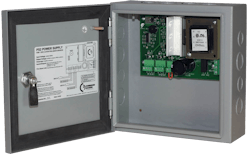
Looking at power supplies manufactured by Command Access, we can see 24VDC linear and switching power supplies ranging from one Amp to five Amps. Each power supply comes with a three year, “no hassle” warranty. All of the power supplies are equipped with Euro style connectors that are removable for ease of connecting wires. They are also equipped with a light pipe that indicates if there is power. A light pipe is a standalone piece of optics that draws the illumination from within the enclosure. The other end is visible through the hole in the enclosure notifying there is power. The light pipe eliminates wiring from the circuit board to the enclosure door.
Command Access linear power supplies are UL 294 Listed, and most are CSA International Certified. The solid state design of these linear power supplies eliminates mechanical relays, providing dry contacts to trigger the input of current.
The Command Access switching power supply, SW4, is rated at 2.4Amp @27VDC continuous power output. The output voltage is adjustable from 24 to 27VDC. There are four fused solid-state inputs and outputs.
The SW4 is designed for solenoid lock/unlock operation in mortise, cylindrical or exit device trim having each of the four outputs rated at a maximum of .6Amp each. There is an alarm link for connection to a Fire Department panel.
Linear power supplies are available with one Amp to five Amps. They are designed as an “all around” power supply able to provide the necessary high current in-rush for powering electric latch pullback, as well as providing “safe” power for electrified locks, electric strikes and magnetic locks. Some of the linear power supplies are equipped with adjustable output voltage, battery charging and multiple outputs. All of the linear power supplies are equipped with a light tube indicating operation when the enclosure is closed.
The Command Access PS1N one Amp, single solid state input/output linear power supply produces 24VDC of filtered and regulated power using a 56 watt transformer. The input is designed to be triggered by a dry contact. Having one large capacitor, the PS1N can deliver the high current in-rush necessary to operate one or two simultaneous electric latch retraction exit device(s).
The PS2 and the PS2BB are two versions of the two Amp power supply. They have sufficient power to operate two latch pullback exit devices using the two independent inputs/outputs. These power supplies are equipped with one large capacitor to insure sufficient inrush surge. The circuit board is equipped with thermal overload sensing. This reduces the risk of failure due to overheating and intelligent short circuit detection and isolation that detects shorts faster fuses.
The PS2 does not offer battery backup and comes in a 10” by 10” by 4” enclosure. The PS2BB offers battery backup/charging circuit with zero voltage drop at power loss. There is an audible alert when the power supply circuitry senses AC power failure and low battery. Battery backup requires two 12V 7Amp hour gel cells that are purchased separately. The PS2BB comes in a 12” by 15” by 4” enclosure.
There four versions of the PS5, a five Amp @ 24VDC linear power supply equipped with a battery charging circuit. Batteries are charged at 27.6VDC, while the output voltage is adjustable from 24 to 27VDC.The power supply options vary by the number of inputs/outputs. The PS5 has one (output only), the PS5-4 has four, the PS5-6 has six and the PS5-8 has eight independent inputs/outputs.
The total output rating is five amps and is divided by the number of outputs to determine the amperage per output. For example, the PS5-4 has four outputs, each have an output rating of 1.25Amps with the PS5-8 having each output rating at .625Amps. The solid state inputs are available as dry contact sensing only. Two large capacitors provide sufficient inrush surge for multiple electrified latch retraction devices.
Choosing the right power supply varies depending upon the manufacturer and the type of lock(s) and access control hardware. The wire run can also be extremely important if there is significant distances. Note: In a future article, we will discuss wire and cable.
To eliminate problems before they occur, factor in at least 10 percent more amperage than the requirement of the electrified lock hardware and an additional 10 percent for variation in the power supply. In power supplies, it is better to have extra power.
For more information, contact your local locksmith distributor or Command Access Technologies, 22901 La Palma Ave., Yorba Linda, CA 92887. Web Site: http://www.commandaccess.com.
About the Author