High Security Cylinders and Keys Go Electronic
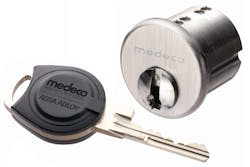
The evolution of mechanical locks into electromechanical locks has been occurring for more than a quarter of a century. The electromechanical lock offers many benefits that are not possible controlling access with a mechanical lock. Many of these locks have the ability to control access via time schedules and groups, multiple credentials, thousands of different User Codes, biometrics, etc. Electromechanical locks offer audit trail, the ability to know who (by the credential) and at what time successfully gained access or was unsuccessful. Because of these technological advances including wireless networking, locksmiths are now able to compete on a more level playing field, having the ability to sell and install many of these access control products.
With most electromechanical locks, it has been necessary to replace the mechanical locks in order to in order to gain electronic access control. However, for about the last decade, electronic lock cylinders have been available as an alternative to the electromechanical locks. These lock cylinders are electronic versions of mechanical lock cylinders. Like a mechanical key, the electronic lock cylinder requires physical connection with the electronic key at the contact position in order to transfer the electronic data.
Not only can electronic lock cylinders control access 24/7/365, but depending upon the manufacturer, they can implement a key’s start and termination date, limit which keys can operate what cylinders, track what key has gained or been denied access, provide time and date stamps, and provide day and time scheduling. In addition, electronic lock cylinders and the electronic portion of the keys can each be interrogated to determine who did what.
Electronic lock cylinders cannot be picked like a mechanical lock cylinder and the electronic keys are designed to be individually unique, and not be duplicated through unauthorized means.
Electronic lock cylinders are manufactured to specifications that enable them to replace existing mechanical lock cylinders. Depending upon the electronic cylinder manufacturer, they are available for key-in-knob, key-in-lever, mortise cylinder, rim cylinder, removable core, interchangeable core and padlock configurations. Contact the manufacturer and determine what core and cylinder configurations are available in order to meet your customer’s applications.
An electronic lock cylinder replaces only the mechanical lock cylinder, converting existing mechanical locks into an access control system. This lowers the costs of conversion to electromechanical access control, as existing lock hardware does not have to be replaced. The cost of an electronic key is more expensive than the cost of a proximity or smart card.
No wiring is required. Some electronic lock cylinder manufacturers require batteries, other do not. Since the electronic lock cylinder is only a lock cylinder, it maintains the opening’s fire ratings.
Two basic types of electronic keys are used to operate the electronic cylinders - those that have an operable mechanical key blade and those thats key tip aligns the electronic contacts between the cylinder and the key. Having an operable key blade can enable the key to operate mechanical locks having the same keyway and corresponding bittings. Eliminating the keyway provides protection against debris being inserted.
To simplify terminology, we will use “duality key” to describe an electronic key that has a mechanical blade. The mechanical blade can be cut in order to operate mechanical lock cylinders. This enable a “duality key” to operate a mechanical lock (i.e. master key system), electronically operate a mechanically combinated electromechanical lock and in some case, electronically operate with a card reader.
Depending upon the electronic lock manufacturer and the electronic system, electronic keys could be used to operate as RFID, 125 kHz proximity and/or 13.56 MHz Smart Card iClass electronic access systems.
A duality key access control system can be used as a standalone system or an interim system during a conversion from mechanical locks to electromechanical locks.
Videx and Medeco offer electronic lock cylinders and keys. For the purpose of this article, we will discuss the Videx CyberLock and the Medeco M3Logic™.
Medeco Logic, M3 Logic
ASSA Abloy companies offer a variety of electronic cylinders and keys, each designed for specific purposes. For this article, we will discuss the Medeco Logic including the M3 Logic.
Medeco Logic is a new retrofit electromechanical product consisting of digital keys and digital cylinders. The Medeco M3 Logic offers access control functionality with features like time date scheduling, audit trails, and adding and deleting user keys without wires. The M3 Logic commercial and residential cylinder options include rim, mortise, KIK/KIL, large format interchangeable core, deadbolts, padlocks, and cam locks. Lock cylinders are available with optional hardened steel nose. M3 Logic cylinders are available in standard finishes and are weather resistant. Medeco M3 Logic mechanical and electronic technology maintains patented key control.
The Medeco M3 Logic takes keeps the mechanical lock mechanism and adds electronic capabilities. M3 Logic cylinders have built-in electronics packages. The package communicates with the electronics in the key when the key is inserted. When a properly programmed key is inserted into a compatible lock cylinder, it activates an electric motor that retracts the electromechanical blocking element. Once retracted, the key is then able to operate the lock cylinder as long as the key is cut to bitting of the mechanical lock cylinder.
M3 Logic lock cylinders can be keyed into an existing Medeco3 master key system, expanding the capabilities and the level of security to those doors that require knowing who entered at what time. Beyond existing master key systems, the Medeco M3 Logic key can be also include an optional RFID coil that will allow it to be read by card readers and RFID electronic locks.
Medeco M³ Logic combines Medeco mechanical M³ lock mechanism with ASSA Abloy Cliq™ electronic technology. Cliq is an electronic access control system designed around mechanical lock cylinders and keys with the ability to communicate and control user access rights, time and date in a 6-Bit DES encrypted data stream between the key and the cylinder. Cliq technology is built into modified mechanical lock cylinders requiring a properly programmed and correctly cut key blade to operate the mechanical-electronic lock cylinder. Cliq is proprietary to ASSA Abloy.
The Medeco M3 Logic cylinder has the capability of storing 1,000 groups per cylinder having 1,000 keys per group. M3 Logic cylinders store the most recent 750 audit records. M3 Logic cylinders are reprogrammed using software and an administration key.
A CR2025 lithium battery having a 20,000 cycle/2 year average life powers the M3 Logic key. An audit key can retain up to 2,000 audit records. The M3 Logic key has an RFID/Proximity coil insert for dual use with Logic lock cylinders and HID compatible reader equipped systems. The inserts are temperature rated for -20 ° F to +122 ° F.
Medeco offers a two-year warranty against manufacturer’s defects for the M3 Logic products.
For more information contact your local locksmith wholesaler or Medeco, 3625 Allegheny Drive, P.O. Box 3075, Salem, VA 24153-0330. Telephone: 800-839-3157. Web Site: http://medeco.com.
Videx CyberLock
The Videx CyberLock, first introduced at ASIS 2000, is a mechatronic (a portmanteau of the words mechanical and electronic) lock system that converts existing mechanical locks into an electromechanical access control system. The Videx electronic lock cylinders, programmable keys and CyberAudit-Web software combine to control access.
The CyberLock electronic cylinders retrofit mechanical lock cylinders. There are mechatronic cylinders for door lock hardware, cabinetry, safes, padlocks and vending machines. The door lock hardware mechatronic cylinders retrofit Schlage® six-pin and Yale® six- and seven-pin K-I-K and K-I-L lock cylinders, mortise and rim cylinders, small format interchangeable cores and Schlage large format cores.
CyberLock electronic cylinders install without batteries or wiring. The power required to operate a lock is provided by the CyberKey’s battery. The contact portion of the CyberLock key appears similar to a modified tubular lock key. The tip of the key fits into the face of the mechatronic cylinder.
There are no mechanical tumblers in the lock cylinder or mechanical bittings in the CyberKey, making the cylinders pick and forced rotation resistant. Each CyberLock key has it own specific identity that provides a unique record when operating a mechatronic cylinder. CyberKeys can be programmed with access privileges during specific days and times. According to Videx, a CyberKey holds a list of up to 3300 lock cylinders it may operate as well as the schedule of the days and times. A master CyberKey can be programmed to operate as many lock cylinders as is part of access control system.
The Videx CyberLock system is based on encrypted, proprietary technology. When a CyberKey inserted into a CyberLock cylinder, the battery in the key powers the circuitry in the lock cylinder. The key and lock cylinder exchange identification (ID). The CyberKey checks that the lock ID is in its list of lock that can be operated. At the same time, the key checks that it is the proper day and time. And the final part of the handshake is when the CyberKey and CyberLock cylinder compare access codes to verify they are programmed to the same system.
If everything is satisfactory, the key gains permission to operate the electronic lock cylinder, which in turn operates the lock mechanism. An authorized to open event is time stamped and stored in the key and the lock. If not, the key is denied permission and a denied event is time stamped and stored in the key and the lock.
The key records up to 3900 of the most recent access attempts and events containing the lock identification, date and time. The lock records up to 1100 of the most recent access attempts and events containing the key identification, date and time.
Weather resistant CyberLock electronic cylinders control access for both exterior and interior doors. The CyberLock cylinder-equipped lock hardware operates as designed; the addition of the electronic cylinder does not alter the functionality.
The keys and electronic cylinders are programmed using Videx CyberLock software. There are three levels of the CyberLock software. Two of the levels, Lite and Professional, accommodate most locksmith applications. The CyberAudit-Web Lite software installs on a local PC or Mac and is intended for managing small, entry level installations of up to 50 locks and 50 keys. Lite provides the basics of access control: setting schedules for access, retrieving the audit trails from locks and keys, setting expiration dates on keys, and setting holidays. Management of locks, keys, and schedules is done using a matrix view; the schedule that a key will use to open a lock is added where the key and lock intersect on the matrix.
CyberAudit-Web Professional software installs on a PC, Mac, or server for managing approximately 500 locks and 500 keys. Professional builds on the Lite’s functionality and adds setting multiple-key mode and delay opening on locks for high-security applications, grouping locks and people, blocking and disabling lost keys, creating report templates, and receiving email notification of flagged events, key battery status, and key expirations.
A standard CyberLock system includes cylinders, keys, a Grand Master key, communicator(s), and the software. The Grand Master key is used for programming additional locks and keys and downloading audit events from locks.
The communicators are the interface between the CyberLock hardware and the management software. CyberKeys upload and download information using a communicator that includes updated program information and renewed expirations, and audit trail data. The Videx IR Encoder and USB Station Basic communicators are used at a computer or workstation. Remote Authorizers, Web Stations, and key vaults may be installed at remote facilities. They communicate with the system software over the internal network or the Internet.
The Videx CyberLock Product Warranty provides repair or replacement of Videx hardware at no cost during the first year. After the first year, Videx has a graduated service fee that includes a renewable warranty. For more information, contact Videx, 1105 N.E. Circle Blvd., Corvallis, OR 97330. Telephone 541-738-5500. Web Site: www.videx.com.
To read additional Locksmith Ledger articles on Medeco products, visit http://tinyurl.com/medeco0112.
About the Author