Selling the Right Safe for the Right Application
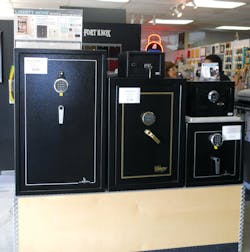
For this article, I spoke with an expert who has been selling safes for much of his life. He began his career working for a major safe manufacturer and is a locksmith company owner. Now, he is successfully selling safes in multiple showrooms, at a variety of venues and on the Internet. He says that the main competition for locksmiths are the club, hardware and big box stores.
I have put together a number of his techniques and beliefs about the best way to sell safes to make money and have satisfied customers. For this article, we will discuss selling safes from a locksmith store that has a safe showroom. A safe showroom can be just a portion of the customer’s waiting area or as much as a dedicated room.
To begin, the showroom should appear to be a fully supplied, clean and the safes dusted regularly. Safes that do not have wheels can be mounted on wood pallets, which make it easier to move them in and out of the showroom.
A well-appointed safe showroom provides the image to the customer that there are choices available even if there are not a lot of safes. If possible, obtain examples of safe locks, cutaway section of safe bodies, color and finish charts, etc., that provide an opportunity for the customer to understand some safe basics. Add a picture or two and some homey touches to create a comfortable shopping environment for the customers.
Types of Safes
Important rule #1 Most customers think there is only one kind of safe.
There is not one kind of safe. There are fire safes and burglary safes and composite (fire and burglary) safes.
A safe, be it designed for burglary or fire or burglary and fire, provides protection in the way of time preventing access to the contents. A fire safe protects the content against heat for a period of time. There are media safes, data safes and fire boxes designed to protect paper. A burglary safe provides protection against forced and surreptitious entry for a period of time. Some safes provide the greatest protection from frontal attacks. There are safes that provide equal protection on all six sides.
To help your customer begin to understand that there are different safes, display printed information on every safe in your showroom. The printed information can be placed within a clear plastic magnetic holder for presentation and to keep it clean. The information should include the manufacturer, model, inside and outside dimensions, cubic feet, the weight, ratings and price. The price can include a retail price and the selling price. This way the customer can do some comparison-shopping as well as ask questions about ratings.
When pricing a safe, do not use percentage for a discount if you offer one. Use a dollar amount so you will know how many dollars you are giving away and how many dollars the customer is saving. Dollars sound better to the customers than do percentages.
Another thing to consider when pricing your safes is “taking off the curse.” Always use cents in the price of the safe or any other product you are selling. The psychological value causes many people to see the lower price.
Bigger Is Better
Important rule #2 No one has ever bought a safe that is too big.
Your job is to sell the customer a bigger, better safe. In the long run, they will be happier. A safe can be a lifetime possession. Customers come into your showroom usually wanting the minimum safe. If they end off buying the minimum safe, they will almost always outgrow it and become unhappy and blame you.
Sell your safes the same way car dealers sell cars, motorcycles, SUVs and trucks. They show the customer top-of-the-line, full-featured vehicles. Begin by showing the customer the full featured, more expensive safes. By showing the expensive safes, show them the lower priced safes with fewer features. By this time, the customer may have fallen in love with some of those features only available on top-of-the-line safes. Remember: It is easier to step down to a less expensive safe than it is to step a customer up to a better and stronger safe.
How do you begin the conversation? Some people are very uncomfortable discussing their need for a safe. Begin with standing in front of the customer, not behind the counter. The first question to ask in a sincere tone is “Have you looked at any safes yet?” The answer will provide you with a lot of information. Most people get their first look at a safe at a club store, big box store, hardware or office supply. Some have their first look at safes on the Internet. The answer they provide will tell you who your competition is and a suggestion of how to proceed.
The next question to ask is “How large a safe do you think will contain the possessions?” Follow up by explaining that safes have different ratings, for fire and burglary protection. You need to know at least the basic different fire and burglary ratings to guide your customer to the right safe for their intention.
Fire protection ratings are available on some safes that offer fire protection. Some safe manufacturers have their fire safes tested by Underwriters' Laboratory (UL) or other nationally known independent testing laboratories. Some independent testing laboratories offer different standards than UL. Some manufacturers perform their own testing and others claim their safes are built to certain standards. Tested safes that have met standards will have a testing agency label. Tested safes are not necessarily more expensive than untested safes. You can sell a safe on the ratings.
Note: Most insurance companies require the appropriate UL burglary rating on the safe in order to obtain coverage.
UL Fire Ratings
UL has three important fire ratings for locksmiths.
-
Class 350 rated safes are designed to protect paper products.
- Class 150 media safes are designed to protect magnetic tapes and photographic film.
- Class 125 data safes are designed to protect flexible computer disks. The class number relates to the temperature protection.
For example, a UL Class 350 2 hour fire rated safe protects the content to external temperature of over 1700 degrees F, maintaining an internal temperature below 350 degrees F for at least two hours. Paper will spontaneously combust at from 400 to about 450 degrees Fahrenheit.
After you explain the different ratings, ask the customer about the stuff he or she wants to protect. Does he or she want to store papers, media, guns, gold, jewelry, etc.? What is the approximate street value of the stuff that will be put into the safe as well as the approximate cubic feet of the stuff?
Remember, most safe buyers will most probably require a safe that is at least 50 percent bigger as people realize how much stuff they want in a safe once the safe is at their home and they are starting to fill it. Do not push the sale to a larger safe. Just mention it. Pushing the customer will probably kill the sale, as the customer will think you are up selling for greater profit.
Most of today’s safes are dual purpose; they provide both fire protection and burglary protection. However, you need to discuss the safes’ ratings, as a safe purchased to protect $10,000 will be very different from a safe protecting $400,000.
Suggestion: Occasionally go to the office supply stores, big box stores and clubs to check out the safes being sold. This way you can determine their pricing and what makes and models are being sold and what their warranties are.
Remember to sell the safe by focusing on the features and benefits. You are a safe expert and you choose the makes and models to sell that are best for your customers. The other guys sell safes as a commodity, probably having a purchasing agent negotiating the deal by removing features in order to lower the price.
Lock Options
Safes are available with mechanical locks and electronic locks. The basic differences are the simplicity of operation and the functionality. A mechanical lock requires rotating the dial left and right for specific number of rotations to specific numbers. Messing up on either the number of rotations or number will result in the safe not unlocking. An electronic lock requires entering a valid code onto the keypad and/or placing a finger into a biometric fingerprint reader. Fingerprints are enrolled or deleted from the keypad's database.
Enter a valid code and/or presenting a fingerprint and the electronic lock will unlock in much less time than what is required to unlock a mechanical lock. Having an electronic lock is an upcharge.
Delivery
Important rule #3. Never give free delivery.
If you offer free delivery, everyone will take it. If you sell 20 safes, you have to deliver 20 safes. If you charge for delivery, about 50 percent of the buyers will pick up their safes.
If you deliver the safe, you are responsible until the safe is delivered and installed. If they pick up the safe, the customers are responsible once the safe has been loaded onto their vehicle.
If you deliver, set your fees on the weight of the safe and include a mileage radius. In a large metropolitan area like Los Angeles, basic mileage can be about 25 miles or less. If you are in a smaller city or rural area, mileage can be 100 miles or more. This is because of traffic in a heavily populated area driving 25 miles can take as much time as driving 100 miles in a rural area.
Never discount delivery because a customer is just down the block. The same amount of time is required to load, unload and install a safe, no matter how far the truck travels. Nor should you try to get rich off delivery.
Your competition in most instances offers “Curbside Delivery,” which is included in the price. This means delivery made to the curb at the end of their driveway, leaving the customer to move the safe the final distance and into the home or garage. However, for an additional fee, usually significant, the service will bring it into the customer’s garage or home. Many delivery services do not offer unpackaging, set-up, instructions, packaging removal or bolt down services. Plus delivery can be a number of weeks later.
Before determining the price of delivery, determine if the safe will be on the ground floor or an upper story. If it is being installed onto an upper story, will the floor support the weight? Will the safe fit through the doorway?
Bolting down a safe provides additional security by keeping the safe in one place. UL considers safes that weigh less than 750 pounds to be portable. Bolting down a safe dramatically increases the security. Many safes can be relatively easily opened once they have been laid on their back.
If the safe is to be installed onto a concrete slab floor, using a hammer drill and a good quality concrete bit, bolting down a safe takes little time. Be sure to have a vacuum to collect all of the concrete dust. On a wood floor using the proper anchors can secure the safe.
As a final note, I was told about a Dean Security video that shows how to bolt down a safe onto a concrete slab floor. Here is the link: http://www.youtube.com/watch?v=TZ1BS2AOOWo
Today’s Burglary Safe
Safes have changed over the last 40 or so years. Back in the early days, burglary safes were either made of cast metals very thick in the form of a cannonball or plates safes that used thick metal plates for the sides and the door. At times the plates used were more than one inch thick.
Unfortunately, some manufacturers of plate safes did not prepare the plates to obtain the best welds possible. A surface fillet weld would be used only on the outside. Then the surface would be ground flat. Putty would be used to fill any voids. And finally the safe would be painted.
As a result the weld would not fully fuse the plates together. Using a wedge or cold chisel and a sledge hammer, a burglar could literally separate the top of the safe from the sides and back. Once the welds were broken, the top could be removed and there was access to the safe contents. See photos of just such a burglary.
Some of the more proactive safe manufacturers would chamfer the edges of the plates in order to provide greater surface area. This would create fillet welds that would fully incorporate the edges of the plates. This method of production ended the popping of the tops.
About the Author