Hardware Designed to Keep Vandals Out
Although we usually think of older products as better made, this is not necessarily the case in all security hardware. While some mortise locks and unit locks are many decades old and still working fine, today's manufacturers are designing and introducing stronger and more vandal-resistant hardware.
In 1989 the Americans with Disabilities Act (ADA) was passed. The biggest impact on the locksmith industry was the proliferation of lever handle locks. On the positive side, the lever made it possible for persons with disabilities to gain entry to an unlocked door simply by pushing down on the lever. By its very definition, the lever added leverage that was missing in a knob lock.
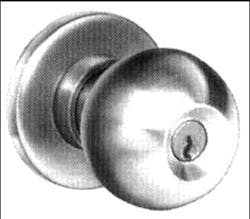
A knob lock by design requires a gripping action to gain leverage. After gripping the knob, the wrist is turned to gain entry. Unfortunately, a disabled person with limited use of his or her hands could have difficulty gaining entry in a door most of walk through without a second thought. (Photo 1) Since a lever is designed to increase leverage, entry through the same door is made easier as a result of the ADA.
With the good news of easier access came the bad news of easier break-ins. Vandals and other unauthorized individuals quickly realized that levers were easier to defeat that most knobs. To defeat a knob, a small pipe wrench or similar tool was required to force the knob. The wrench gripped the knob and provided additional leverage to overcome it. This resulted in the need of carrying a large, bulky tool, which is very difficult to explain starting with "Officer, I was just …"
The lever had its own built-in leverage. By using a downward kick, the lock could be easily forced open. No wrench or other tool was required -- just stand on the lever.
Another disadvantage soon became apparent. By simply replacing the knob with a lever, the return springs soon wore out. The additional downward force resulted in drooping levers. Some major manufacturers experienced spring failures on locks that had been in the field for only a few months. If the droop was severe enough, the exterior lever had to be lifted up just to push in the inside locking button.
Levers come in various styles, but two distinct types: straight lever and return lever. The straight type lever may be curved in style but has no return at the open end of the lever. (Photo 2) The return type lever has a portion at the open end that returns toward the face of the door. An open ended straight lever can snag clothing, hoses, straps or loose items easily. The return is designed to keep clothing or fire fighter equipment from becoming caught on the lever. (Photo 3)
Some levers meet ADA code; some meet fire/life safety code; some meet both and some meet neither. The straight type lever meets ADA code if the lever is long enough to allow four fingers to grasp the lever without slipping off the end. The return type lever meets fire code if the return portion returns to within one-half inch of the face of the door. Most Grade 1 and Grade 2 commercial levers with a return will meet both codes. Some small Grade 3 residential levers have a return but may be too short to meet ADA requirements. (Photo 4)
NOTE: If there is any question in your mind, always check with the local Authority Having Jurisdiction (AHJ) to be sure the hardware you suggest or install meets all applicable codes and laws regarding ADA and Fire, Life Safety.
Lever manufacturers eventually solved the spring problem by designing larger escutcheons with spring cages inside. The addition of two through bolts also strengthened the lock mechanism. Depending on the manufacturer, the two through bolts might be positioned at 12 and 6 o'clock, at 10 and 4 o'clock or at 1 and 7 o'clock. Some of the new leversets have the ability to place the through bolts in different positions to accommodate an existing installation. Replacing a knob lock usually did not require drilling additional holes in the door. Sometimes replacing one lever with another requires re-drilling two or more holes.
Another lever design is used in high-traffic, but mainly detention applications. In this instance, the lever actually returns into the large escutcheon plate and is interlocked. The plate has a raised, arced slot that the lever end rotates through. (Photo 5)
Most lever locks today are available in a rigid or clutched design. The rigid design lever is fixed in place when the door is locked. It has limited vandal resistance, but is a good choice for many internal doors.
When locked, a clutched lever will move through its intended arc but will not withdraw the latch. The clutched levers usually cost a little more, but are free moving when the door is locked. This free motion is accomplished is one of two ways. In one, a simple clutch separates the locking mechanism, but if the lever is drawn to the end of its arc, continued pressure may cause the lock to be forced open. In a better design, the lever reaches a positive stop or solid fixed block at the end of its travel. Continued force may break the lever handle but will not open the door.
Some lock manufacturers have redesigned their mortise locks to accommodate lever handles. In some mortise locks with lever handles, damage may occur to the spindle but not the lock. Also, forced rotation will not cause the mortise lock to retract the latch bolt.
Other security hardware designed to increase protection from vandals include:
- Hardened Collars – The standard thin trim ring collars for mortise cylinders can be replaced with a solid, hardened steel collar. This prevents the use of a wrench or pliers to twist the cylinder out of the lock body, allowing easy entry by manipulating the inner lock mechanism. (Photo 6)
- Drill Resistance – Some medium and high security locks use anti-drill pins in their lock cylinders. The placement of these pins resist drilling the shear line and/or sidebar. The hardened pins or discs deflect the drill bit or cause it to break. (Photo 7)
- Latch Guards – Latch guards protect the latch or bolt mechanism from attack by covering the area with a thick steel plate. Some offer an interlocking pin that engages with the doorframe, preventing spreading of the door and frame. (Photo 8)
- Cylinder Guards – Cylinder guards cover the cylinder face of a mortise or rim cylinder and may include a hardened spinning plate around the keyway. The cover prevents cylinder wrenching and the hard plate prevents drilling the plug. (Photo 9)
- Strengthened Strike Plates – Heavy-duty strike plates prevent or lessen the possibility of kicking in the door. In most kick attacks the frame breaks away in the area of the latch or bolt. By installing a hardened steel strike plate with long screws the resistance is increased. The longer screws usually must be at least 3.5 inches long to reach into the solid framework of a wood doorframe. The standard strike plate screws only attach at the trim level. (Photo 10)
In addition to vandalism, attempted break-ins and misuse, today's locks seem to take more abuse in general than locks did in years past. People seem in more of a hurry. In addition, having a lever rather than a knob or handle enables the person to use more force when operating the lock. Grabbing the lever, jerking the door open all the way and slamming it closed seem to be the norm. Although we usually think of older products as better made, this is not necessarily the case in all security hardware.
Sure, there are mortise locks and unit locks that are many decades old and are still working fine, but manufacturers in our industry have been designing and introducing better hardware all the time.
When you add in the extreme versatility of electronic products, we are in a position to offer increased security to our customers like never before.
So before you leave that next 'simple rekey' job, think of what products you can offer your customer to increase their level of security at a reasonable cost. Deter or prevent vandalism while offering them a battery-operated, stand-alone, audit-trail, proximity card-operated office door lock, well you get the idea!