Door Closers, Top to Bottom
The most important thing about door closers has nothing to do with the closers themselves. Before installing, servicing or adjusting a door closer, make certain the hinges are properly lubricated, the hinge screws are tight and the door closes smoothly and latches properly. If the door is not operating properly, no door closer will be able to solve the problems.
The purpose of a door closer is to close and latch the door under controlled operation every time, preventing slamming and minimizing the sounds that occur as the door is closing. For the purpose of this article, we will only discuss swinging door closers including overhead concealed, surface mounted and floor closers.
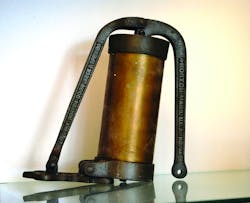
Door closing equipment has been around for well over 100 years. Some of the original products are still sold today, such as spring hinges, springs, weights, door checks and door closers. An early Norton closer has the name “Door Check” engraved into the arms.
Door closers come in different applications, configurations, sizes and shapes. They can be mounted into the floor beneath the door, into the header area above the door, and surface mounted onto the face of the door. Each type of door closer has its advantages and disadvantages.
Most architects install concealed door closers, usually on the public exterior doors of a building because of the aesthetics.
Early pot (traditional) closers would wind up the clock-style spring as the door is being opened. The spring would unwind as the door is closing. To control the closing speed, the spring would drive a piston, forcing fluid through orifices in the cylinder. Many pot closers have two holes in different positions. The first, larger hole would permit faster movement (sweep speed). The second, smaller hole closer to the end of the travel, created sufficient force to close and secure the door (latch speed). Without fluid, the spring would expand rapidly and the door would slam.
The standard “streamline” or modern surface-mounted door closer operates using fluid in a rack-and-pinion spring-loaded piston mechanism. When the door is opened, the arm assembly rotates a geared spindle that moves a gear driven piston, compressing the main spring and forcing fluid into the area previously occupied by the piston. The spring pressure increases as the door is opened. The farther the door is opened, the greater the spring pressure. As the door is closing, the spring expands and exerts pressure on the piston. As the piston moves back, fluid is forced back to the area surrounding the spring. The valves that control the movement of the fluid as the spring expands determine controlled opening and closing of the door. If fluid is permitted to move too quickly, the door will slam. If fluid is restricted too much, the door will not close and latch.
Surface-Mounted Closers
Surface-mounted door closers were usually available with a specific spring power force. The sizes ranged from one to six. For example, a number two door closer is designed for lightweight interior doors. As the weight and height/width of the door increased, so did the size number of the spring force required.
Then manufacturers introduced adjustable sized surface-mounted door closers whose spring force could be adjusted to different sizes, eliminating the need to carry different sized door closers. Adjustable sized door closers vary by manufacturer and model. There are adjustable spring power door closers whose adjustable range is from size 1 through 6 with additional adjustment of more than 50 percent over size 6. Some manufacturers have adjustable closers from sizes 3 through 6. Door closers adjustable from sizes 1 through 4 comply with Americans With Disabilities Act (ADA) requirements for handicapped access.
To be ADA compliant, an interior door cannot have an opening force of more than 5 pounds. In addition, an ADA compliant door closer must adjust the sweep to take at least three second from an open position of 70 degrees to move to a point 3 inches from the latch.
Most standard surface-mounted door closers are non-handed, meaning they can be installed onto left or right hand door openings with either in swing or out swing doors.
The following four methods are used for installing a surface-mounted door closer:
Parallel Arm Mounting - The closer is mounted onto the door face with the shoe mounted onto the jamb using a soffit plate. The arm is parallel to the opening. This application is for out swing doors with the closer on the interior. Because the arm is parallel to the door face, there is less opportunity for damage that can result from a perpendicular arm.
Regular Arm (Standard) Mounting – The closer is mounted onto the door face with the shoe mounted onto the jamb. The arm is perpendicular to the opening. This application is for in swing doors with the closer on the interior.
Top Jamb Mounting - The shoe is mounted onto the door face with the closer mounted onto the jamb. The arm is perpendicular to the opening. This application is for out swing doors with the closer on the interior.
Parallel Arm, Regular Arm and Top Jamb configured door closers can be provide between approximately 80- and 180-degree opening depending upon the trim and the installation.
Track Arm Mounting – The closer is mounted onto the face of the door with the track arm mounted onto the jamb. Track arm mounting can be used for in swing doors and out swing doors, having the closer mounted on the interior side of the door. However, the maximum opening for a track arm installation is approximately 110 degree swing. The advantage of a track arm mounting is the arm is not exposed when the door is closed.
Note: The door closer arm function and provided components determine the mounting. Some arms are mount specific, for example a parallel rigid arm. If the door closer is being installed onto a narrow stile aluminum glass door, some mounting configurations will require the uses of a mounting plate in order to secure the top or bottom mounting screws.
Surface-mounted door closers are relatively easy to install and can be used to retrofit concealed door closer applications. On the other hand, a surface-mounted door closer is on the face of the door. Acts of vandalism or readjusting the valves can occur because the door closer is “out there.”
Concealed Closers
Concealed closers have several advantages over surface-mounted closers because the closers operate as part of the attaching and swing mechanisms at either the top or bottom of the door. On the opposing end of the door, a point of rotation either carries the doors’ weight or pivots the door at the header.
A surface-mounted door closer is an add-on component that controls the opening and closing of the door only, as the hinges carry the weight of the door itself.
According to the Laws of Physics, every action has an equal and opposite reaction. Unfortunately friction takes away energy as a door is opened and as it is closed. For a door closer, more energy is required to open a door than to close the same door. Friction is also part of the closer’s operation and the method of attaching the door to the jamb.
A concealed door closer operation requires more energy than a surface-mounted door closer because of the leverage difference as a concealed closer is mounted at or within inches of the hinge end of the door. Whereas a surface mounted door closer is mounted farther from the hinge end of the door and does not require as much energy expended to open or close the door.
Concealed overhead and floor closers are installed when the opening is installed. A concealed closer is fully hidden, which helps to maintain the aesthetic design of the opening. Concealed closers are used with Herculite (frameless glass) doors. Center hung doors can be operated as single or double acting (door swings both ways). A major difference between surface-mounted and concealed closers is access for adjusting, servicing or replacing.
Concealed overhead closers are installed into the header using mounting hardware specifically designed for the composition of the header (wood, metal, aluminum). There are fixed power overhead concealed closers and adjustable power models.
The Jackson Corporation developed and patented the overhead concealed closer more than forty years ago. Since that time, most manufacturers produce their overhead concealed closers to the same dimensions as Jackson: 11-5/8” length, 1-1/2” height, and 3-11/16” width. To ensure retrofit capability, spring caps are threaded to accommodate the two 1/4-20 x 7/8” bolts, and the tabs on the opposite end are threaded for screws to secure the hinge end of the closer within the frame. These hydraulic overhead concealed closers use two springs to control the closing of the door. Most overhead concealed closers are available in five fixed spring force sizes and as adjustable.
Overhead concealed closers use an arm assembly to transfer the energy from the spindle to the door. Different side and end load arms are normally transferred from the original closer onto the replacement closer. Centering the door within the opening is accomplished by adjusting the two opposite direction bolts at the front end of the arm assembly. A floor-mounted bottom pivot carries the weight of the door, keeps the door at height and enables the door to swing. When replacing an overhead concealed closer, it is strongly recommended to replace the floor pivot.
A variation of the overhead concealed closer, Ellison Doors are equipped with balanced hardware that meet ADA Standards. The elliptical opening and closing path is unique. This variation on the overhead concealed closer requires less intrusion in interior space or sidewalks compared to conventional doors. The overhead hydraulic check can be removed for service and replacement.
Floor Closers
Some floor closers are designed for very large doors and can accommodate doors that weigh over 1,000 pounds. Shallow body closers are designed for lighter duty traffic with doors up to 250 pounds. For heavy doors, intermediate load bearing pivots are installed. For light doors, non load-bearing intermediate pivots are normally installed.
Floor closers can accommodate doors that are mounted either offset or center hung. An offset installation is when the pivot point is located ¾” from the heel (hinge) edge of the door and either ¾” or 1-1/2” from the face of the door. Center hung door are located within the center. Floor closers are available for interior and exterior doors. They can be ordered with selective hold open. Adjustment valves can include closing speed, latching speed and backcheck.
Unlike surface mounted door closer, floor closers can be ordered with built-in positive dead stop that prevents the door from swinging beyond the specified degree of opening. Handicapped floor closer models meet ANSI A117.1 . Note: Most floor closers require a portion of the threshold to be removed in order to make adjustments.
Always use the recommended size of closer for the door. Using an under-powered door closer will usually result in inconsistent closing and latching, and premature failure. Never use an over-powered closer or an adjustable closer at too high a power setting. Excessive closing force may cause the door to unintentionally hit people walking through the opening. In addition, this closer may cause premature wear on the door, hinges, pivots and the closer.
Common Problems
Three closing problems confront door closers: stack pressure, temporary door distortion and regulations requiring maximum force required to open a door closer-equipped door.
The term “stack pressure” describes the movement of air within a hermetically sealed building. Air pressure builds within the building as the air is forcibly moved through the air conditioning/heating intakes and ducts. This pressurization can sometimes be felt and seen when opening an exterior door. The stack pressure results in the door unable to close as the air is forced through the open door. If the HVAC system is off, the door will normally close and latch with no problem. However, with the air movement forced by the HVAC, the door closer cannot close thee door. Adjusting the closer will not solve the problem as the closer will close with excess force when there is no HVAC.
Temporary door distortion occurs to an exterior hollow metal door that is located on the sunny side of an unobstructed building. When the sun rises, the door is exposed and heats up. Depending on the construction of the door, it can begin to warp, distorting its shape. This can make the door unable to close and latch normally.
The result is the door will bow either towards or away from the jamb. The greatest variation is usually following the hottest time of the day with the greatest variation usually at the area of the latch. When the door is in this condition, it may not be able to be closed until it cools down. Eventually, the door will become warped to the point that it will not return to an operable shape.
For a temperature-induced bow, no door closer or power door operator may be capable of closing, latching and securing the door at some point in time. The only option is to replace the door with one that will not warp.
Some regulations, codes and ordinances differ geographically. Some are federal, state and local. For example, California mandates five pounds or less force required for a door closer on non-fire rated doors. Manufacturers had and have to develop products that can close the door with a price tag of less than a power door operator. To make surface-mounted door closers more efficient, closer manufacturers have developed some specialized and unique door closers.
Note: Use a door pressure gauge when adjusting the closing force. Contact the local authority having jurisdiction (LAHJ) or ask your local locksmith distributor about codes for your area.
An example of a specialized surface mounted door closer is the “cam” closer. Unlike the regular surface mount door closer whose greatest amount of force is in the beginning of the closing cycle, a cam action door closer applies the closing force at specific locations within the closing cycle to obtain greater efficiency. The cam action door closer provides an extra “kick” of power at the end to help the closer latch and secure a door.
The non-handed Sargent 421 Cam Door Closer is designed for push or pull track operation and has adjustable spring power. Unlike a conventional door closer, the 421 cam operates in conjunction with two pistons. When servicing a cam action door closer, the latching speed valve adjustment is critical to ensure proper door latching.
Note: When servicing a cam action door closer, the latching speed valve adjustment is critical to ensure proper door latching.
The Norton Trinity 9000 Series door closer automatically adjusts itself in order to accommodate the building’s conditions. An on-board computerized control module adjusts the single, internal valve to keep the closer functioning within a specific operation range in addition to controlling backcheck and delayed action. No external power source is required as opening the door generates power. These computerized adjustments are designed to reduce the need for “stack pressure” adjustment.
Backcheck on a door closer limits the door from being forced. Never close the backcheck valve completely. Tightening the backcheck valve causes increased internal pressure. This pressure can rupture the seals and result in premature failure.
Always save instructions, templates, and tools from the door closers you install. This way you will have a quick reference source and tools for future re-installation and adjustments.
When installing a door closer, write the date of installation onto the inside of the cover. This way, should there be a problem, the installation date will determine the years of operation.
Closer manufacturers offer different lengths of warranties. For example, DORMA offers a 25- year warranty on their mechanical door closers manufactured after August 1986.
For More Information
For contact information on the above discussed companies and their products, contact your local locksmith distributor or:
DORMA Architectural Hardware, DORMA Drive, Drawer AC, Reamstown, PA 17567. Telephone: 717-336-3881. Web Site: www.dorma-usa.com.
Ellison Bronze Inc., 125 West Main Street Falconer, NY 14733. Telephone: 800-665-6445. Web Site: http://www.ellison-bronze.com.
Norton Door Controls, 3000 Highway 74 East, Monroe, NC 28112. Telephone: 877-974-2255. Web Site: www.nortondoorcontrols.com.
Rixson Specialty Door Controls, 9100 West Belmont Ave., Franklin Park, IL 60131. Telephone: 866-474-9766. Web site: www.rixson.com. Rixson provides installation videos for offset and center hung floor closers, under Installation Aids on the Rixson web site.
For replacement components for discontinued door closers, contact New England Door Closer, Inc., 694 Union St., West, Springfield, MA 01089. Telephone: 413-733-7889. Web Site: www.nedoorcloser.com.
For door pressure gauges, contact HMC Int’l. Div., Inc., 5996 South Crocker St., Littleton, CO 80120-205. Telephone: 303-794-2510 Web Site: www.HMC-International.com.