This month we offer brief overviews of some of the newest video surveillance products and technology on the market. VideoIQ cameras and storage devices, CelAccess remote access control and PoE technology may provide much-needed solutions for your forward-thinking customers.
VideoIQ
VideoIQ’s line of iCVR and iCST cameras and encoders provide performance and value that differentiates them in a market crowded with imposters. Their offerings include HD and non-HD camera packages, as well as encoders which permit the security installer to configure around a favorite camera or upgrade an existing camera deployment.
Distributed storage, storing the video at the camera as opposed to sending it back to a central location, reduces the real-time load on the network, increases the reliability that the video will get recorded when it matters, and mitigates the need to augment and manage additional storage when cameras are added.
VideoIQ technology is dual stream, so the security installer can tune the frame rate and resolution of continuous background and alarm recording to suit the application. The camera management software includes an extended suite of analytic capabilities and camera controls consistent with the leading standalone VM software but it is included with the VideoIQ product.
Storage at the camera is measured in months (not days), and VideoIQ offers a choice of hard drive capacities. Also worth noting is that the hard drives they use are solid state and have a life expectancy of 10 years.
VideoIQ works with Ethernet or Wi-Fi networks, and can be adapted to interface with point to point proprietary topologies.
Last summer we deployed traditional IP cameras using Wi-Fi topography, and based on that experience I am currently preparing to submit a proposal for another remote surveillance project, only this time transitioning to VideoIQ.
Judging from the feature set and product pricing it should prove to be cheaper, easier, better, and will empower the customer with enhanced set of valuable VM tools which increase the return on investment in demonstrable ways.
VideoIQ cameras may be viewed using a browser, and are a totally scalable solution. Since the head-end is in the camera, and due to the bandwidth no-load/lo-load characteristics of VideoIQ, the cost-benefits actually increase with the more cameras deployed and those often challenging strategic deployments.
VideoIQ’s iCVR camera and encoder family delivers intelligent video surveillance while eliminating the need for external third party Network Video Recorders (NVR), Digital Video Recorders (DVR), and Video Management System (VMS) platforms and the bandwidth they consume. Whether you are looking for indoor or outdoor surveillance, perimeter security, or HD/megapixal camera functionality, using VideoIQ's innovative IP cameras and video analytics the result is:
Proactive surveillance: VideoIQ’s adaptive analytics uniquely identify people, vehicles and boats from objects, animals and scene movement, ensuring the most accurate real-time threat detection on the market.
Network efficiency: By storing video within the onboard NVR, iCVR cameras and encoders can record at full resolution and frame rate – even full high definition with 1080p/30fps resolution – using no bandwidth at all. The overall system needs less than 10 percent of the bandwidth of high definition and conventional IP cameras, allowing customers to deploy over existing networks, wireless networks and cellular connections. And as every iCVR continuously records, they are always ready to send real-time alarms when threats are detected, stream live video on demand and perform sophisticated search.
Simple installation: with fully integrated, onboard NVR storage and an advanced VMS, iCVR cameras and encoders eliminate the need for expensive centralized storage – reducing deployment costs, system complexity, infrastructure, time and resources. Additionally, VideoIQ’s adaptive analytics automatically calibrate in minutes, getting more accurate with each object detected and further reducing installation time and resources. Customers simply need to mount a camera and connect the device to any network.
VideoIQ also delivers the only solution designed for self-monitoring, professional outsourced monitoring or on-site guard monitoring. With superior real-time threat detection, customers can effectively prevent theft and vandalism at 1/5th the cost of an onsite guard, or make their own guard force more effective and efficient.
Outsourced: VideoIQ's video surveillance solutions are purpose built to support remote, third party professional monitoring. Replacing the function of onsite guards, at a fraction of the cost, outsourced monitoring organizations receive alarms in real-time and are specifically trained to access the threat and respond 24/7.
On-Site: VideoIQ's advanced adaptive analytics continuously monitor their field of view 24/7. By receiving real-time alerts when specific behaviors are detected, VideoIQ's surveillance solutions augment onsite guard teams, making them more effective and efficient, delivering better coverage and rapid response at lower cost.
iCVR-HD Cameras deliver full 1080p resolution and frame rate, zero bandwidth recording, full megapixel analytics and support for IQTrack™ — automatic digital PTZ zoom and track. With up to a half terabyte of intelligent, onboard Network Video Recorder (NVR) storage within each camera, iCVR-HD high definition cameras eliminate the need for expensive centralized storage and separate high capacity networks— reducing deployment costs, system complexity, infrastructure, time and resources.
Additionally, VideoIQ’s embedded, adaptive analytics automatically calibrate in minutes, delivering superior real-time threat detection and forensic evidence at no additional cost.
VideoIQ iCVR-HD cameras are VideoIQ’s highest resolution cameras, delivering dramatic 1080p video at up to 30 frames per second. With almost seven times the resolution of a standard VGA camera, the iCVR-HD allows customers to digitally zoom in for superior detail, or cover nearly three times the horizontal area — reducing costs by requiring fewer cameras for the same area.
• IQTrack™. VideoIQ iCVR-HD cameras use unique VideoIQ intelligence to automatically identify, track and digitally zoom in on suspicious objects, delivering enhanced detail, while continuing to monitor and record the entire scene. This feature enhances operator effectiveness by focusing attention on critical activity while maintaining the necessary scene context to appropriately respond to threats and investigate after the incident.
• Email notification. Whenever a rule configured by the customer is triggered, emails can be sent directly to any device supporting video email attachments or video mms, including cell phones, and smart phones, making it ideal for roaming guards or remote facility managers. Emails can be sent to as many as 32 approved addresses at the same time, and users can have their video system automatically notify and send them video clips of intruders or security breaches.
For more information, contact your local locksmith distributor or visit www.videoiq.com.
PoE In Security
Power over Ethernet or PoE technology describes a system to pass electrical power and data over Category cable. PoE has entered into the lexicon of electronic security, initially in applications involving PoE enabled IP cameras, PoE enabled UPT technologies, and PoE enabled IP based EAC (Electronic Access Control) modules.
The IEEE standard for PoE requires Category 5 cable or higher for high power levels, but can operate with Category 3 cable for low power levels.
Power is passed over two or more pairs of wires in the Ethernet cable.
Power comes from either a PoE-enabled network switch, a midspan device such as a special purpose hub, or a standalone injector.
The original IEEE 802.3af-2003 PoE standard provides up to 15.4 W of DC power (minimum 44 V DC and 350 mA) to each device with just12.95 W available at the powered device due to loss in the cable.
The updated IEEE 802.3at-2009 PoE standard (also known as PoE+ provides up to 25.5 W of power.
The 802.3at standard provides 51 W of power over a single cable by utilizing all four pairs in the Cat.5 cable.
Numerous non-standard PoE schemes exist.
Power sourcing equipment:
The PSE is a device such as a switch that provides the power source. When the PSE is a switch, it's called an endspan.
If it's an intermediary device located on the network cable somewhere between a non PoE switch and a PoE device, it's referred to as a midspan.
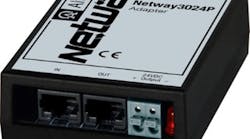
One type of midspan is an injector which is an interface placed in series between the network switch and the PD (explained next). A power supply connects to the injector, and sends the power in the direction of the PD. Another type of midspan is a hub which manages both the data as well as injects the power onto the network cable.
A powered device (PD) is the object of the injection such as a electronic access control module, IP Camera, PoE phone or an access point.
Many powered pevices have an integral auxiliary power connector for an optional, external, power supply.
Having multiple ways to power a PoE PD can enable the system designer to provide for continued powered operation even if there is a power failure.
Two PoE Modes, A and B, are available. Mode A delivers phantom power on the data pairs of 100BASE-TX or 10BASE-T. Mode B delivers power on the spare pairs. PoE can also be used on 1000BASE-T Ethernet in which case, there are no spare pairs and all power is delivered using the phantom technique.
Mode A has two alternate configurations (MDI and MDI-X), using the same pairs but with different polarities.
In mode A, pins 1 and 2 (pair #2 in T568B wiring) form one side of the 48 V DC, and pins 3 and 6 (pair #3 in T568B) form the other side.
These are the same two pairs used for data transmission in 10BASE-T and 100BASE-TX, allowing the provision of both power and data over only two pairs in such networks.
The free polarity allows PoE to accommodate for crossover cables as well as patch cables.
In mode B, pins 4–5 (pair #1 in both T568A and T568B) form one side of the DC supply and pins 7–8 (pair #4 in both T568A and T568B) provide the return; these are the "spare" pairs in 10BASE-T and 100BASE-TX. Mode B, therefore, requires a 4-pair cable.
The PSE, not the powered device (PD), decides whether power mode A or B shall be used. PDs must accommodate either mode in order to be compliant with the Standard.
To stay powered, the PD must continuously use 5–10 mA for at least 60 ms with no less than 400 ms since last use or else it will be unpowered by the PSE.
Endspans are normally used on new installations or when the switch has to be replaced for other reasons (such as moving from 10/100 Mbit/s to 1 Gbit/s or adding security protocols), which makes it convenient to add the PoE capability. Midspans are used when there is no desire to replace and configure a new Ethernet switch, and only PoE needs to be added to the network.
PoE is also used in non-Ethernet applications such a UTP video which uses Category 5 style cable topology to route rather than Ethernet topography
CelAccess Access Control
The need for a solution that provides for wireless communications and access control for isolated locations is not that uncommon. Remote storage yards, and athletic fields as well as construction sites are typical applications. But any location where the cost to trench cable, and the inconvenience this type of hard wired installation will invoke is a candidate for a wireless solution. Sometimes there is power at the isolated location, but often there isn’t.
CelAccess' offers out-of-the-box 100 percent cellular access control and monitoring solutions for a variety of security applications.
The CelAccess GC-1010 is a simple, yet powerful cellular access control and monitoring device. Whether as a stand-alone system or integrated with other access control systems, it can be used to open any electronic gate, door or lock.
The CelAccess GC-1010 is a 100 percent cellular based, server managed, access control system. There are no line of sight requirements or distance limitations. If cellular service is available, any electronic gate, door or lock can be controlled. A resident or business owner, as well as their guests and employees, can use a cell phone or an internet connection to control access to any residential or business property via the CelAccess Automated Control Center
The CTE1000 Cellular Telephone Entry System has no line-of-sight or distance limitations, and requires no trenching or phone lines. It's easily installed right out of the box on to any electronic gate, door or lock. A call is routed through the CelAccess Automated Control Center to either a single phone number or multiple numbers simultaneously so that the customer can send the CTE an open command. All transactions are recorded in a real-time activity log.
Being a cellular system, there are no trenches to dig, no hard wired connections to run, no line of sight requirements and no distance limitations. If there is cellular service available, the CTE-1000 can connect anywhere in the world - just hook up power and begin using its many features.
The CelAccess WIM1000 will allow any Wiegand compatible device to operate anywhere cellular network service is available, without the expense and complexity of a local master control system.
The WIM1000 is simply wired directly to the Wiegand device at the electronic door, gate or lock. Access codes read from Wiegand devices are then received and transmitted via the cellular network to the Automated Control Center where access codes set up by the customer and verified.
How Cellular Access Control Works
CelAccess solutions are comprised of two basic components: the cellular device which connects to the gate or door controller and CelAccess servers which are accessed by users via the Internet or telephone. CelAccess’ cloud-based server network enables all internal management and reporting for CelAccess, as well as provides the user with complete account management through the Automated Control Center.
Their unique combination of cellular plus internet functionality offers capabilities, flexibilities, and affordability found in no other solution.
Deployment involves an initial site survey to confirm the site is on the AT&T grid, and then a typical installation of the control and connections to input devices, output devices and operating power.
There is no learning curve for you or your customer as use is highly intuitive, and the services are automated.
For more information, contact your local locksmith distributor or visit www.celaccess.com.