Automotive Key Generation Tools
Roadside service providers have done a lot of good things for locksmiths. For years they have been supplying many of us with a steady stream of business and a quick and easy source for automotive key codes. Unfortunately, a few people abused the key code service and now it has become much more difficult to get a key code over the phone for the rest of us. Suddenly, I'm getting a lot of calls from locksmiths who had been dependant on getting key codes, but now want to learn how to generate keys the old-fashioned way.
In the automotive locksmith world, generating a key without having access to a key code service basically breaks down to the following four techniques.
1. Finding the key code somewhere on or in the car.
Never assume that the customer even knows what a key code is. It's amazing how many times you can find the key code numbers written on the owner's manual or on some of the original paperwork that came with the car.
I once had an employee who spent all afternoon trying to make keys to an early 90s Cadillac Seville, and only called me to help after he had damaged the steering column. After I repaired the damage, I went to work on the door and trunk key while he began interrogating the VATS system. The first thing I saw when I opened the glove compartment was a small envelope that was labeled "Key Codes." Inside the envelope were the original "knock-outs" from the keys!
Had my employee taken 30 seconds to look in the glove compartment, the job would have gone from an all-day mess to a very simple VATS interrogation. Learn from his mistake and make sure that you always look for a code before you start disassembling things.
2. Using tryout keys.
Tryout keys are a lot like that old guy that you know up the street — they're simple, slow, and nerve-wracking, but can be utterly reliable. They can also be a very simple solution to some very complex problems. They work almost every time they're tried. There is almost always a faster way, but not always a better way. I've never heard of anyone seriously damaging a lock while using tryout keys.
Perhaps the most common use of tryout keys is the Ford 10-cut system. In that system, one-third of the information necessary to generate an ignition key (two out of six cuts) can be gained from the door locks. Once that information is known, the number of tryout keys needed to determine the remaining four cuts is a relatively small number. The tryout sets for the ignition can be grouped in such a way that makes it easy to finish the key quickly and easily without any disassembly.
The procedure for getting the door cuts is another matter. Some locksmiths use tryout keys for that as well, but others use a variety of methods. While the ignition is a sidebar lock, the doors use a single throw six wafer-tumbler system. Several of the other methods described below can be used to decode the doors, and the choice of method boils down to personal preference.
The bottom line is that tryout keys are extremely effective, but slow. They can also be a little expensive if you try to outfit yourself with tryout keys for every system out there. If you have a visual impairment, tryout keys may well be your best choice. I have a friend who is an accomplished locksmith despite being legally blind, primarily thanks to tryout keys.
3. Disassembling the lock and fitting a key by hand.
This method will almost always get you a working key, but it can be very difficult to accomplish. Removing the lock often requires being able to turn the lock and if you don't have a key, that means picking the lock. While lock picking is one of those skills that a true locksmith is supposed to possess, in reality it is often just not an option on many automotive locks.
That is not to say that removing and disassembling the lock is never the correct choice; in many cases it is far easier than it sounds. In the Ford 10-cut system mentioned above, the door lock is often held in place by a simple metal clip that extends to the edge of the door that can easily be removed with a screwdriver. Once the lock is in your hand, it can be sight-read by looking through the drain hole in the bottom of the lock.
In other cases, it is possible to get part of the information needed to make the key by disassembling a glove box or compartment lock that is readily accessible. Once that has been done, the remaining cuts can be obtained by a variety of methods including impressioning, progression, tryout keys, wafer reading and using decoders.
4. Decoding and/or Progressing
Learning to "read" wafer-tumbler locks can make your life a lot simpler, but it does require visual acuity and the use of a magnifying scope. This topic was recently covered in detail so let's go on to using decoding tools to accomplish the same thing.
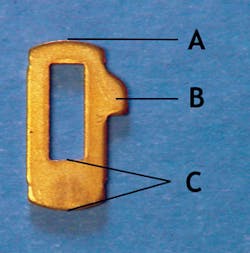
To understand how the decoding tools work, it is first necessary to understand wafer lock construction and the factors that allow the tools to work in the first place. Photo 1 shows a typical wafer tumbler. The three letters refer to different parts of the wafer; each part plays a role in the operation of most decoders. Let's take a look at what these parts are and how they make decoding tools possible.
Part A is the uppermost portion of the tumbler, and this part contacts the inner surface of the lock housing when the tumbler is in the "rest" position. For the purposes of this article, the rest position is the normal position of the tumbler when there is no key in the lock. The pressure of the spring pushes the tumbler up until part "A" contacts the inside of the lock housing, at which point the tumbler can go no further. (The terms "up" and "down" as I am using them here are relative only to the photo and in reality the lock could be mounted in any position.)
Part B is the spring tab. The spring maintains tension between this tab and the base of the chamber that contains the spring. In the rest position, the spring is as fully extended as possible inside the lock.
Part C is the lower portion of the tumbler. The width of this portion determines the depth of the cut on the key. The wider this portion is, the deeper the cut will be. It is this portion of the tumbler that the decoding devices measure in order to decode the lock. The part of the tumbler that contacts the key is often referred to as the "key landing", or just as the "landing."
All three of the decoders that I'll be discussing in this article measure Part C of the tumbler in one way or another in order to decode the lock. Two of the decoders, the EEZ Reader and the Kobra Reader, go about measuring Part C in essentially the same manner, while the Determinator approaches the problem from a different angle.
In visual key reading, you would gauge the relative positions of the key landings of Part C of the tumblers against one another to determine the cuts. Using a decoder allows you to do the same job without the necessity of peering into the lock. Even with the best of lighting conditions and the best of scopes, it is often difficult to see the tumblers at the back of the keyway. A decoder essentially moves the measurement process to the outside of the lock, which makes the job much easier for many people.
Photo 2 shows two different tumblers from the same lock. The tumbler on the left has the shallowest cut and the tumbler on the right has the deepest cut in the system. By measuring the difference in the position of the key landing between the two tumblers, portion "D," we can determine the difference in the depths of the two tumblers. As we can see by the numbers stamped on the tumblers, there are six different cuts in this particular system. This means that determining the difference between a number two and number three cut boils down to being able to determine one-sixth of dimension "D." This can be tricky to do visually, especially with the tumblers at the rear of the keyway.
Photo 3 shows a set of four tumblers from a typical automotive system arranged so that you can see the progression of the different depths. It is these differences that all of the decoders measure. Keep in mind that all of the measurements of the tumblers are made assuming that point "A" on the tumbler is at rest against the inside of the lock housing which will align all of the tumblers as they are in the photo. As you use any of the tools, or attempt to sight read the lock, always make sure that the individual tumblers are not bound in any way. Otherwise you will get false or misleading readings.
Using the EEZ Reader
The EEZ Reader was the first decoder of its kind on the market, but has only been sold through six regional distributors, so not all locksmiths are familiar with this tool. There are 14 EEZ Readers for selected applications. All of the EEZ Readers work on the same basic principal and are similar in construction to the one shown in Photo 4. Each reader consists of two parts, a specially milled key tool — "A," and a calibrated slide — "B." There is a slot milled into the key blank — "C," that runs down the length of the key that the slide fits into. Near the tip of the key blank, there is a slot — "D," that is just slightly wider than the thickness of one tumbler. There is also a series of index marks — "E," near the head of the key blank that work in conjunction with the index mark on the slide — "F." Spacing marks "G" are also placed along the blade of the key tool to help you determine which tumbler is being decoded.
Photo 5 shows the EEZ Reader assembled, as it would be inserted into the lock. Notice that the slide covers the slot at the end of the tool; this prevents any of the tumblers from falling into the slot as the tool is inserted. After the tool is inserted fully into the lock, the slide is withdrawn, allowing a tumbler to fall into the slot. Then the tool is pulled out of the lock slowly until a tumbler becomes trapped in the slot. The spacing marks on the shaft of the tool help the user determine which tumbler has become trapped for the decoding process.
After a tumbler has been trapped, it is decoded by pushing the slide back into the tool until it touches the trapped tumbler. The index marks on the slide "F" and the key tool "G" indicate the depth of the tumbler. A light touch and a little practice are required, but when used properly, this tool can quickly decode the tumbler and give the user the exact depth. After an individual tumbler has been decoded, the slide is pushed in far enough to release the tumbler and the tool is withdrawn to the next position where the process is repeated. After all of the tumblers in the lock have been decoded, a key can then be generated.
EEZ Readers are available only through the six distributors in the PLS Network:
E.L Reinhardt, St. Paul MN, 800-328-1311
H.E. Mitchell Co., Portland, OR, 800-626-5625
Locks Co., Miami, FL, 800-288-0801
Maziuk Wholesale Distributor, Syracuse, NY, 800-777-5945
McDonald Dash, Memphis, TN, 800-238-7541
R&H Wholesale, San Francisco, CA, 800-367-5625
Using the Kobra Reader
The Kobra Reader (Photo 6) works on essentially the same principal as the EEZ Reader, but with a few major differences. Photo 6 is actually a pre-production drawing of the tool to be introduced at the ALOA show in Chicago this July. Initially the Kobra Reader will be available for five of the most common lock systems, but more will be available at a later date.
The Kobra reader features a high-intensity LED illuminator "A" and a high-contrast scale "B" to make decoding at night much easier. In addition, the spacing guides "C" are larger. The precision slide is also held captive in its slot so that it cannot be lost. Because the slide is held in the proper alignment regardless of its position, it yields a more accurate measurement of the tumbler depth than would not be possible if the slide were free to "float."
The Kobra Reader is manufactured and sold exclusively through Lockmasters, Inc., Nicholasville, KY, telephone 800-654-0637.
Whenever you use either of these tools, here are a few techniques that you need to understand:
Make sure that the tumbler has dropped all the way to the rest position by rocking the tool slightly after the tumbler is trapped to fully seat the tumbler in the slot.
Push in on the tool to bind the tumbler as you take the reading in order to bind the tumbler so that the slide stops against the tumbler instead of lifting it.
When in doubt, make the cuts on your key high — you can always cut them deeper, but it's impossible to go the other way.
Expect the tumblers near the face of the lock to be more worn that the ones at the tip of the keyway.
Using the Determinator
Unlike the first two tools, the Determinator is not designed to read the exact depth of the tumblers. Instead it uses a system of half depths that in most cases will produce a key that is close enough to turn the lock on the first try. Once the key has turned, it can be refined by simple impression and / or progression to produce the finished key. Due to variations in the tolerances in different lock systems, the Determinator can be used on a wider variety of locks than the other tools. More than 40 Determinator tools are available for different lock systems.
Photo 7 shows the components of a typical Determinator. Each tool consists of one or more specially machined keys "A" and a matching tumbler release tool "B." The release tool fits into the milled slot "C" on the key in order to release the tumblers after the notch "D" near the tip of the key has trapped them. Each Determinator also has a spacing guide stamped onto the shaft of the tool (Photo 8). The spacing guide allows the user to determine which tumblers are trapped and which are not trapped.
The theory behind the tool is essentially the same as we have seen with the other tools. As shown in Photo 3, tumblers that correspond to deeper cuts in the system will extend further into the keyway when the tumblers are at the rest position. The trap notch at the tip of the key is designed to trap tumblers that extend past a given point in the keyway as the tool is being withdrawn from the lock. In a system that only has four depths, only one key is needed to decode the lock when using half cuts. In systems that have more than four depths, more than one key will be required. After a tumbler has been trapped and the depth recorded, the release tool is used to release the trapped tumbler so that another tumbler can be read, or the tool removed from the lock.
To use the tool, you first insert the key all the way into the lock and then slowly withdraw it until the tool stops. The reason that the tool will stop is that it has trapped a tumbler in the notch at the end of the tool. At that point, the spacing guide on the side of the tool will tell you which tumbler has become trapped. This will tell you two things: the cut associated with the trapped tumbler is one of the deeper cuts in the system, and in most cases this will also tell you if you are decoding the even or the odd side of the lock. The odd side of the lock begins with wafer number one, the wafer closest to the face cap. On most modern vehicle lock systems, the door lock has opposing (double throw) wafers with the even numbered wafers (2, 4, 6, etc.) move in one direction and the odd numbered wafers (1, 3, 5, etc.) move in the opposite direction to the unlocked position.
The depth that is indicated by a trapped tumbler will vary according to the number of depths in the system, but in a four-depth system, any tumbler that traps can be cut to a 3.5 depth, while any tumbler that does not trap can be cut to a 1.5 depth. Each Determinator includes a pad of work sheets like that shown in Photo 9 to record the depths as the tool is used. Reading and understanding the instructions for each set is extremely important.
After all of the trapped tumblers have been recorded, a test key is made. (For the purpose of this article, I'll use a Determinator that is designed for a four-depth system, but bear in mind that the depths of the cuts will vary in other systems.) In each position on the key a cut is placed according to whether or not a tumbler was trapped in that position. In our example, a cut of 1.5 would be placed in positions where a tumbler was not trapped, and a cut of 3.5 would be placed in positions where a tumbler was trapped. The even-numbered cuts would be placed on one side of the key and the odd numbered cuts would be placed on the opposite side of the key. If the lock was properly decoded, this will result in a key that is cut too high in some places and too low in others, but due to the tolerances in the lock system, it will either turn the lock or be close enough that a little impressioning will allow it to turn.
Following the instructions supplied with each tool and using the basic locksmithing skills of impressioning and progression will usually produce a finished key in a matter of minutes.
The Determinator is available through many locksmith distributors and is manufactured by Car Openers, Inc., Ocoee, FL, telephone 800-561-0443.
All of the tools that we covered here have specific applications for specific vehicles. In some cases, all three tools could be used on a specific vehicle and in others, only one tool may be available for that vehicle. Some locksmiths own all three tools for a specific application and use them either alone or together according to conditions.
Since many of the newer domestic automotive lock systems incorporate wafer tumbler locks for the doors, deck and compartments along with a sidebar lock in the ignition, all of these tools will require the user to be skilled and have a good working knowledge of the lock system. Producing a finished key that is cut to factory specifications will almost always require some additional work on the part of the locksmith. But, any and all of these tools can save you time on the job, which amounts to putting money in your pocket.