First Do No Harm: Proper Security in the Facility
An essential element of a comprehensive security program is the facility security layout. The design of the layout includes many considerations. Protected areas need to be designated at the proper level. The egress from protected areas must be unobstructed, within the requirements of life-safety provisions, while still offering enough control that paths leading out of the area are predictable and securable. The right types of doors and related hardware need to be matched with the intended level of security and functionality. All components of the design must deliver the proper amount of security without inhibiting the work within the protected area.
Customers’ needs and expectations relating to security must be evaluated and carefully incorporated in the design. Consult with specialists whenever possible and review the design from time to time.
Never install, repair, or maintain security hardware that has is unsafe. Remember the Physician’s motto as it also applies to locksmiths: “First do no harm.”.
Three Examples
It is important to note that the application of untried security components within the facility can be problematic. In some cases, issues arise that degrade both security and life safety.
In an East Los Angeles convenience store, the clerk was behind the counter and almost completely enclosed in thick polycarbonate. Although the thickness suggested that the enclosure could withstand most forms of hand-weapons, the walls of the enclosure stopped at about 18 inches from the ceiling.
Of course the intention of this type of installation was to prevent robberies, but the space above the walls created an unforeseen security risk. Nothing stops a perpetrator from tossing over a simulated lit stick of dynamite. The clerk would most likely race from the area at breakneck speed, without activating a duress alarm. Not only is the perpetrator free to raid the cash drawer, but the clerk might get hurt in the process.
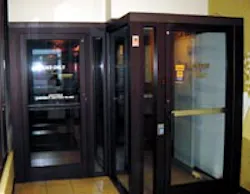
A recent trend in banking is to retrofit the entry with a “man-trap.” Figure 1 is a picture of a typical trap that includes bulletproof doors and a controlled vestibule where patrons must identify themselves before entering. To comply with life-safety regulations, the exit out of the portal is either by a “request-to-exit” signal from the security guard or by delayed-action exit device.
This type of installation inhibits the majority of perpetrators, but attracts a more dangerous brazen type. Once inside either by posing as a customer or actually having the foresight to be a customer, the robber can overpower the guard and then control the coming and-going of the bank by its own access control.
I was asked to repair locks at a facility that collected cash. Routinely the employees were locked into the building while working. Internal vestibule doors were protected with auxiliary electrified fail-secure deadbolts. The electrified deadbolts were tied into an interlock system that prevented the deadbolts from being energized (allowing access) if an exterior entry door was left open
All exit doors were fortified with double-cylinder deadbolts above the exit devices. Other than the doors, there is no means of egress as the brick building has no windows.
In the case of a power outage, there is no battery backup. The armed guards from within must release an exit door by unlocking the double-cylinder deadbolts. In the case of fire, there might not be enough time to do this. Because of the precarious design of the locks, the guards would be more likely to fight a fire then call the fire department.
Parts of the building are so designed that if an occupant were in a room when there is a fire, the only means out would be through a vestibule door. During a fire these doors require electricity and the entry door to be closed to allow egress. These requirements assuredly guarantee the occupant would be trapped.
A disgruntled employee could start a fire, and purposely leave the door ajar, using some obstruction. The interlock is then prevented from releasing the vestibule doors. Valuable seconds are spent by the guards trying to get the vestibule doors open; release the deadbolts of the exit doors; or fight the fire.
Despite the all-important safety issues, the “security” layout creates huge security problems. A “crew” (organized group of thieves) now has the advantage of predicting where and when the fortified facility will be accessible. The power could be cut at a prescribed time, forcing the employees out of the exit doors as all other vestibule doors are locked by default since they require electricity to release the locks.
Another security issue could arise if a perpetrator working from inside the area set a fire causing immediate confusion and loss of focus.
These three are glaring examples of what could occur when security upgrades create more problems than they solve. Each example creates more problems than it solves while leaving the owners in a possible state of liability. Poor planning that instigates tragedy is hard to defend.
A side note regarding the last example: I would not have anything to do with the repair of the electrified deadbolts and informed the owners of both life-safety and security concerns. I tried in vain to get them to reason but they cited that they had been doing business that way for 20 years and saw no reason to change.
A fire inspector was called out to make a determination and he concurred regarding the seriousness of the situation. The owners enlisted the opinion of a second inspector who, to my surprise, was unable to find any problems.
Fire inspectors carry a lot of weight and there really isn’t much more to do than to document the incident and move on. It is important for locksmiths to note that we must never participate in the degradation of life safety, especially in the effort of heightening security. Even when an inspector says it is okay, don’t do it. Repairing the existing locks could get the locksmith in a lot of hot water.
A question the accident investigator will have is who the last person was that worked on the locks. Any person involved with the creating or maintaining a fire trap can be legally and possibly be held criminally responsible for an accident, locksmiths included.
Expertise Required
Remember that the history of life-safety regulations is partially based on researching the cause of serious accidents relating to door and locking hardware. Sometimes the individual who designs the facility layout is less experienced regarding security hardware and more experienced regarding other types of facility systems (i.e. HVAC, lighting, plumbing, etc.). In this case, the designer is best served by consulting experts in the field. Enlist a group of security professionals to review needs of the facility layout. No one person is the ultimate expert in security design.
A veteran locksmith knows just the right type of lock to use, just as a veteran alarm technician knows best when it comes to alarm components. Before deviating from standard security hardware applications, consult with the local authority having jurisdiction (LAHJ).
Although we consider fire departments as being the authority relating to life-safety issues, the fire department in many states is also the expert on how best to secure homes and businesses.
Using consultants keeps the designer abreast of new security products and how they perform. Consultants also have means to lower the cost of a project. Sometimes they offer discounts not normally available to the designer. Sometimes they can offer alternatives that are more effective. Consultants can offer points of view not distorted by company politics or culture.
Be aware that consultants may have a strong affiliation with a specific lock manufacturer and their affiliated companies. Ask questions, sometimes the best products are not always available from only one company.
Periodic reviews of the facility by different consultants can lead to improvement or discovery of where designs can improve.
Customer Requirements
Match security to the needs of the customer. Each customer has different ideas and needs relating to security.
To governmental sub-contractors that borrow proprietary or classified information from the customer (while under contract), security is about accounting for the information. Areas are constructed within a facility that do nothing but protect the access to information.
These areas are protected with locks that require ciphers and combinations. These locks are not designed to be the world’s strongest locks, but rather to guarantee that the area or information is not accessed without showing some kind of signs of compromise. The key word for security in these facilities is surreptitiousness.
Security for large department stores is all about loss prevention. Stores are laid out so that the merchandise can be watched. All exterior doors are secured either with exit alarms (Figure 4, exit devices that integrate alarms) or exit devices and local alarms.
Because stores are concerned with “shrinkage” caused by both the public and through employee theft, local alarms are always controlled by keys carried by management.
The “floor” is the area that the public shops in. It is deliberately laid out to be very open so to accommodate an unobstructed view for cameras and floor-walkers.
Stores may have many sets of exit doors but usually there are only a few doors keyed for employee entry. By limiting the amount of doors that can be ingressed, stores save money when it comes to rekeying the perimeter.
Very few areas in a store are keyed. High-dollar storage areas that protect expensive electronic equipment usually are locked up in a fenced area in the back of the store and usually secured by padlock.
An area that is always well-protected is the vault. This is the area where money is collected. Some stores like to put these vaults up front where management can keep watch and cash pickups can be made quickly with as short a walk as possible.
Bank facilities obviously are all about protecting currency and valuables. The facility surrounds a vault to make it as impervious as possible. The public areas are separated from employee areas by locked doors and counters. Cameras and a myriad of duress devices are abundant.
The bank’s designer needs to take into account the possibility of robbery. Depending upon the viewpoint of the bank, robberies will be made easy or hard.
One policy is to design areas so that the robber gets in and out with a minimum of fuss. Banks employing this policy rely on a lot of high-resolution cameras in and out of the building. Usually this policy takes into account a quick response from law enforcement and predetermined paths the robbers will take while getting away.
As mentioned earlier, a recent trend is to provide the obvious deterrent of a man-trap. Banks that get “hit” a lot are attracted to these types of security deterrents.
After talking with bank officials that have gone with this trend, there seem to be a lot of second-thoughts. They cite that customers get the wrong impression, that the banks are inherently unsafe. Other customers don’t like being in the banks and are less likely to visit the bank.
Although the number of robberies has gone down, the type of robber attracted to these banks is usually more brazen and much more likely to be heavily armed.
Sometime security is best enhanced through detail. For example, a chain of convenience stores suffered multiple robberies. Because stores were built similar and stores were being robbed all of the country, it appeared that the increase was due to facility design.
After a careful review it was determined that window clutter caused the increase of robberies. The location and amount of window advertisements was limited. The lighting on the inside of the stores was increased. Counters were relocated.
These simple changes to the facilities allowed an easy check from passer-bys to see what was going on in the store. Robberies decreased.
Don’t fight the core layout of the facility. The core layout of buildings requires an ample amount of egress paths and doors for the calculated occupant load. The core layout also dictates that doors protecting one-hour corridors be protected with certain fire-protected systems and provisions. Stairwell or stair refuges must be accessible while maintaining smoke-free integrity. Elevators must follow strict guidelines when it comes to operation during an emergency.
Multi-tenant high-rises provide a special challenge. How does a tenant occupying a single floor of a high-rise protect its perimeters?
Too many times I’ve seen deadbolts installed on the entry into the stairwell or refuge. They were installed because the single tenant on the floor decided to secure the perimeter by locking up the stairwell entries onto the floor.
Another mistake is to seal the entry from the elevators by installing vestibule doors. These pose a subtle problem when a person gets off an elevator right before the building goes into fire mode. The elevator returns to the first floor and cannot be called. The person is trapped on the floor since the vestibule doors keep the person from using the refuge. A better means is to create a pathway from the elevator to the stairwells. Tenant areas can be to the right or left of the new pathway.
There may be the need to secure areas with deadbolts. Safety codes require auxiliary or deadbolts can only be installed in areas whose occupant loads are less than 10. Rather than fight or ignore the codes, work with them. Areas can be compartmentalized so that they meet code.