Wireless technology has permanently changed our lives in innumerable ways, and has a profound effect on the security and access control industry. Although certain clients and applications will always resist battery-operated security, wireless technology will revolutionize our industry by enabling deployments simply not feasible using wire, and cutting installation costs by eliminating trenching and wire pulling.
Some factors have made wireless a reality for professional security applications where perhaps earlier it was not. These include:
Battery Life: Improvements in battery technology have resulted in smaller and longer lasting batteries. Battery life is always a pivotal issue when considering wireless devices. Low current electronics and processors have also enhanced the duty cycle and performance characteristics of wireless equipment to the point where there are no performance or feature trade-offs when going wireless.
Encryption: Due to the maturing of computer technologies with respect to memory, processing power, and processor speed, corresponding advances in encryption have further immunized wireless systems from unexpected guests.
Labor Costs: Even though we seem obsessed with importing low cost laborers, installation costs (and the constraints of certain installation environments) mean that the portability of wireless and the reduced installation costs are of growing importance to the providers and the buyers in the industry.
In short, benefits of wireless access control solutions include:
1) Reduced installation cost by up to 35 percent or more.
2) Reduced implementation time by up to 90 percent.
3) Reduced disruption to facilities and workplaces.
Schlage Wyreless
Schlage’s Wyreless Access Control offers a feature-rich open architecture solution for virtually any access control application where pulling wire is not acceptable. It is also cost-effective on new installations, and has been adapted into the design options of several major access control manufacturers as a world class technology.
Readers already familiar with wireless alarm products will no doubt recognize certain features which long ago became givens in that market segment of protective technology, and have now migrated over to access control.
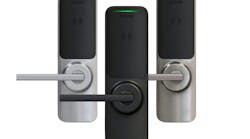
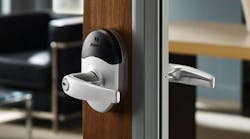
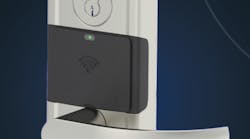
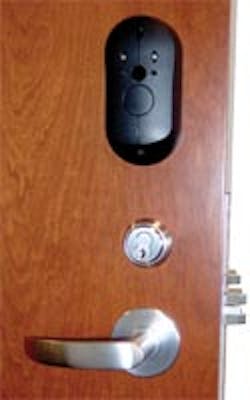
The Schlage Wyreless Modular Integrated Reader Lock replaces the door-to-panel wiring and wiring around the door. Each device contains the electronics needed for real-time access control at a door. The card reader, electrified lock, power supply, RTX sensor, and door position switch button are included. Request-to-Enter button can be ordered as an additional option.
The Schlage Wyreless line includes: modular integrated reader lock, wireless exit trim, wireless reader interface, wireless portable reader, wireless integrated strike interface, wireless universal strike interface and wireless contact monitor.
WA Series modular locksets are available in either cylindrical (WA5200) or mortise (WA5600) locks with HID proximity, HID iClass proximity, Indala proximity, or magnetic stripe reader technologies. The Schlage WA Series Modular Locksets can be installed in about 60 minutes, which saves more than 90 percent of the time needed to install individual devices at a door.
Wyreless access communications protocol is very robust. The transmitters are high power and the receivers are high sensitivity. The communications are based on encrypted spread spectrum technology. The same 128-bit data packet is encrypted using the proprietary spread spectrum algorithm, then transmitted simultaneously over several frequencies. Each message is mixed with Pseudo-Noise codes and a randomly generated address into the bit stream. The receivers will only accept an “open” transmission after it has first sent a valid request (Card Read, or REX). Additionally, the Wyreless system utilizes a supervisory “heartbeat” which polls every access point at a factory-set 10-minute interval to monitor that the telemetry is working and every point in the system can send and receive. This interval can be reprogrammed to a shorter interval if desired.
Benefits:
Installs quickly and reduces wiring costs (RF Wireless, no more wiring at the door).
No coordination hassle or need for multiple trades (Integrates all hardware elements into one easy-to-install package).
Compatible with ALL existing access control systems (Uses either Magnetic stripe (clock/data) or Wiegand (data1/data0) interfaces).
Seamless integration to existing installations (Available with existing card technologies: HID Proximity, HID iClass Proximity, Indala Proximity, or magnetic stripe)
Virtually impossible to be compromised (Uses Spread Spectrum with encoded transmissions)
Reduces installation time (Simpler integrated Request-to-Exit and Door Position Switch configuration)
Long range with ultra-reliable communications (900 MHz Spread Spectrum RF technology)
Easy to upgrade to latest software (Flash memory)
Wyreless System Design Considerations
To design a successful wireless access system, follow three simple steps:
1) Determine product placement.
2) Select wireless products.
3) Conduct an RF coverage test.
Below, we approach steps 1 and 3, with the goal of allowing you to make wireless access products an integral part of your upcoming access control projects and to provide a greater value to your customers.
Determining Product Placement
Radio frequency transmissions from wireless systems don’t require line of site for effective communications with indoor applications. By operating at 900 MHz, signals are able to transmit through common building materials such as cinder block, plaster board, wood and concrete. This enables tremendous flexibility with product placement.
PIMs (Panel Interface Modules) are the bridge between wired systems and wireless locksets or access points. PIMs are available in two versions. One type supports one or two wireless access devices and provides connectivity between most access control panels or reader interface modules using standard Wiegand or mag stripe protocols. The other type supports up to 16 wireless access points and connects directly to select access control panels via an RS485 interface without reader interface modules.
Companies that have developed this interface and distribute PIM-485 modules include: Apollo, Diebold Card Systems, Geoffrey Systems, GE, Lenel, Maxcess, Pacom Systems, RS2, Software Data Systems, Software House and Galaxy Control Systems.
While PIMs can be placed up to 500 feet away from access control panels, PIMs are often co-located in the same equipment closet, simplifying the installation process.
For best performance, Wyreless recommends wireless access points are within 200 feet of their respective PIM, which is located on the same floor.
For retrofits, distances can be determined by counting ceiling or floor tiles, pacing it off, tape measures or measuring wheels. Planning systems for new construction can be accomplished with scaled grids.
Because Wyreless offers 15 channels and more than 65,000 unique addresses per channel, (that’s nearly a million combinations) there are virtually no system limitations.
Common barriers in a building can affect RF coverage. Elevator banks with metal-lined walls will likely reflect RF signals and cause an area of low signal strength.
Wyreless access control solutions are designed for outdoor applications as well. Indoor applications are rated at 200 feet, but outdoor applications can run up to 1,000 feet with their internal antenna. For longer spans, optional gain antennas may be used to bridge distances up to 4000 feet. Direct line of sight is required between PIMs and wireless access points outdoors. If there are obstructions blocking the line of sight, repeaters may be used to overcome the problem.
RF Coverage Testing
As a final certification of a wireless system design, it is highly recommended that you use a pre-installation test kit which includes a PIM-T tester, which is typically placed where you plan to install a PIM, and a hand-held tester you can take from door to -door to validate RF coverage in the actual facility. By using the tester, you eliminate surprises within the walls that could impede the RF signal. While RF signals are capable of penetrating brick, concrete, wood, cinderblock, and plasterboard, challenges can occur in historical buildings which often have thick walls made of marble, granite, and stone, sometimes over two feet thick.
If the pre-installation test fails there are several options to try.
1) Sometimes the PIM-T is placed too close to metal objects like ventilation ducts, pipes, or cabinets. Try moving the PIM-T just inches, or locating the PIM-T in a clear zone or adjacent wall to eliminate obstructions.
2) Rotating a PIM-T 90 degrees may resolve the problem.
3) Other transmitting devices in or around the building may be blocking the signal. With PIM-T’s hard coded to Channel 15, you can try a standard PIM to retest using an alternate channel.
4) Relocate the PIM closer to the wireless access point.
5) Use an external antenna, a gain antenna or a repeater.