Installing the SARGENT 7500 Interconnected Lock
SARGENT Lock’s new 7500 Line, ANSI 156.2 Series 4000 Grade 2 standard duty interconnected locks are UL Listed for three-hour Fire Doors and meet national and state fire and handicap requirements.
The SARGENT 7500 Line has an escutcheon that interconnects the cylindrical lock with the deadbolt. This enables the inside lever, when activated, to retract both the latch and deadbolt. As the inside lever rotates, the driver tab causes the mechanism inside the escutcheon to retract the deadbolt. The escutcheon is non-handed and reversible to accommodate left- and right-hand doors.
The two lock cross bore openings are located four inches from center to center. The exterior rose of the cylindrical lock is three inches in diameter. The deadbolt contains a one inch throw bolt with hardened steel bar. The standard backset is 2-3/4”, available as an option with a 2-3/8” backset. The 7500 Line can accommodate doors from 1-3/8” to 1-3/4” thick.
When operating the deadbolt using the key, only the bolt retracts or extends. When operating the cylindrical lock using either the key or outside lever* when unlocked, only the latch retracts. (*The outside lever is always rigid on the Storeroom function.) To meet code, when the interior lever of a SARGENT 7500 Interconnected Lock is activated, both the latch bolt and deadbolt retract simultaneously, providing unrestricted egress. An inside escutcheon plate interconnects the two locks.
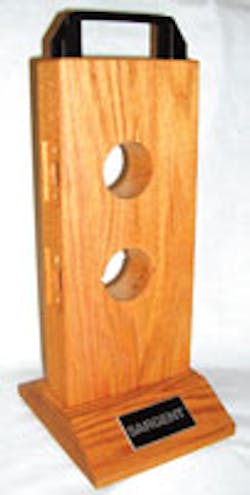
For this article, we will install the SARGENT 75G05 entrance double locking interconnected lock onto a mount. This interconnected lock has four- inch spacing between the deadbolt and the cylindrical lock cross bore openings. The cross bore openings for both the deadbolt and the cylindrical lock are 2-1/8” diameter. The edge bore openings are one inch in diameter.
To install the SARGENT 75G05 entrance double locking interconnected lock:
Step 1. Place the template onto the door to locate and mark the center of the cross bore and edge bore openings.
Step 2. Drill the cross and edge bore openings. If drilling a wood door free hand, drill the cross bore openings from both sides to limit the possibility of splintering. For metal doors, drill a 5/32” diameter hole on the exterior side of the door face at the 3 and 9 o’clock positions to accommodate the anti-rotation tabs.
Step 3. For wood door installations, recess the door edge to accommodate the face plates and install the latch and deadbolt. For metal door installations, use a latch forming tool to accommodate the deadbolt if needed.
Step 4. Install the cylindrical lock latch and the deadbolt into the door edge. The bolt was provided with a clear plastic spacer to fill the opening on a commercial door. When installing the SARGENT 7500 onto a residential application, remove the plastic spacer. Use the provided screws. Leaving the screws slightly loose during installation makes it easier to install the lock bodies.
Step 5. Locate the center line of the latch and the deadbolt. Extend this line to the jamb. Determine the position of the strike plates, making sure the latch strike plate is aligned so that when the door closes, the dead latch pin stops on the face of the strike plate.
Step 6. Cut out the opening necessary to accommodate the strike boxes.
Step 7. Install the strikes and their boxes using longer screws that will thread into the stud.
Determine the thickness of the door. If the door is 1-3/4” thick, install the locks without adjustment. If the door is 1-3/8” thick, the cylindrical lock must be adjusted.
To adjust the lock to accommodate a 1-3/8” thick door:
Step 1. Insert the operating key into the cylindrical lock.
Step 2. Rotate the key 45 degrees and maintain in place.
Step 3. Using a paper clip or similar tool, remove the outside lever.
Step 4. With the outside lever removed, rotate the outside rose plate clockwise three turns to center to accommodate a 1-3/8” thick door. The outside lever will be installed once the lock has been mounted onto the door.
To install the cylindrical lock and deadbolt onto the door:
Step 1. Extend the deadbolt.
Step 2. Turn the tailpiece vertical.
Step 3. Place the deadbolt with cylinder housing onto the door face, making sure the tailpiece slides through the opening in the deadbolt.
Step 4. Place the inside mounting plate onto the door and secure deadbolt lock cylinder using the longer two of the four through-bolt screws. Do not tighten the screws.
Step 5. Insert the cylindrical lock body through the cross bore, securing the latch onto the lock.
Step 6. Secure the cylindrical lock using the two shorter through-bolt screws. Do not tighten the screws.
Step 7. Test the operation of the key to make certain the cylindrical lock and deadbolt operate properly.
Step 8. Slide the inside escutcheon onto the mounting plate making sure the driver tab slides into the slot in the cylindrical lock’s inside tube. Make sure rotating the inside lever causes both the latch and the bolt to retract.
Step 9. Secure the escutcheon onto the inside lock plate using the four provided Phillips head screws.
Step 10. Install the inside cover, making sure the tailpiece slides into the thumbturn. Test to make sure the lock operates.
Step 11. Install the inside lever. Test to make sure the lock operates.
Step 12. Tighten the four screws securing the latch and the bolt to the door edge.
The SARGENT 7500 Interconnected Locks are available in four functions: storeroom double locking, classroom double locking, entry double locking, and entry single locking. The double locking functions have keyed deadbolt and keyed cylindrical locks. The single locking entry has a keyed deadbolt and a passage function cylindrical lock.
A choice of three lever designs is offered. The “L” and “P” lever designs are non-handed, having a return within one-half inch of the door face. The “Y” Coastal lever design is handed. They are available in seven finishes. Split finishes are also available.
Keying options range from standard SARGENT to competitor keyways, interchangeable core, and several levels of higher security including SARGENT XC and SARGENT Signature key systems.
For more information, contact your local locksmith wholesaler or SARGENT Lock at 1-800-727-5477. Web site: www.sargentlock.com.