SDC Exit Check Helps Business Fight Crime
In a not so unusual move, the client contacted our locksmithing business after becoming a victim. They were not sure if it was a robbery or a larceny, but they were very sure they were out $10,000. The door was unlocked to the premises, and the money was apparently taken after business hours.
The questions included:
1-Was it an employee?
2-Did someone conceal himself in the building and wait for everyone else to leave, and then grab the loot?
3-How did the robber know where the money was kept?
4-What measures could the business take to prevent such a thing from occurring in the future?
The police could not answer the first three questions, but we were able to provide multiple choice answers for question number four. First, we sold them a safe for the money and other valuables. Second, after a survey of the site and an interview with the operations manager and the president, we proposed installing an access control system. Management approved our proposal and the system was installed.
It sounds like it was easy, but actually it was not. We had to overcome a few hurdles, the least of which was the specification and installation of the access control system and the door controls. That part was pretty straightforward.
The hurdles were the fact that the client wanted a credential-based system that would log and control entry as well as egress through the two doors to the facility. The building had been designated as a historical landmark, meaning any changes to the exterior required a difficult approval process. In addition, the two subject doors were currently in-swinging.
We wrote a proposal that specified delayed egress electromagnetic locks and credential-based door control for entry and egress, and we stipulated that the client would need to get approval from the local authority having jurisdiction (LAHJ) before we would accept the job.
As anticipated, the LAHJ accepted the system we designed, but failed the building. First off, the smoke detector system was not operating or even being monitored. Next, the sprinkler system was dry. Finally, the two exterior doors were in swinging, which made them unsuitable for emergency exits or for special locking arrangements. Once the doors were modified for out swing, we were on our way. The sprinkler guy and the fire guy were on their own.
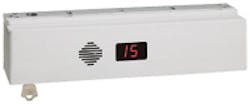
The new Security Door Controls Model #1511S Exit Check Delayed Egress Emlock; Security Door Controls Model MSB550 Mechanical Switch Bars and Security Door Controls Model 631 RF power supplies were selected for the project. Security Door Controls came out with a Delayed Egress Electromagnetic lock several years ago, and this new model combines features of several different models and adds code compliance capabilities at a new lower price point.
We were able to configure the #1511S to our exact application. We wanted to lock the doors magnetically without latching hardware. This was partially because of the higher price of a comparable latching delayed egress system, the ease of installation of electromagnetic locks, the type of doors we were installing on, and the feature set of the #1511S. While the LAHJ responded favorably to our system design, he still handed us a page out of the 2003 International Fire Code, and told us to be sure our equipment complied. The #1511S, of course, does.
Many delayed egress electromagnets use an integral sensor to trigger the system that someone is attempting to leave the premises and initiate the delayed egress feature. The #1511S can be field-configured for either internal trigger as just described or for an external trigger. Because of the unique trigger logic and design of the 1511S, the following operational sequence was perfectly tailored for this application. The electromagnet has essentially three states: Unlocked, Locked and Delayed Egress/Alarm.
By applying a closed dry contact to the bypass terminals of the 1511S, the 1511S is unlocked and it ignores all door movement. By opening the circuit to the bypass terminals, the 1511S locks. We wired the 1511S to an external trigger, which was a SDC switchbar mounted on the door. When someone presses the bar, the 1511S sounds a warning. If the pressure on the bar exceeds the nuisance time delay, the 1511S goes into the delayed egress unlock cycle. This includes a digital readout that descends from 15 down to 0, a verbal message and alternating beeping alarm sound. Contacts are provided on the 1511S for remote alarm annunciation. At the end of the cycle, the door unlocks. The audible alarm continues to sound. The door remains unlocked until it is reset with the supplied key and key switch. If someone pulls on the door from the outside while the system is locked, the 1511S ignores it, since it is looking for a trigger from the bar only. If a valid credential is presented to either the entry or egress reader, the 1511S unlocks for the programmed time. If the door is propped open, the alarm sounds and will continue to sound until the system is reset by key.
OPERATION
When unauthorized egress is initiated, the Exit Check delays egress through the door for 15 or 30 seconds. Meanwhile, the person exiting must wait while personnel or security respond. An integral digital countdown display and voice commands inform the person intending to exit of the seconds remaining to unlock. The door unlocks after 15 or 30 seconds have elapsed, permitting egress. A signal from the fire/life safety system will release the lock for uninhibited egress in an emergency.
Exit Check applications include:
Restricting the egress of patients for their own safety.
Restricting the egress of commercial center patrons for security application needs.
1511S Operational Description (NFPA-101)
The 1511S operation complies with the following building and fire codes: NFPA 101; NFPA 1-UFC; UBC; IBC; IFC; SBC; California Building Code. Listings: UL Listed: Special Locking Arrangements and Auxiliary Locks; California State Fire Marshal (CSFM) Listed.
The door is normally closed and secured and/or latched. The Model 1511 S Exit Check secures the door in the locked condition, and the display shows the preset delay time.
Activation of the 1511 S Exit Check is made by releasing the door latch and applying up to 15 lbs. of pressure to the door or by pressing the PSB560 Sure Exit request-to-exit bar, giving a pre-activation warning tone. A one- or two-second nuisance delay will prevent false activation of the alarm. When the nuisance delay time has been exceeded, the Exit Check begins the irreversible door release cycle. At this time, the display continues to count down, the verbal warning continues and an alarm output is provided to alert personnel of an unauthorized exit.
The integral digital countdown display and voice commands inform the person intending to exit of the seconds remaining to unlock. The Exit Check will release the door after the 15- or 30-second delay cycle has expired, allowing free egress. A steady warning tone with the voice command "Exit Now" will sound until the Exit Check is reset by authorized personnel.
1511S Operational Description (BOCA/Chicago)
The 1511 S operation complies with BOCA National Building Code and the Chicago Building Code: UL Listed, Special Locking Arrangements and Auxiliary Locks. The releasing operation of the 1511 S is the same as described above, with the exception that the door relocks automatically 30 seconds after closure (reset switch not required). Each time the door is open before 30 seconds has elapsed, the relock timer resets and relocks the door in 30 seconds.
INSTALLER SELECTABLE PARAMETERS
RELEASE TIME: Release time is selectable to 15 or 30 seconds. The Nuisance Delay time period is included in the door release cycle and it will not increase or decrease the "total time to unlock" once the ExitCheck is activated.
NUISANCE DELAY: The Nuisance delay time feature, intended to avoid accidental triggering, is selectable for one or two seconds. Releasing the door latch and pushing on the door will activate the internal trigger sensor.
Activating the trigger beyond the nuisance delay time will start the irreversible Exit Delay cycle time. The Nuisance Delay time period is included in the lock release cycle and it will not increase or decrease the "total time to unlock" once the ExitCheck is activated. Releasing the door before the end of the Nuisance Delay time will turn off the warning alarm and reset the ExitCheck to secure mode.
REQUEST-TO-EXIT PERIOD: The REX time is selectable to 1, 15, 20, or 30 seconds. REX time is the period of time the lock will remain "bypassed" after a remote normally open contact switch is momentarily activated. When activated with an access control system, the REX time cycle begins immediately after the access control open time expires. The ExitCheck will automatically relock if the door is opened and then closed during the REX time cycle. The REX input may also be used to reset the lock after the Exit Delay Cycle has expired.
TRIGGER TYPE: The trigger type is selectable to "REMOTE" or "INTERNAL." Selecting INTERNAL mode uses the internal trigger sensor to activate the Exit Delay cycle. Selecting REMOTE mode disables the internal trigger. Activation of the Exit Delay cycle is triggered by an external exit device equipped with a normally open contact switch.
POWER-UP OPTION: The power-up option, indicating the state of the ExitCheck upon restoration of system power, is selectable to "unlocked" or "locked." In the locked mode, the ExitCheck will attempt to reset to secure mode. In the unlocked mode, the ExitCheck will remain unlocked and the digital display will indicate two horizontal bars "--". Turning the reset switch momentarily to the reset position will relock and rearm the door. This feature enables the ExitCheck to comply with code requirements in jurisdictions that require manual reset/relock upon loss and restoration of system power.
ALARM TYPE: The alarm type is selectable to "TONE ONLY" or "VOICE." When secure, the ExitCheck digital display will indicate a 15-second delay time. Upon activation of the irreversible Exit Delay cycle, the digital display begins counting down to zero. In VOICE mode, the countdown will be accompanied by a warning beeping tone and verbal exit instructions. When the digital display indicates zero, the ExitCheck releases. The speaker output changes to a continuous warning tone and the verbal instruction announces "Exit Now." In TONE ONLY mode, the countdown will be accompanied by a warning beeping tone only, which changes to a continuous tone once the Exit Delay cycle expires.
MESSAGE TYPE: The message type is selectable to "MSG2" or "MSG1." MSG1: (Female Voice): "Facility staff has been alerted, door will open in 12 seconds...door will open in 5 seconds...exit now..." MSG2: (Male Voice): "Security has been alerted, door will open in 12 seconds... door will open in 5 seconds...exit now..." Both messages repeat "Exit now" until the lock is reset.
STANDARD FEATURES
- 1650 lbs. Holding Force
- 15 or 30 Second Exit Delay when activated.
- One-or Two-Second Nuisance Delay
- 85dB Alarm Tone with Digital Display & Selectable Voice Instruction
- Choice of Activation Trigger: Door Movement or Exit Device w/ REX Switch or Touch Sense Bar w/REX
- Vandal resistant Proximity Sensor Trigger
- Auto Sensing 12/24VDC input power
- Connection for Tandem Option (Pairs of Doors)
OPTIONAL FEATURES
- DPS Door Position Switch
- BAS Bond Alert Sensor
- ATS Anti Tamper Switch
- Energy Saver Option (1200 lb. Holding Force)
SELECTABLE AUTOMATIC & MANUAL POWER-UP FEATURE
Auto Power-Up occurs when power is restored and/ or the fire panel is restored.
Manual Power-Up is a UBC & California Building Code Compliant feature. - Only after power restoration and fire panel reset may the lock be reset manually at the opening. Lock can be reset with the built-in reset key switch or, a key switch or keypad adjacent to the door.
INPUTS & OUTPUTS
- REX Input
- Fire Alarm Release
- Remote Reset Input
- Remote Trigger Input
- Tandem/Slave Lock Input
- DPS - Door Position Status (Optional)
- BAS - Magnetic Bond Status (Optional)
- ATS - Anti-Tamper (Optional)
- Alarm Output
- Lock Status Relay Output
- Door Secure
- Door Unlocked
- Specifications
- Interior Applications Only
- Input Voltage Requirements:
- Dual Voltage (Auto Sensing) 12/24 VDC (+/- 10%)
- Power Consumption: 1511 S - 830/450 mA@ 12/24 VDC
- 1511T -1500/850 mA @ 12/24 VDC
- Size: 11 "L x 2-3/4"H x 2-5/8"D
- Lock Status Relay Rating: 1 amp @ 30V resistive
- Alarm Output Rating: 1 amp @ 30V resistive
- DPS Rating: 250 mA @ 30V resistive
- BAS Rating: 250 mA @ 30V resistive
- ATS Rating: 1 amp @ 30V resistive
For more information, contact your local locksmith distributor or Security Door Controls, 3580 Willow Lane, Westlake Village, CA 91361. Telephone: 800-413-8783. Web site: www.sdcsecurity.com.
About the Author
Tim O'Leary
Tim O'Leary is a security consultant, trainer and technician who has also been writing articles on all areas of locksmithing & physical security for many years.