Save Time and Money with the AD30 Transponder Coil Detector
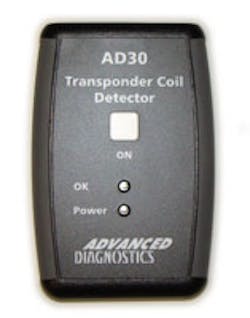
Advanced Diagnostics USA has introduced the AD30 Transponder Coil Detector to determine if a vehicle is equipped with a transponder- based anti-theft system. The battery operated AD30 has been designed to provide two important answers. The first is to identify if a vehicle is equipped with a transponder- based anti-theft system. If the vehicle is not equipped with an anti-theft system, then a locksmith can service the vehicle as necessary using non-transponder-equipped keys.
If the vehicle does feature a transponder-based system, the second, and probably more important, question that is answered with the AD30 is, “Is it emitting a signal through the coil assembly?” If the answer is yes, then the transponder-based anti-theft system is most likely operational. If no signal is emitted and the vehicle is equipped with the anti-theft system, making a key and attempting to program the vehicle will probably not be successful. This knowledge can keep the locksmith safe from the “whoever last touched it is responsible” rule.
The Advanced Diagnostics USA AD30 is approximately 4-1/2” by 3” by 1”. The transponder coil detector is equipped with an ON button and two LEDs. The Power LED illuminates when the ON button is pressed. The AD30 stays on for approximately two minutes before automatically turning OFF.
The second LED, labeled OK, illuminates if the vehicle tests positive for transponder signal. In addition, an audible tone sounds if a signal is detected.
Depending upon the make, model and system, the AD30 can detect the transponder-based anti-theft system signal in one of three scenarios. The first is placing the detector into the vehicle when the door is opened. The second is when the key is just inserted into the ignition lock, as the transponder coil detector is place near to the ignition lock face. The third is when the key is turning towards the ON position and the AD30 is placed in proximity to the ignition lock face.
To test the system, press the AD30 ON button. An LED by the word Power will illuminate, indicating the unit is operational. Open the driver’s door. If the signal is detected, the “OK” LED will flash and an audible beep will sound. If the detector does not detect the system when the door is opened, enter the vehicle. As you place the key into the ignition, position the detector as close as possible. If the signal is still not detected, turn the key towards the ON position, with the detector in close proximity. If the vehicle is equipped with a transponder-based anti-theft system, the AD30 will emit an audible beep and the “OK” LED will flash.
Note: Be sure to place the Advanced Diagnostics AD30 as close as possible to the coil surrounding the ignition lock when inserting the key or turning the ignition towards the ON position.
For more information, contact your local locksmith wholesaler or Advanced Diagnostics USA, 180 South Spruce Avenue, Warehouse “C”, South San Francisco, CA 94080. Telephone: 650-876-2020. Fax: 425-867-8959. Web sites:
www.autokeys.com or www.tcodeusa.com.