Someone in Europe started a group recently with the intention of treating lock picking as a hobby or sport. Through their picking conventions and on the internet, they have introduced methods for picking and opening locks to the general public. It is difficult to see what their motives are, but the damage has been done. This movement has now emerged in North America beginning with a picking convention held this summer in New York.
One of the results of this convention has been to highlight the procedure of key bumping in order to unlock a cylinder. If you use an internet search engine and ask for “key bumping”, you will find many sites including one which sells nine popular precut bump keys for $14.99. Anyone with a credit card can order the keys.
During the last few weeks, there have been a large amount of calls to our office on this subject. People are asking what key bumping is all about. They are also asking what it means both for our industry and for the security of existing locks in use.
Key bumping depends on Newton’s law that every action has an equal and opposite reaction. When a cue ball on a billiard table is propelled towards another billiard ball, the cue ball stops at impact and the second moves away. Mechanical and electric pick guns use this same principle. By striking a bottom pin in a lock with the momentary force of a pick gun probe, the driver pin reacts by bouncing away from the bottom pin which forms a momentary gap between the two pins. If a pick gun probe strikes all of the bottom pins in a lock at the same time, there will be gaps formed at each tumbler position and the plug can be turned to the unlocked position during that brief instant.
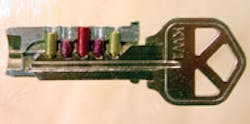
Someone discovered that a cut key could be used to strike the pins instead of using a pick gun. A specially cut key can strike all pins simultaneously which eliminates any guesswork involved with a pick gun. Using Kwikset as an example, the deepest normal cut is a “6”. A Kwikset bump key can be made by code cutting a key with a “6” depth in each space.
The next step is to remove a small amount of metal from the shoulders of the key. A second alternative is to insert the uncut key blank into the code machine vise jaw and align it with the vise jaw key stop. Next, move the shoulder approximately 1/16” away from the key stop (about the thickness of a dime) and tighten the key blank before cutting. In either case the result is that the distance from the shoulder to the center of the first cut has been changed to a longer dimension.
To begin key bumping, the cut key is first inserted fully into the lock and the key is allowed to come to rest. Normal spring pressure which holds the tumblers firmly into the key cuts causes the key blank shoulders to be held a small distance away from the plug due to the lengthened shoulder-to-first space dimensioning.
The unlocking procedure consists of delivering a quick tap to the bump key using a screwdriver handle, small hammer or other light instrument. One manufacturer of locksmith picks has introduced a special tool for tapping bump keys. Unfortunately his tool was somehow obtained for use at the recent New York sport picking convention.
When the bump key is hit, the added dimensioning from shoulder to plug allows the key to move inward a short distance before the shoulder strikes against the plug. During this quick inward movement, the tips between each cut on the key strike the tumblers, exerting upward movement to the bottom pins. A gap can occur between each bottom pin and driver pin because of the Newton action-reaction principle. A very light turning pressure is exerted at the same time the key is being struck. It usually requires multiple releases of tension and taps on the bump key before either the cylinder opens or the mechanic decides that key bumping will not work on this particular lock cylinder.
The theory behind key bumping is real, but in actual practice key bumping is not always successful. The first problem is with the timing in “catching” the gap. Very light turning pressure may allow the top and bottom pins to rejoin contact. Heavy turning pressure does not allow the pins to separate.
A second problem can be the actual key combination. If the combination of the lock contains some of the deeper cuts, those long bottom tumblers will be moved across the shearline during the bumping process and there will be little or no opportunity to turn the lock open. A video on the internet available at www.toool.nl shows an 11-year-old girl at the New York picking convention who hit the bump key only twice before a Kwikset lock opened. It would be interesting to know what the cut combination was for that particular Kwikset lock. One can almost guess that it contained all shallow cuts either deliberately or by accident.
I am reminded of a locksmith who gave a class several years ago on servicing foreign car locks. He sold homemade cut keys which could pick open Jaguar Tibbe locks in a fews seconds. He had several Tibbe locks which were passed around the room and everyone immediately unlocked the locks using his special keys. I later tried unsuccessfully to open several different Jaguar Tibbe locks with one of his keys. I discovered that the only Tibbe locks that could generally be opened were those which had a combination using just one ‘3’ cut and that ‘3’ cut had to be in the first position of the combination. By prearranging cuts in the trial locks, the picking key worked, but it rarely worked on the job when it really counted.
A third problem is the possible damage done to the lock. Each time the key is bumped, or hit, the shoulder is pounded into the lock plug and the tumblers are being violently pushed horizontally as well as vertically. Tumbler holes, especially in soft material such as die cast, could become egg-shaped after repeated bumping. You could end up with a damaged lock plus a door that is still locked.
It is true that key bumping is a possible alternative for opening a percentage of pin tumbler locks. Lock picking is also an alternative for opening many types of locks. Both unlocking techniques may open a particular cylinder but there is no guarantee that either technique will always accomplish the job. The real problem with key bumping is that there is very little training needed to teach someone how to beat the dickens out of a lock with a bump key.
We do have many solutions for key bumping in the locksmith community and they are called high security locks. Bump keys usually only work on lock systems which have a single action such as with standard cylinders where tumblers are moved to a shearline. Most high security cylinders have at least two actions, primarily moving tumblers to the shearline plus a second action involving sidebars or side pins . There are also high security locks which use other systems such as rotating parts or magnets which are also not generally susceptible to key bumping.
LAB was contacted for their ideas regarding special driver pins that might be available to deter key bumping. LAB introduced grooved driver pins in 1983 which are designed to ‘lock up’ and resist movement of the driver pins whenever turning pressure is exerted on a lock plug. Regular vertical pin movement, such as when inserting an operating key, is not affected. LAB is currently undertaking trials of their grooved driver pins and other driver pin designs in order to provide answers to the threat from key bumping. Locksmith Ledger will report on their findings when available.
In addition to key bumping, the locksmith profession is also under siege from nationwide companies with high priced charges for lockouts. Their employees reportedly use battery operated drills more often than lock picks. As with key bumping, it takes just a few minutes to train an amateur about where to drill for the cylinder shearline. For a few extra cents, manufacturers could install a hardened washer behind the face of lock plugs. While not a complete prevention, at least it could slow down or deter these amateur newcomers.
It will be interesting to see how lock companies come to grips with these questions about basic pin tumbler design. From residential to commercial, most stock locksets have been manufactured for over 100 years with standard, single-action pin tumbler cylinders which can possibly be unlocked by key bumping. High security cylinders have usually been considered special order or aftermarket replacement items. Perhaps there should be at least three levels of off-the-shelf locksets: standard, drill resistant and high security. As the public is made aware of possible security weaknesses in existing products, the demand for better lock products will be there.