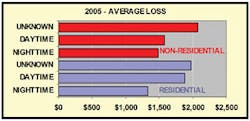
National crime statistics for 2005 were released in September, by the Department of Justice. Residential burglaries (home invasions) are just slightly up from the previous year.
Locksmiths are an important component to crime prevention programs. They are routinely called upon to suggest locking hardware and property modifications to limit the chances a residence will be burglarized and to thwart the burglar wherever possible.
Understanding how burglars think and what attracts them is advantageous for a locksmith when performing home security surveys.
About burglars
In 2005, more than 1 million homes in the United States were burglarized with the average “take” being $1,725. That’s a burglary every 30 seconds and close to $2 billion taken-down.
Burglary is a crime of opportunity. Burglars are either burglarizing homes or scouting neighborhoods for potential targets. Most home burglaries occur during the day. A daytime potential target is a residence where no one is home and entry is both easy and concealed.
When the reward or “take” is believed to be sufficient, the burglar will return at a later date when the opportunity again avails itself. A big “take” can guarantee the burglar will be back, even if the home has been fortified.
As burglars perfect an entry technique, they will gravitate to homes that allow them to use that technique. The technique will be repeated again and again until it is no longer effective.
Taking A Bite Out Of Crime
Before fortifying the castle, you need the fortitude of the homeowner. It is not practical to make a home burglar-proof. Your customer would hate living in a home that feels like a prison.
To install the right locks that provide burglar protection, the locksmith must be aware of what works in the area and the commitment of the homeowner to use the locks after they are installed.
About half the burglaries in 2005 were made by entering unlocked doors or open windows.
What the locksmith wants to achieve is not to make the home a fortress but to reduce the chance the home is chosen for a burglary.
The locksmith’s goal is especially difficult to achieve if the home has been burglarized before.
A comprehensive plan is to: reduce the opportunity; increase the burglar’s risk of being caught; and limit the reward when a burglary is committed.
The opportunity is reduced when the only means into the home is through doors and windows that are adequately secured and easily visible from the street or to good neighbors.
Closing the Door on Thiefs
All doors into the home should be heavy-duty, either hollow metal or solid core wood, and at least 1-3/4” thick. Door with less thickness or doors that are damaged need to be replaced.
If wooden doors with panels are desired, the doors should be made out of oak or other hardwoods with reinforced panels. Or as an alternative, a hollow metal door with the panels is an option.
Any decorative window lites should be double-paned and tempered.
French doors or bel-air style (half the door is a glass pane) doors should always be replaced as they present an opportunity. Where burglars usually do not like to break glass, they do not mind breaking small panes of glass or glass near a lock that can be easily reached.
The face of metal doors must be sufficiently thick so that the doors cannot be easily flexed at the bottom or top. The faces of many residential steel doors are often impressed with a paned pattern. These doors must be filled with foam that adds to the rigidity of the door.
Doors can be both aesthetic and secure. There is an argument that aesthetic doors and locks are too expensive and the homeowner never recovers the cost when the home is sold. However, these doors can provide a level of security that tells a burglar to “move on.” That in itself is worth the price of the door and locks.
In Photo 1, the homeowner replaced the entry doors with massive oak doors.
Double doors present a real problem. Where homeowners may think that two doors are better than one, burglars know that the deadbolt is only as secure as to what it locks into. Usually the non-active leaf is secured by ¼”-to 5/16” aluminum bolts (top-and-bottom). These offer little or no security.
A partial running kick to the middle of these doors it all that is needed to make an entrance -- no tools necessary.
In Photo 2, the replacement doors feature 1/2” diameter steel bolts at the top and bottom of the non-active leaf.
Panels that are installed into the bottom of doors for pet access can create an opportunity for entry. There are thin burglars who specialize at entering through medium-to-large dog doors.
Several years ago there was a rash of burglaries in California where the burglar used the children he was baby-sitting to make entry into homes through pet doors. He would keep the children occupied by having them make sandwiches in the kitchens of his victims while he ransacked the home.
The door is only as strong as the jamb around it.
Jambs that are cracked, loose, or weather-worn need to be replaced.
Quality Deadbolts
Every door should have a quality deadbolt installed on it. This is the lock that should always be thrown to secure the door. Homeowners will often lock the bottom lock (the lockset) and ignore the top lock (deadbolt). Burglars know this and often rely on the fact that the deadbolt is not locked. According to statistics, approximately half of the residential deadbolt locks are used on a day-to-day basis. That works out to about one in four residences have and use a deadbolt lock.
Because reducing the opportunity is all about visible deterrence, it is a good idea to replace the lockset with a passage or handleset. It then becomes obvious that the door is either left unlocked or secured with the deadbolt. The greater the visible deterrence, the more likely the burglar will go somewhere else.
Auxiliary security screens, installed with deadbolts, are an excellent deterrence but can greatly decrease the curb-appeal of a home. In high-crime urban environments, they are a must because they are inexpensive and effective.
When a security screen is desirable, it is a better idea to have one built that conforms to the design of the house. These types of security screens have more curb appeal.
In very high crime urban areas, even the windows are secured with gratings and bars.
In one city a burglar perfected an entry technique that included the use of a simple come-along. He chose homes that were built close to each other, each having grated windows across from each home. The burglar fastened a “come-along” on one home’s grated window and then fastened the other end to the other home’s grated window. He would ratchet away and whichever window gave first that is the home that got burglarized.
Entering through a concealed open or unprotected windows is always the preferred method for the burglar. Window latches are notoriously easy to thwart. Windows should be pinned or secured closed with window locks.
Windows of Opportunity
Window sections that can be removed from the outside by lifting the section before removing need to be pinned at the top so that they cannot be lifted.
Window security should be visible from the exterior so that it gives a clear message to the burglar that entering will be no picnic.
When addressing windows, the best method is to replace older windows with modern window kits that feature double panes and heavy-duty reliable latches.
These types of modern windows are both visibly attractive and secure. The added benefit is that these windows pay for themselves by offering superior insulation and noise abatement.
Sliding Glass Doors
Sliding glass doors often attract the burglar especially those that feature outside leafs that slide and can be removed from the exterior side (these doors are often called “outside sliders”).
It is very difficult to secure “outside sliders.” Locksmiths might be tempted to install elaborate locks designed to secure “outside sliders” but this is contrary to the main goal of “telegraphing” that this is a door that cannot be opened. Replace “outside sliders” and keep the burglar from getting close enough to try the door.
Burglars are familiar with the locks on sliding glass doors. Most can be easily rattled open even when they are locked.
There are many types of sliding glass door locks available, but the best to use are those that can be seen from the outside (to discourage trying the door) and those that are visibly evident that they are locked.
A homeowner should be able to glance at the lock and tell if the door is properly secured.
Roof Access
The only means into the home should be the doors or windows. There is a trend with today’s burglars to make entry by removing roofing material and climbing through ceiling material
Any kind of climbing-aid or ladder must be removed away from the building and made unavailable, especially on two-story homes. Doors that lead into the home from balconies need to feature deadbolts. Make sure that all parts of the roof are easily visible from the street and neighbors’ homes.
Lighting
Lighting is important. Although most burglaries are committed in the daytime, a significant amount of home burglaries are committed at night.
In Photo 7, the homeowner has had a security light installed that features a motion sensor. Persons passing by on the sidewalk can set this off.
Exterior lighting controlled by motion detectors is key to reducing opportunity by night.
Windows that are left opened upstairs are very tempting to burglars. Homeowners will often underestimate the ability of burglars to climb into the second floor.
Gates leading to backyards need to be visibly secured by an adequate deadbolt or padlock.
All brush, bushes and trees that normally obstruct the view of gates, doors, and windows, need to be cut back.
Walking by the two homes in the same neighborhood reveals one is easier to enter the rear yard than the other. Even though the one gate looks more secure, the bushes allow the burglar to conceal the entry into the rear yard.
In Photo 8, the traditional window is concealed by bushes. The picture on the right is after a modern security window is installed and the bushes are trimmed down.
Window fans and air conditioners often lend a means into the home. They should be adequately fastened to the window or opening so that it is obvious that entering by removal is not an option.
Increasing visibility is essential to reducing the opportunity. Clearing the lot, limiting the height of greenery, and eliminating concealment will reduce opportunity during the day.
Besides fortifying the home and exterior lot, homeowners should also make the home look occupied whenever possible.
One of the best means to reduce the chances of a burglary is to get a loud, barking dog. Size does not matter; attitude does. A barking dog inside of the residence keeps the potential burglar outside.
When a burglar is visible, he is vulnerable. Bright lights and barking dogs are not what he wants.
Increasing the chance of getting caught
When reducing the opportunity has failed, the back-up plan is to increase the burglar’s chance at getting caught.
Locksmiths are especially good at this, since this relies on the proper installation of locks and hardware. Locksmiths also know how to “beef-up” the installation.
The addition of over-sized and hardened screws and bolts can greatly fortify a typical installation. Special preparation can slow down the burglar’s entry.
Strike plates and deadbolt keepers need to be tied into the 2x4 to which the door jamb is nailed.
When securing plates: deliberately drill-out the holes that would normally fasten the plate to the jamb. Use hardened 2” or 3” screws that pass through the jamb and tie into the 2x4.
Doors that open inward should have at least one screw per hinge removed and replaced with a 2” or 3” screw in similar fashion.
This prevents kick-ins from the hinge-side of the door. A burglar who specializes at this will get quite a surprise when the hinges don’t split away after two-or-three kicks.
Door that open outward should feature non-removable-pin hinges; or studs that are mounted between the door and jamb. This prevents the door from being lifted out of the jamb casing.
The upper rail of windows (and sliding doors) can be pinned so that window sections cannot be lifted out and then removed.
The locksmith should have available an ample supply of window pins and assorted security screws when fortifying the home.
Interior lighting controls can be installed, providing random patterns of light activation. Some have built-in motion sensors that can catch a burglar by surprise.
Alarms
Nothing says “leave quickly” like triggering a loud alarm. The best home alarms are tied into the homes lighting and exterior sounders. They literally create a light show until they are reset.
Loud exterior and interior sounders drastically reduce the amount of time the burglar is in the home.
Alarms are tricky as false alarms must be severely limited. Too many false alarms and neighbors stop paying attention. Many communities have ordinances limiting false alarms.
If it can be afforded, private security is an excellent means to inhibit the burglar. Private surveillance is expensive, the neighborhood watch is not.
Neighborhood watches are great deterrents. Nothing deters a burglar more than the movement of the window curtains next door to a targeted house.
Exterior and interior cameras are great at catching the burglar in the act. Make sure the recording media is either well-secured or transmitted to a remote location.
On the average (as per the Department of Justice) burglars give themselves 45 seconds to get in and out. Time is critical. As an example, a burglar might expect that a set of double doors will blast open when rushed with full force. When this doesn’t happen, the burglar is confused. A second attempt might be made, but when it fails most likely the burglar will leave.
While trying to reduce the opportunity of a burglary, the locksmith should add deterrents that are visible. The opposite is holds true when the locksmith prepares deterrents to increase the risk of getting caught. The idea is to steal (excuse the pun) seconds from the burglar. Enough “penalty” time and the burglar must leave or risk being nabbed.
Deterrents designed to slow the burglar down should be random, unexpected, and difficult to understand how they work. Imagine that burglar who is trying to smash through the hinge-side of an in-swinging door. When the door doesn’t give (remember those reinforcement screws) it isn’t immediately clear as to why. It is better to walk away than waste precious seconds figuring it out.
Limiting the reward
A worst case scenario is when the home is successfully burglarized and the burglar was amply rewarded. There will be a second attempt.
Locksmiths should convince their customers, especially those who have been burglarized, to compartmentalize there valuables.
Use strong boxes, safes, and vaults.
Strong boxes and safes that are light enough to be carried or rolled should be fastened to the building’s infrastructure with bolts.
Locksmiths know that security lag bolts drilled and tapped into concrete do not keep a strong box or safe from being removed. It is very easy to pry lag bolts out of concrete.
A better way is to cut out a section of the concrete; install a steel plate (that the bolts will be fastened to); and then refill the void with hardened concrete.
Where this cannot be done, install bolts into the concrete after placing the strong box or safe on the concrete but up against a wall. Mount additional bolts that tie into the studs of the wall. The bolts should run through the box or safe from the inside so when the door is closed there is no access to the bolts.
Another way to “limit the reward” is to engrave or mark valuables with identification numbers. Pawn shops will not deal with goods that are marked.
Preventing another occurrence
No matter how little the “take” or if the attempt was unsuccessful the police should be informed. Sometimes the homeowner neglects to do this.
While repairing a break-in late at night, one locksmith let the police know that the forced entry was done with a particular pry bar that left distinct marks. By passing that onto the investigating police, the burglar was nabbed that night because of a random stop and his possession of that same pry bar in the trunk of the car.
Wise homeowners will ask the locksmith to perform a comprehensive survey. There are many resources for home security surveys. Law enforcement and neighborhood watches make these available on the internet. Some of the best survey materials are offered by lock manufacturers.
Home Security Checklist
Reduce the Opportunity
—Check for roof entry
—Padlocks & Hasps on both sides of garage door
—Securely fasten window-mounted air conditioners
—Install lighting with motion sensors
—All doors minimum 1-3/4” thickness
—Glass lites double-paned and tempered
—Double doors secured top and bottom with heavy duty bolts
—Heavy duty deadbolts on all exterior doors
—Install security screens with deadbolts
—Replace outside sliding glass doors
—Install heavy duty lock that can be seen from outside
—Use type of lock that indicates locked status
—Remove climbing aids (to roof or 2nd floor)
—Clear brush/bushes that block doors and windows
—Limit entry to back yard through a locked gate
—Consider a loud barking dog
—Start a Neighborhood Watch
Increase the risk of getting caught
—Reinforce strike plates and jambs
—Install screws in top channels of windows
—Install interior lights with motion sensors
—Install a home alarm with loud alarm sounder
—Install video camersas and secure recording media
—Employ private surveillance
—Report suspicious behavior
Limit the reward
—Use strong boxes, safes and vaults
—Fasten security compartments to walls/floors
—Mark or engrave identification onto valuables
Limit the chance of a second try
—Report all burglary attempts to police
—Let the neighbors know what is going on
—Greatly fortify the home
—Make the home look occupied at all times