LA GARD Smartpoint: Full Blown Access Control for the Safe
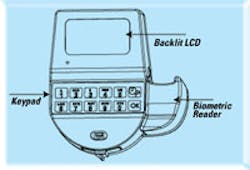
Controlling access has become more and more important in our security and liability conscious society. With the development of electro-mechanical and electrified door lock hardware, we can now control and monitor persons that have access into a specific locations within a facility, area or office complex.
In fact, the way that access can now be controlled has become much more personalized. Instead of a User Code and/or magnetic/proximity card, an individual’s form of identification can now include a part of his or her body, such as an individual’s unique characteristics of a finger, hand, eye, or even face. These biometric features cannot be easily replicated, unlike User Codes or even identification (magnetic/proximity) cards.
Why stop at the door? Why not continue this higher level of security with the next area of importance, the safe?
Safes have been around for a very long time. They have evolved from the mechanical key and dial operated units to electronically operated locks that resist manipulation and have the ability to delay and/or limit access to specific days and/or hours. To satisfy growing needs for privacy and security, safes are becoming larger with greater need for separate compartments.
Expanding upon the features of controlling access into a safe and the individual compartments, LA GARD has developed the SMARTPOINT, a battery or AC powered, biometric identifier system built into an electronic safe lock mechanism with audit capabilities. The LA GARD SMARTPOINT controls access for up to five wired electronic safe lock mechanisms. These include the LA GARD Dual Handed Springbolt Lock, the Deadbolt Lock, the Springbolt Lock and the Redundant Mechanical Lock (RML). The RML provides a completely redundant opening mechanism, one electronically controlled and the other mechanically controlled.
Each of these lock types is equipped with an audit log recorder for the last 500 events. The log includes time, date, user and definition of the activity.
Individual lock’s audit logs only record those events that affect the operation of the lock itself. Each lock’s audit log will not record events such as programming the SMARTPOINT or any other entry that does not operate the specific lock.
The SMARTPOINT logic module records the last 1,000 events and functions performed regardless of lock’s address, which is usually located on the outer door of the safe. The audit logs can be scrolled through using the backlit LED on the front of the logic module.
The SMARTPOINT logic module contains the keypad, LED, and the FingerPoint Technology™ Reader. The keypad is used to program the system and the codes. The biometric unit contains a Light Emitting Sensor (LES)- equipped reader designed to read a fingerprint image when a “live” finger is placed onto the Teflon coated sensor. The sensor of the LES reader is not porous and can be cleaned using a mild cleaner. Contact LA GARD for specifics.
To create the image, all of the finger’s characteristics play a part. The physical finger and the body’s blood flow create electromagnetic radiation. When bombarded by particles from the FingerPoint Technology Reader, radiation fluoresces to create a three-dimensional image of the finger’s surface that is contacting the sensor. The image is recorded, then interpolated using the proprietary algorithm to determine the desired identifiers. The identifiers can include the depths and angles of the whorls, ridges, etc. Each finger’s interpolation is considered unique and entered into a database from which future finger images will be compared. The SMARTPOINT system requires no more than three scans per finger to extract all of the necessary data. The SMARTPOINT prompts for two fingers in order to enroll a person. The reason for multiple fingers is in case of a cut or injury, you have a back-up. A third finger image can be entered into the system for a duress situation.
Important: Placing the third finger enrolled onto the sensor silently notifies the alarm monitor or security personnel. The safe will also unlock when the duress finger is read.
For normal operation, the proper person’s finger is placed on the opaque Light Emitting Sensor reader. The LES transmits the fingerprint image data. Proprietary algorithm interprets the image looking for the finger points; comparing the ridges, valleys, whorls, and the distance between them to those images stored in the database. Once a proper match is found, the User is identified and access can be granted if the time, authorization number, etc. are correct.
Security settings for the fingerprint image on the SMARTPOINT can be changed for specific individuals to accommodate individual situations. There are seven levels of security. The number four level is the standard. If set at seven, the fingerprint data must match exactly. For a person having prints that are more difficult to read, the security setting for that individual can be set lower.
Note: The factory recommends discussing potential changes with a LA GARD representative prior to making changes.
The LA GARD SMARTPOINT system is designed for three levels of keypad codes. The Master Code can program all functions of the SMARTPOINT including gain access to the Master Menu and set system operation mode. However, the Master Code cannot unlock any of the locks. There is only one Master Code and it is eight digits.
The Manager Code cannot install locks; however it can gain access to the Manager Menu, program User Codes/Fingerprint Users and can unlock the locks. There is only one Manager Code and it is six digits.
The Users Codes can only unlock locks that they are programmed to operate. There are eight Users Codes, each of which is six digits.
The SMARTPOINT system can be programmed by the Master Code to operate using:
- Code or Fingerprint only
- Dual Code
- Fingerprint and Code
- Fingerprint and Dual Code
- Dual Fingerprint and Dual Code
To prevent manipulation, the wrong try penalty is a five minute delay period after four (4) consecutive invalid codes.
The LA GARD SMARTPOINT is sold as individual components, enabling each installation requiring only the necessary parts.
The software driven program for the SMARTPOINT is designed for operation on a PC or laptop running Windows® 2000 or higher.
The SMARTPOINT can be battery powered or AC powered, with DC backup. There is one nine volt battery contained within the logic module. Small or large battery boxes are available if using time delay/time lock functions.
When battery powered, the factory recommends that the battery be change yearly. The nine volt alkaline battery is located in the logic module beneath the keypad. To change the battery, remove the black plastic battery compartment cover by pulling down on the handle.
For more information, contact your local locksmith wholesaler or LA GARD, Inc. Telephone: 310-325-5670. Fax: 310-325-5615. Web Site: www.lagard.com. E-mail: [email protected].