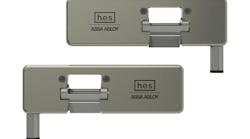
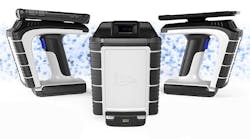
Whenever a new product hits the scene, locksmiths want to know two things: how it can help them do their jobs easier, and ultimately, how it can help them make more money.
The field of access control has exploded with new technologies and products. Two of the newest products are HES electric strikes. Each of these is a step forward. One of the electric strikes improves installation and adjustment, while the other features a built-in proximity reader for self-contained installations. Since each of these new HES items is unique, we'll use this article to do an overview of each item.
RF5010 SERIES HYBRID
The RF5010 is a unique ‘hybrid' product that merges the access control characteristics of an HID proximity card reader with the mechanical security of an HES grade 1 electric strike.
In addition to the integrated HID prox module, a door position switch and latchbolt monitor is a standard feature. A red/green LED and audible buzzer confirm an authorized access.
The non-handed RF5010 comes in two versions: one with an internal antenna (for use on out-swinging doors) and one with an external antenna (for use on in-swinging doors).
These units work with cylindrical locks having up to a five-eighths inch throw latchbolt, while its sister product, the RF5210, accommodates up to a three-quarter inch throw latchbolt.
The RF5010 features open architecture compatibility and interfaces with existing Weigand Protocol systems. It recognizes HID 26-39 Bit Format proximity cards and supports HID 125 KHz credentials.
The proximity reader module requires an operating voltage of 10-14VDC (125 mA Max. @12VDC) and the electric strike module operates at 12VDC (240 mA Max. @12VDC).
The Weigand interface specifies a 500-foot maximum distance to the host using 18-22AWG (depending on distance) stranded and shielded cable.
The RF5010/RF5210 offers a lifetime warranty against defects in material and workmanship.
The RF5010 Series allows you to install a single, complete access control device in the space and time it takes to install an electric strike. Note: The external antenna version for in-swinging doors does require a one-inch hole on the outer jamb for the reader/antenna.
To clarify, the RF5010 external mounted sample shown has the external antenna/reader mounted on what would be the inside of the frame. On an in-swinging, door this antenna/reader would be mounted on the exterior doorframe.
After mechanical installation is completed, the unit can be tested for proper operation. When power is supplied to the electric strike, the LED will flash green three times while the beeper simultaneously beeps. The LED will then turn red. This sequence indicates that the micro-controller is operating properly.
Presenting an authorized HID card to the reader/antenna will cause the LED to turn green while the beeper beeps once, indicating an authorized credential. The keeper will click open to allow access.
An unauthorized credential will result in a red LED and no strike activation.
5900 / 9001 ELECTRIC STRIKE SERIES
Introduced recently at the SHDA conference is a new family of electric strikes at HES. All of these strikes share some common features. They all:
· Fit into a standard ANSI 115.2 dust box with no cutting or frame cutting or frame prep required.
· Conceal the strike entirely within the frame for a smooth, clean installation.
· Feature a unique ramp and keeper design to deliver Grade 1 strength.
· Incorporate vertical adjustability to accommodate sagging misaligned doors.
· Accommodate cylindrical latchbolts
The first generation in the new series is the HES 5900. It incorporates all of the features mentioned above. The second generation 9001 adds the ability to handle 25 lbs of pre-load pressure and is scheduled to be released in early 2008. The third generation (as yet un-named) is still in R&D testing. It will deliver both the pre-load feature and a fire rating.
HES first introduced the 9000 series in 1986. It was the first electric strike to fit into a standard frame without cutting and frame modification. However, for this type of strike to function properly, the centerline of the dead latch/latchbolt must vertically align perfectly. In the ‘real world,' many doors don't align perfectly and the application of this strike was limited. Still, the concept was strong.
Building on the lessons of the 9000, recent HES innovations include a vertically adjustable internal ramp, allowing the introduction of the 5900/9001 Series. Without this feature, this type of strike would not be reliable.
The patented design permits ramping of the latchbolt back into the door as the door is opened, in a motion similar to when the door is closed. The 5900 also incorporates a vertical adjustment feature that allows the unit to operate smoothly when adjusted to accommodate a sagging or misaligned door.
During installation, the strike is set into the frame and a pencil mark is made to denote the vertical centerline of the deadlatch. On the side of the strike, loosen the two 6-32 truss head screws securing the ramp. Slide the ramp up or down to align the center point between the two ramps with the pencil mark. (Note: My sample was a pre-production model. The centerline between the two ramps will be inscribed on the production models).
The unit is field selectable for 12 or 24volt operation and fail-safe or fail-secure application. Electrical specifications are stated as .24 Amp @ 12VDC and .12 Amp @24VDC, DC – Continuous Duty / AC Intermittent Duty.
Standard Features include:
· No cutting of the frame
· Vertically adjustable internal ramp
· Tamper resistant
· Static strength 1,500 lbs.
· Dynamic strength 500,000 cycles
· Field Selectable fail-safe/fail-secure
· Field Selectable 12 or 24volt AC or DC
· Non-Handed
· Internally mounted solenoid
· Latchbolt accommodation up to five-eighths with one-eighth door gap
· Strike body depth one and one-sixteenth
· Plug-in connector
· Five year warranty
An optional latchbolt monitor is available and accessories include a plug-in bridge rectifier, an ElectroLynx adapter, a Smart-Pac II, a plug-in buzzer and a plug-in LED indicator.
The design of the 5900 Series is so shallow that it fits into the frame without removing the ANSI dust box. With no cutting on the frame, the Grade 1 strike is designed to simplify installation and reduce installation time.
Both electric strikes offer a choice of faceplates in multiple finishes to cover any application.
· 501 Faceplate (1-1/4” x 4-7/8”): Square corner ANSI installations in a metal jamb. ANSI A115.2 (1” dust box)
· 501A Faceplate (1-1/4” x 4-7/8”): Radius corner ANSI installations in aluminum jambs.
· 502 Faceplate (1-7/16” x 7-15/16”): Radius corner installations in wood or aluminum jambs.
· 503 Faceplate (1-1/4” x 6-7/8”): Radius corner installations in aluminum jambs.
· 504 Faceplate (1-3/8” x 10”): Radius corner installations in wood or aluminum jambs
Faceplates for cylindrical latchbolts also include:
· 594 Faceplate (1-1/4” x 9”): Radius corner installations in wood frames.
Faceplate architectural finishes include 605-Bright brass, 606-Satin brass, 612-Satin bronze, 613-Bronze-toned, 629 Bright stainless steel, 630-Satin stainless steel, and BLK-Black.