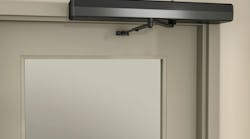
Door closers and automatic operators provide convenience, safety, accessibility, and security in buildings by controlling door speed and force. Properly manufactured, installed, and maintained door controls provide many years of safe, trouble-free operation.
However, in the overall scope of builders hardware products, door closers and door operators are more likely to be involved in personal injury litigation than other hardware products. The reason is obvious; a door weighing from 100 to 200 lbs. moving in the path of a pedestrian can be hazardous if the door speed is not under control.
Considering the enormous number of doors with door closers and operators, and the relatively few reported incidents of personal injury involving door control products, their safety record is outstanding. However, accidents do happen, and a few of these incidents result in personal injury lawsuits.
The best way to avoid a personal injury lawsuit is to keep door hardware, particularly closers and operators, in good working order. However, despite the best efforts of those responsible for installing and maintaining doors and hardware, there is always the potential for a personal injury lawsuit, even if the door appears to be working perfectly. Those responsible for installing and maintaining door controls should have a preemptive personal injury lawsuit defense.
When an accident happens, the question arises, “Who is likely to be sued?” The “water cooler” answer is typically, “everyone involved.” The real answer is more straightforward. Plaintiffs, through their attorneys, try to recover damages from defendants with the means to pay, namely “those with deep pockets.” Building owners, management companies, manufacturers, and contractors with tangible assets or liability insurance are the most likely to be named in a lawsuit or cross complaint. Their employees are rarely named as defendants. However, employees may spend hours digging through records in the “discovery” phase of litigation, or in giving lengthy depositions.
Building owners or managers and their tenants should maintain a safe environment for their employees and their patrons. A written and enforced inspection and maintenance policy helps prevent accidents and serves as a formidable defense in itself. Should a lawsuit arise, such a policy shows the court the defendant is diligent and responsible. Contractors and locksmiths can build a preemptive defense through several “common sense” procedures.
LICENSING
It is important to understand state and local licensing laws. For example, California locksmiths operating outside in the field are required to have a California State Contractor's License. The owner of the firm holds the license and employees must have a locksmith permit issued by the state. Entrepreneurs may not represent themselves as being licensed by using someone else's license number. Unlicensed contractors have no legal right to collect payment for their services and have virtually no defense should their actions result in a personal injury lawsuit.
INSURANCE
Companies that install and service automatic doors must advise their liability insurance carrier of activity in this field. It is important to tell the carrier what type of automatic door is being serviced. Some insurance carriers offer lower rates for contractors installing solely low energy automatic doors as defined by ANSI A-156.19 versus those who work on high-speed operators (ANSI A-156.10).
KNOWLEDGE OF ANSI STANDARDS
The American National Standards Institute (ANSI) maintains minimum design and performance standards on builders' hardware products. Manufacturers certify that their products meet ANSI standards and the various grades within the standards. Building codes and procurement agencies typically require that products used on commercial and government buildings meet ANSI standards. Compliance with ANSI standards is often at the core of plaintiff and defendants' cases. Expert witnesses and consultants use ANSI standards as a guide when performing their inspection during site surveys. In deposition and trial, compliance (or non-compliance) with an ANSI standard may be pivotal in the ultimate outcome of a case. Contractors and building managers should maintain a file of ANSI standards. The manuals are relatively inexpensive and available directly from the American National Standards Institute.
CERTIFICATIONS
Hardware manufacturers and distributors offer courses in the installation and maintenance of their products. Technicians should attend these classes and request certificates of completion. Industry trade associations offer certifications that require industry experience or completion of a testing program. The Associated Locksmiths of America (ALOA) offers classes and several grades of certification with elective choices. The American Association of Automatic Door Manufacturers (AAADM) offers an inspector certification to member-sponsored participants that work with automatic doors. Candidates must verify tenure in the industry, take a two-day class, and pass an examination based on the material they learned in the class. Certifications and membership in industry associations enhance a defense.
Distribution and installation of automatic door operators was once limited to factory branches or franchises. However, since the adoption of disabled access provisions in building codes, several manufacturers now offer “low energy” door operators through the builders' hardware distribution channel. The standard for low energy door operators is ANSI A-156.19. It limits door opening and closing forces, door speed and weight. Access to these products opens a sizable market to small contractors and locksmiths. However, it exposes them to increased liability exposure, even though the safety record for low energy door operators is excellent. AAADM recently included low energy door operators in their inspector certification program.
AAADM
Manufacturers of automatic doors formed the AAADM trade association in 1994 to promote automatic door operator safety. The AAADM inspector program lays out a method for technicians to inspect automatic doors in the field using ANSI A-156.10 and A-156.19 standards as guidelines. The AAADM certified inspector is expected to advise the building owner or manager of non-compliance with ANSI standards. While inspection and reporting would seem straightforward, legal arguments arise about which revision of an ANSI standard applies. ANSI revises its standards about every three to five years to keep up with evolving technology. Building codes typically reference ANSI standards, but typically do not require each and every automatic door to be brought up to the current standard. When a major safety upgrade is appropriate, automatic door contractors may advise their customers to do so, but do so on a voluntary basis.
Included in the AAADM inspection program is the “daily safety check” wherein the certified inspector applies a sticker with a checklist of inspection points in sight of the automatic door. The certified inspector is expected to review points with the building manager. Those who participate in the AAADM certification program should make a conscious effort to follow the steps outlined by the Association including daily safety check training. Plaintiff's attorneys are fully aware of the AAADM inspection program and are critical of service providers who do not follow the guidelines to the letter. The AAADM inspection program promotes automatic door safety, but it is not an installer certification nor is it a building code.
SERVICE REPORTS
In the discovery phase of a lawsuit, clients' attorneys typically demand copies of all documents related to the case. This can be a time consuming process, particularly for the parties that must produce the documents. Opposing attorneys usually answer with a statement that the request is unreasonable. After legal wrangling, service reports almost always become part of the evidence package. It is most important that the service reports be accurate. Checking boxes by line items without actually performing the service or inspecting the work is detrimental to the defense. Supervisors should read all service reports and look for “red flags” such as “…door closer was leaking oil. But works OK. Wiped oil stain off door.” Obviously, a leaking door closer should be replaced immediately before it becomes a hazard.
USE WHAT CAME IN THE BOX
Manufacturers pack fasteners with their products that they have tested for use with their products. It may take longer to use manufacturer provided screws, but not doing so may create a hazard. Perhaps the most common field substitution is the use of the drywall screw. Its long pitch and deep cutting thread tempts the installer to use them everywhere to save time. This writer has seen far too many incidents where the improper fasteners were the direct cause of an accident when a door closer body became dislodged and struck a pedestrian.
Building codes require specific door closer fasteners for fire labeled doors. A plaintiff's expert will spot standard screws where thru bolts were appropriate. The plaintiff's attorney will claim the use of incorrect fasteners was a sign of poor workmanship even if the screws were not directly involved in the accident.
DO NOT MODIFY
Locksmiths work with complex mechanisms daily. They have experience, knowledge of mechanics, and can create unique field modifications. A product modification may be ingenious and solve a difficult field application problem, however field modifications virtually eliminate any responsibility on the part of others involved in an incident. If standard product won't work on a particular application, the installer should document field measurements and request a special template from the manufacturer. Otherwise he or she may find them selves as “the lone defendant.”
STICKER MARKETING
In an effort to develop new customers, many service providers apply stickers to door closers and operators with their company name and phone number. Often such stickers are applied randomly, regardless of who installed or is maintaining the products. While this may be an effective marketing technique, this writer has seen businesses that never serviced the product dragged into a personal injury lawsuit simply because their sticker was on the device involved. Companies who indulge in this practice need to be aware that they are increasing exposure to litigation.
GIVING DEPOSITIONS
The process of resolving a personal injury lawsuit may require you to give a deposition, even if you were not personally named in the suit. A deposition is similar to trial, where you give your testimony under oath. The attorney assisting you should spend a few hours preparing you for a deposition. He or she should not coach you on what to say, but should provide advice on how to say it.
Appearances are important when giving a deposition. Dress conservatively and maintain an attitude of professionalism. Do not make jokes or become argumentative during the course of a deposition. It will only damage the defendant's case.
Answers should be brief and truthful and you should not guess at an answer. If you don't know the answer, say so. An incorrect answer discredits testimony. Opposing attorneys may try to “rattle” you in an attempt to get answers that are detrimental to the defense. The classic example is, “When did you stop beating your wife?” Listen to each question carefully, think about your answer, and take a deep breath before you respond.
You are entitled to ask for a break and confer with your attorney. Such conferences are not privileged and the opposition is entitled to ask what was discussed.
You have the right to review the deposition transcript and correct obvious errors. However, if you significantly change your answers, it will discredit your testimony.
The same rules apply should the case go to trial, which is unlikely. Over 90 percent of personal injury lawsuits result in a settlement before trial begins.
Personal injury lawsuits are expensive, time consuming, and can cause disruption and financial stress a defendant. The best way to avoid being sued is to create a safe building environment through a documented inspection and maintenance plan. Proper licensing, certification and insurance are essential. Knowledge of local building codes and standards with common good practice will provide a strong preemptive defense against the personal injury lawsuit.
Dick Zunkel has a long history in the door control industry as a product designer and service provider. He holds a California Contractors license and serves as an expert consultant/witness for attorneys representing clients involved in personal injury litigation.