Most modern ignition locks fall into two broad categories: pin-retained locks and locks that are held in place by an “active retainer.” Active retainer locks have a retainer that is usually spring-loaded, and can generally be released only after the lock has been turned from the Locked position to a particular position.
Most locksmiths would rather deal with ten active retainers than one pin retainer. You generally have to fight, curse, and dig the pin retainers out their sockets, all while assuming painful positions under the dash. So naturally, this article is about the various kinds of pin retainers and how to deal with them as efficiently and painlessly as possible.
Why do manufacturers use pin retainers?
There are generally two types of pin retainers: those that can be driven completely through whatever they are retaining and those that are driven into a “blind” socket, where only one end of the pin is accessible. Any time you see a “blind” pin retained lock, think of it as a “No Trespassing” sign posted by the lock manufacturer. The manufacturer never intended for anyone to remove that pin. The manufacturer intended for the entire lock to be replaced rather than serviced.
Unfortunately, some manufactures forget to take the real world into account while designing locks. They never ask themselves what would happen if the owner loses the key in the middle of the night, or on a holiday weekend, or simply can’t afford to pay for towing the car to a dealership and having the dealer replace the lock. They also assume that the locks will not fail before the cost of replacing the lock exceeds the value of the car.
Locksmiths have to deal with the real world situations that the manufacturers either did not foresee or simply didn’t care about. We get the dirty job of working on things that weren’t designed to be serviced and fixing things that weren’t supposed to break. These operations often require us to remove pin retainers that were never designed to be removed, and that is why we make the “Big Bucks.” Or, at least that is why we should make the big bucks!
Types of Pin Retainers: In order to work properly, a pin retainer has to stay in its socket for the life of the lock. To accomplish this, various methods are used to keep the pin tightly in place after they are installed, and we can classify the different types of pins by the way they are held in place.
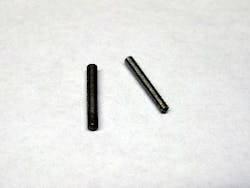
Solid / Tapered Pins: As the name implies, a solid pin (photo 1) is essentially a solid rod that is driven into a socket (hole) in the lock housing to hold two or more parts together (usually the ignition lock). In order to make sure that the pin remains firmly in place, the hole is drilled or cast slightly undersized and the pin is forced into the hole under pressure. To make sure that the pin can be started into the hole easily, the ends of the pin are usually tapered. In some cases the entire pin may be tapered as well, but this type of pin is almost never found in an automotive application. A good example of a solid or tapered pin is found on many Toyota and Lexus locks as shown in photo 2.
Splined Pins: A splined pin (photo 3) is also a solid pin, but instead of having smooth sides, it has a series of splines running the length of the pin. These splines dig into the relatively soft metal of the lock and housing, usually cast zinc, to tightly hold the pin in place. Generally, splined pins and tapered pins are interchangeable and can usually be removed with the same techniques. The solid pins used on the Toyota locks that I mentioned above may or may not have splines.
Roll Pins: Roll pins, sometimes referred to as tension pins, are made from a flat piece of spring steel that has been rolled into a cylinder in order to form the pin. Once again, roll pins are inserted under pressure into a slightly undersized hole, but in this case, the roll of spring steel is compressed and the compression of the spring holds the pin in place. Both ends of the pin are tapered so that the pin can be easily started into the hole.
Replacement roll pins are usually available from quality hardware stores and locksmith supply houses. If you plan to work on many ignition locks, I strongly suggest that you buy a roll pin assortment and keep it in your truck. Even if you do not damage a roll pin in removing it, they have a tendency to disappear into the background when dropped on the floor. A sample of various sized roll pin is shown in photo 4.
Capped Pins: This type of pin is held in place by a cap, usually formed by swedging some of the metal of the housing over the top of the pin. About the only place you will find these rare pins is on the old Alpha-Tec ignition locks used by GM in the mid-1990s as shown in photo 5. If these locks have been removed from the car, you can actually grind away the metal that has been staked over the top of the pin and then shake the pin out its socket.
Mushroomed Pins: These are not actually pins that can be removed, but are in fact a part of the lock that fits through a hole in a matching part and are then mashed so that the two parts are locked together. This type of retainer is often found on Toyota and Lexus ignition locks holding the face of the lock in place as in photo 6. This type of retainer must be dealt with very carefully, so that you do not damage the lock, or grind away so much metal that you cannot reassemble the lock properly.
REMOVING DIFFERENT TYPES OF PIN RETAINERS
Solid pins and spline pins that are mounted in “blind” sockets all need to be dug out of the lock. Attempting to simply drill them out can be a very frustrating experience. The metal of the pin is harder than that of the surrounding lock housing, so a hand-held drill has a tendency to slide off of the pin and into the housing of the lock. If you get your drill to bite into the pin, chances are that the pin will soon start spinning in the hole, which is impressive to watch, but accomplishes very little.
Roll pins can sometimes be removed with a sheet-metal screw or a tap screwed into the hole in the center of the pin. Obviously, you can’t do this with tiny roll pins, but if the pin is large enough in diameter, give this method a shot. Photos 7 though 9 show this method in use on a Ford Escort ignition, which has relatively large diameter roll pins.
You want to use the smallest tap or screw that will fit into the pin and still get a grip. If you use too large a tap or screw, you will expand the roll pin and make the job of removing it even more difficult. In these photos I’m using a number 4 X 40 tap. I have also used a generous amount of tap lubricant (Tap Magic) on the tap and on the pin in order to prevent the tap from binding and to help the pin slide out. Because this tap barely bites into the pin, it will thread in easily until it bottoms out in the hole. In photo 8 you can see that the tap has bottomed out in the socket and by continuing to screw the tap in, it acts as a puller to pull the roll pin out of its socket. In photo 9, you can see the pin and the tap after they have been removed from the lock. Avoid trying to pull the pin out with the tap; that is a very good way to break the tap off in the pin and make your job harder.
The process of digging out smaller pins, regardless of whether they are solid pins or roll pins, generally involves drilling or grinding a hole next to the pin, and then prying the pin out with a tool like an ice-pick. When you are drilling your hole, make sure that you drill from the side of the pin and not from either the front or the rear of the pin. You want to make sure that when the lock is reassembled, the pin holds the lock together just as well as it did before you removed it. If you drill inline with the direction the lock has to move in order to come apart, the parts may not fit back together as tightly as they did before you started.
My personal preference when it comes to digging out pins is to use a “dental burr” to grind away just enough metal for me to reach the pin and then to cut slightly into the pin itself. On a roll pin, you can actually grind a hole in the pin with the tip of a dental burr. Dental burrs can be purchased from dental supply houses, and they come in a variety of different sizes and shapes. They are also not cheap, but if you talk to your dentist, you may be able to get them for free.
Dental burrs have a special heat-sensitive coating that changes color when the burr gets too hot. Once the burr changes color, the dentist will throw it away because they cannot afford to generate too much heat while drilling a tooth. Too much heat can kill the nerve in the tooth. Locks don’t generally care if they get a little hot, and cast zinc is a lot softer than teeth. A dental burr that is too dull for dental work will still cut through a spring steel roll pin like butter. My dentist saves his old burrs for me and every time I go for a check-up, I get a small bag of them for free. In order to avoid possible contamination from things like AIDS, he “autoclaves” the burrs, which sterilizes them. This is not an extra step for him because current regulations require that medical tools such as dental burrs be sterilized before they are discarded anyway.
Once you have your dental burrs, you will need a way to hold them and to spin them at very high speeds. Your Dremel tool will work great for this with the addition of a “finger chuck” as shown in photo 10. Finger chucks are available wherever Dremel accessories are sold. The last finger chuck I bought cost $3, so it’s not a huge investment. The finger chuck replaces the standard collet and allows you to hold various sized bits. Dental burrs are tiny in comparison to normal Dremel bits, so I always tighten the chuck with the wrench, using the flats on the base of the chuck. Dental burrs are also designed to spin at speeds up to 100,000 rpm, so you will want to run your Dremel tool as fast as possible as you use them.
Another advantage of the finger chuck is that once you have one, you can also hold some very tiny drill bits and spin them at very high speeds. Dremel even offers an inexpensive set of bits that are designed for high speed work as an option that is shown in photo 11.
Armed with my dental burrs and a rechargeable Dremel tool, it’s easy to cut an angled slot next to the pin as shown in photo 12. I begin by using the dental burr as a drill to grind a hole at an angle down to the roll pin and then continue cutting until I have either cut a notch in the side of the pin if it is a solid pin, or a hole in the side of the pin if it is a roll pin. Then, I cut away the metal above the hole so that I have a clear path to pry the pin out through. Next I use an ice pick, or a Shrum tool, as I’m using in photo 13, to pry the pin out of the socket. I like the Shrum tool because it is shorter than an ice pick and I can generally get it into tighter places.
DEALING WITH TOYOTA / LEXUS IGNITIONS
Toyota and Lexus use a combination of a splined solid pin and two mushroomed pins to hold the face cap onto most of their ignitions. Removing the face cap is therefore a two-step operation. First, remove the solid pin and then disengage the two mushroomed pins before the face cap can be removed and the lock serviced.
You could remove the solid pin with a dental burr and an ice pick but there is an easier way. The solid pin goes through a tab in the underside of the face cap that fits into a rectangular casting on the bottom of the lock. The pin is in a blind hole, but it is easy to drill a small hole from the side, at the base of the pin, and then push the pin up with an ice pick or Shrum tool. In fact, if you’re lucky, you can often hit the base of the pin with your drill bit as you drill the hole and the drill bit will push the pin up far enough for you to grab it.
In photo 14, you see how I’m using the Dremel tool to drill the hole at the base of the pin. I wasn’t lucky enough on this one to have the pin pop up, but I do have a hole into the pin chamber that I can easily work through.
Photo 15 shows how I was able to push the pin up partially with the end of a Shrum tool. This is far enough up for me to grab with a small pair of side-cutters as shown in photo sixteen. Once I have a grip on the pin, I can rock the side-cutters to pull the pin up more. After repositioning the side-cutters, you can usually pull the pin out the rest of the way.
With the solid pin removed, we next need to deal with the two mushroomed pins. These pins are cast into the face cap and can easily be broken off if you are not careful. When the face cap is installed on the lock, the ends of the pins that protrude through the face of the lock are mashed flat to hold the face cap in place as shown in photo six. If we grind off all of the mushroomed part of the pins there will be nothing left to hold the face cap in place securely. This will cause the face to be loose unless we use something like J-B Weld to reattach the face cap.
I prefer to grind off a portion of each pin and then carefully pry the face cap off a little at a time. If you are careful, the remaining parts of the mushroomed pins will fold up and allow the face cap to slide free of lock. If this works correctly, there will still be enough metal left for you to restake the pins to hold the face cap securely.
Photo 17 shows the same pin as we saw in photo 6, but now I’ve ground away the edges of the pin at the top and the bottom using a Dremel tool and a cut-off wheel. A little careful prying with a small screwdriver as shown in photo eighteen will usually pull the pin through the face of the lock, and leave enough metal for you to stake the pin back in place when you reassemble the lock. Tapping the pin in the center with a sharp punch can also help you free up the pin from the face of the lock. Photo 19 shows the face cap after it’s been successfully removed from the lock.
The most important thing to remember when dealing with pins is to take your time and don’t force anything. Think about what you’re going to do, develop a plan of attack and then work carefully to solve the problem. And whenever you’re drilling or grinding on one of these locks, wear your safety glasses. I once had a hot piece of metal burn its way into the white part of my eye while I was under the dash of an antique Desoto. I thought I got it out, but I was mistaken. When I woke up the next morning, it felt as if my eye was on fire. Fortunately, the doctor was able to pluck the piece of debris out without permanent damage, but after that close call, I have become a real believer in safety glasses.