Cansec Zodiac 250: Standalone Biometric Access Control
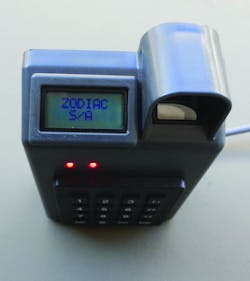
The Cansec Zodiac 250 standalone fingerprint reader can enroll, manage and control access for up to 250 users (two fingerprints per user). The 250 users is an impressive number for a standalone capable fingerprint biometric.
Biometrics, according to Wikipedia, the free encyclopedia, “comprises methods for uniquely recognizing humans based upon one or more intrinsic physical or behavioral traits.” For our purposes, every human has his or her own unique physical trait - that is fingerprint’s arch, whorl, and loop. Fingerprints by agreement are the friction ridges on people’s fingers, which have sufficient uniqueness to be individualized.
Fingerprint-based access control systems use fingerprint authentication to verify a person’s identity. The access controller (administrator) already knows who the person is because the person has provided a fingerprint template to the access control system. In order to gain access, the “candidate” or offered fingerprint image is compared with one or more fingerprint templates to determine the degree to which they match.
Part of the reason this is rarely a perfect match is the fingerprints are almost never aligned perfectly when viewed and a person’s fingerprints vary as they age and lose or gain weight/fluid and other biological or environmental factors. In addition, fingerprint readers are a flat surface where it is up to the person to properly position their finger.
Here is where the problem lies. Reading the finger’s position and then comparing the number and complexity of fingerprint patterns requires a great deal of computer processing power. Computing power means speed versus time. Access control requires quick authentication of someone who can gain access. For this reason, a number of biometric companies including Cansec use a “one to one” comparison via a PIN attached to the stored fingerprint template in order to authenticate the person. This way, the candidate fingerprint image does not have to be compared to more than one template.
As a comparison, a proximity card or user code requires almost no time to process. It takes longer for the individual to find the card and swipe it or punch in the code then it takes to process the information and determine if access is granted. To practically compete, fingerprint biometrics must be as fast. Slow access can be the result for companies where many people enter and leave at specific times.
To minimize the time required to gain access, the Cansec Zodiac 250 attaches a Personal Identification Number (PIN) to the fingerprint and the backup fingerprint. By doing this, only one or two fingerprints are compared, instead of having to compare all of the fingerprints in memory (one to many).
According to Cansec, “Approximately four seconds for authentication and locking mechanism release. The time frame does not change whether there are one or 250 users programmed in the system.”
The Zodiac 250 is compact, measuring about six inches tall, by three and one half inches wide, by one and one half inches deep. The front of the unit has a 16-button keypad with the characters 1-0, ESC, ENT, PGM, F1, F2 and F3. The fingerprint reader is hooded to minimize ambient light. The tamper resistant glass prism covers the sensor.
The Zodiac 250 uses optical technology to read fingerprint minutia points. During programming, the sensor captures an image that becomes the template. At the same time a PIN is assigned to the template. Up to 500 user templates can be stored in the Zodiac 250 non-volatile memory.
The system’s level for authentication is factory set at just above average. This setting compensates for normal variation within people. As a result, this setting reduces the number of False Acceptance Rates (FAR) and has an even smaller possibility of False Reject Rates (FRR). FAR is the number of probabilities that the fingerprint biometric incorrectly matches the candidate to a non-matching template. FRR is the number of probabilities that the fingerprint biometric fails to detect a match of the candidate to the matching template. The smaller the number of FAR and FRR, the more practical the biometric is.
The Cansec Zodiac 250 can be installed as a standalone unit, programmed at the reader. The Zodiac 250 can also be operated as just a biometric reader, incorporated into an existing access control system using switchable 26-bit Weigand format or Cansec 37-bit proprietary format. For our purposes, we will set up a standalone system.
Installation
For our system, Cansec has provided the Zodiac 250, the Zodiac Door Control Module (DCM), 16.5 Volt 40 VA Plug-in Class 2 AC transformer, Cansec 12VDC/3A output Power Supply and an Electric Strike.
The Zodiac 250 can be installed on the interior or the exterior. For exterior applications, an optional cover protects against moisture. If the unit is installed on the exterior, an optional heater must be purchased if the temperature goes below freezing. The heater comes with a power supply.
The Door Control Module is always installed onto the “secure” side of the opening, taking the information from the Zodiac 250 and providing the unlocking function. With the Door Control Module not available, if the Zodiac 250 is pulled off the wall, there is no way to jumper the exposed wires in order to unlock the lock. Two Form “C” lock relays have a nominal switching capacity of 2 Amps @ 30 VDC. The lock device relay portion of the DCM connections is designed for electric strikes having a maximum one Amp draw and a magnetic lock or motorized lock having a maximum two amp draw. The one Amp electric strike draw maximum compensates for the in-rush.
To wire the Zodiac 250 to the Door Control Module, Cansec specifies six conductor, 22 gauge overall shield cable (6 CONDUCTOR 22 AWG SHIELDED). Shielding prevents electromagnetic interference (EMI) from being absorbed by the conductors. The metallic shield drain wire along with the ground wire is connected to both the Zodiac 250 and the Door Control Module GND (Ground) connectors.
Important: The metallic shielding must be grounded to prevent electromagnetic interference.
Five wires are the minimum necessary to transmit signals and provide power to the Zodiac 250. According to Cansec, 22-gauge stranded wire is the optimal size for wire runs up to a maximum of 500 feet.
The Cansec Power Supply provides filtered and regulated power of 12VDC at 3 Amps. The Cansec 16.5 Volt 40 VA Plug-in Class 2 AC transformer powers the power supply. The Zodiac 250 with Door Control Module draws a total of 300 mA. As an added benefit, the DCM can be connected to either a four or seven Amp hour backup battery for operation during power failure.
For this article, we will use an HES electric strike to control access.
Wiring the Zodiac 250 is straightforward. For our purposes, there is an eight-pin plug-in connector to which we will connect five wires. We will connect D0, D1, LED, GND, and 12 VDC to the same five connections at the READER portion of the Door Control Module circuit board fixed connector. Except for GND and 12 VDC, the wire color does not matter as long as the connection is correct. Use red for the 12 VDC and black for the GND.
The colors of the six conductor shielded cable are: red, black, white, blue, green and brown. For our purposes, in addition to the red and black for power and ground, we will use the blue for D0, the green for D1 and the white for LED.
Important: Be sure to twist the drain wire and the black ground wire together before inserting into the GND connector position in order to reduce EMI. Keep as much of the exposed wires covered with the shielding as possible.
Since we are not installing a door contact switch, a jumper wire must be installed between NC and GND on the DCM in positions three and four. Do not use the GND slot above the NC slot. It is for the power in ground. Then power must be provided from the transformer to the power supply board, the power supply board to the Door Control Module, and the DCM to the electric strike.
For our purposes, the DCM will power both the Zodiac 250 and the electric strike as the total power demand is less than two Amps. A second jumper wire must be installed onto the Door Control Module between the +12V OUT and the COM.
To suppress reverse surges, a 1N400x series diode should be connected to the positive and negative wires at the electric strike. A diode conducts electric current in only one direction preventing reverse surges.
Programming & Authentication
Programming and authentication are the two steps through which access is controlled. Each person authorized to gain access must first be programmed into the Zodiac 250. The programming begins with administrators. The administrators are those individuals who will add and delete Users and will have authorization to change system settings. No administrator, no programming of users. Up to nine administrators can be enrolled (programmed).
The administrators control two menus: the administrator menu and setup menu. The administrator menu can add and delete users, display user information and display the total number of enrolled users. The setup menu adds and deletes administrators and determines the system operational functions. This includes setting time and date, deleting all users, factory reset and selecting the mode. The mode choices include the Zodiac 250 operation as a standalone system or a reader.
For this article, we are setting up the Zodiac 250 as a standalone system. When the correct user PIN and fingerprint are presented and authenticated, access is granted.
Upon startup, the two-line LCD displays, “The unit is in virgin mode. Setup required press PGM key*****”. Pressing the PGM key sets up the first administrator by recording a PIN and red LEDs on the scanner glass waiting for a fingerprint. If successful, the LCD displays “Function Complete.”
Administrators have only a single fingerprint template. Cansec recommends the primary administrator enroll a second time with an alternative finger. For this installation, I became the administrator using my right hand index finger.
Once the administrator has been enrolled and the changes have been made to the setup menu options, the users can be enrolled into the Zodiac 250 in one of two ways:
PIN + Fingerprint – The user receives a PIN and then when instructed, places the finger to be enrolled onto the glass of the scanner. Once scanned, the Zodiac 250 will instruct the user to enroll the backup finger, an alternative fingerprint under the same PIN to help insure access.
If a fingerprint is not viable, the alternative is a Bypass Number. The Zodiac 250 will request a five- to eight- digit number that can be used to gain access. The longer the number, the greater the level of security.
Users can be added and removed by the administrator knowing their PIN.
For a user to gain access, the PIN is enter and the “ENT” button is pressed. Red LED’s will illuminate at the fingerprint sensor. Place the enrolled finger onto the glass. Almost instantaneously, the LCD indicates “ACCEPTED” and the two front LED’s illuminate green. If a finger is not placed onto the glass, the system will reset. If the backup finger is placed on the glass, additional time is required for the system to authenticate both fingerprint templates.
Up to 250 users can be programmed into the standalone configuration of the Zodiac 250. This includes up to 250 backup fingerprints.
The body of the Zodiac 250 is manufactured of polycarbonate material that is UV stabilized against discoloration. The unit is not waterproof for exterior applications. However, Cansec offers an optional cover to protect the unit when installed in outside installations. For areas whose climatic conditions go below freezing, Cansec offers a heating unit. This thin, rectangular heater is placed behind the Zodiac 250. It comes with its own power supply.
For more information, contact your local locksmith distributor or Cansec Systems Ltd. Telephone 905-820-2404. Web Site: www.cansec.com.