Trends in Electronic Locks
The electromechanical lock is not new. I installed battery operated motorized deadbolts and electronic locks way back in the 1980s. I remember a “key free” electromechanical knob and deadbolt lockset that was pretty amazing. To enter the combination, the knob was rotated to the left and/or right. An LED would display the numbers as the code was being entered. When the correct combination was entered, both locks would unlock. I think the lock could be programmed to one of ten thousand possible combinations. There was key override for both locks. Power for the locks was 4 AA and one nine volt battery.
Since then significant improvements have occurred. Once lock manufacturers were able to practically motorize a mechanical lock mechanism, electromechanical locks became a viable product. Unlike the solenoid that is used to lock and unlock most electrified mechanical lock hardware, the motorized electromechanical lock hardware draws significantly less power. This allows electromechanical lock manufacturers to power their locks with batteries that can last for many thousands of operations. For example, the six AA batteries in the Securitron SABL® have been tested for over 100,000 cycles.
Most electromechanical locks are based on mechanical cylindrical locks, mortise locks and exit device platforms that have been tested according to ANSI/BHMA standards. For example, ANSI Grade 1 cylindrical locks are designed for commercial applications having met cycle requirements of 800,000. Grade 2 cylindrical locks are designed for light commercial, etc. applications having met cycle requirements of 400,000.
The electromechanical lock based on a Grade 1 lockset is designed to provide the highest possible operational levels. A Grade 2 lockset has met the Grade 2 Standards. When choosing an electromechanical lock, make sure it is the correct operational grade for the application. For more information, contact ANSI or BHMA.
Schlage AD-Series electro-mechanical locks are designed to meet or exceed ANSI/BHMA 156.25 Grade 1 specifications. They are built using a plug-in modular electronic platform. The AD locks have changeable modules. A lock’s modules can be removed and different modules installed, reconfiguring the lock in order to migrate to new or different credential technology or functionality without having to replace the entire lock.
Omnilock, a product division of Stanley Works, offers the Quick Adapter Schlage (QASOM) and the Quick Adapter Exit Device Adapter (QAXOM). The QASOM system converts existing Schlage D-Series Grade one cylindrical locksets and AL-Series locks to an Omnilock compatible electromechanical lock. The QASOM can also convert a double cylinder leverset, such as the Schlage D-82PD using two Quick Adapters to become a code-in code-out lock. The QAXOM adapter is designed for Grade 1 Corbin Russwin, Precision, Von Duprin, Sargent, Yale, Arrow and Detex exit devices.
Although most electromechanical locks have a key override, their operational intent is to control access using some type of reader. There are keypad, mag-stripe, proximity, Smart Card and biometric readers built into the standalone electromechanical locks. With keypad readers, there is single user code entry and for higher security requirements, the Marks USA iQwik LITE has the option of double code entry. The lock can be set to require two User Codes to be entered before access is granted.
To make entering the User Code easier, the Arrow Lock Revolution and the Samsung EZON Digital Keypad Deadbolts are examples of touchscreen electromechanical locks.
Some electromechanical locks have more than one reader. For example, some of the Sargent Profile Series electromechanical locks are available with keypad and proximity readers. A Profile series lock equipped with keypad and proximity can be programmed to require both a keypad entered user code and a proximity card in order to gain access. This is known as dual credentials.
Most of the newer, full featured electromechanical locks have dual credential capabilities. Dual credential capability provides an increased level of security by requiring a second credential in order to gain access. Digitlocks Inc., ADEL APEX US-1 Biometric Lockset is equipped with a keypad and fingerprint reader. The APEX US-1 can enroll up to 95 fingerprints into this standalone lock.
On a different security level, the Federal Government developed the Federal Information Processing Standards (FIPS) publication 201, a United States federal government standard that specifies Personal Identity Verification (PIV) requirements for federal employees and contractors incorporating Smart Card technology. The Kaba Ilco E-PLEX® 5800 Series is certified to meet the GSA standard for FIPS 201 approved products. This 5800 series can be operated using the PIN code and/or FIPS 201 (contactless) Cards or DESFire® (contactless) Smart Cards.
With the cost of memory dropping over the last years, manufacturers have been able to increase the capabilities of their electromechanical locks. This includes the number of users, controlling access features and audit trail events. Today’s electromechanical locks have many more users and multiple level hierarchies. For example, the Corbin Russwin Access 800®WI1 supports up to 2,400 users with a ten thousand event audit trail.
The hierarchy determines who can do what and when. Within each electromechanical lock’s hierarchy, there is the absolute (top) user code and the basic user codes. Between these two, there can be a whole range of users that have differing degree of controls. These can include and are not limited to Sub-Masters, Supervisors, Managers, Emergency Codes, Service Codes and Single Use codes. Each lock manufacturer determines the levels within the hierarchy, the functions at each level and the number of available users at each level. For example, the Codelocks CL5000 single Master Code performs all programming functions, but cannot be used to unlock the lock.
The increased memory enables standalone (non-networked) locks to maintain a greater number of audit trail events. Events are normally retained as first in, first out. With increased memory, events can be remain in memory for days, if not weeks or months depending upon the amount of memory and the door use.
Networking and Beyond
A number of electromechanical locks are available with networking capabilities. All of the locks communicate with a PC either using Ethernet cable or wireless. Networking is probably the most important for commercial and institutional applications. Network enabled electromechanical locks eliminate the “lock by lock” programming and audit trail retrieval. For example, Schlage offers the four versions of the AD Series locks. These include the two online AD-300 Networked Hardwired Locks and the AD-400 Networked Wireless Locks.
Networking permits all of the locks (on a network) to be programmed remotely and allows remote access to the audit trails and commands such as emergency system wide lockdown or unlock, passage mode or locking mode and open door (not secured) warning. Many of the network lock software programs provide the ability to check the battery level in each of the locks, having remote early warnings to replace the batteries, eliminating the need to annually replace batteries. Examples of networked electromechanical locks are the Alarm Lock Trilogy Networx™ Locks and the Sargent Profile Series v.S2 Locks.
With the increase in violence, many networked electromechanical locks can be remotely locked down. If these networked locks are hardwired, they can be in constant communication with the PC. However, to conserve power, most battery operated electromechanical locks have an end user programmable sleep time. For most, during this down time, the lock is not in communications with the PC. Sleep times can range from less than 15 seconds to more than a minute.
Knowing the position of the door is important. Is the door locked and secured? Is the door being held open? If equipped and installed, a lock can notify the PC that the door has been open for too long a time. Door open condition can be determined using a door position switch and/or a latch position switch. Contact the lock manufacturer for details.
Every networked lock installation is unique. The end user will have specific wants and requirements for their locks. Having the proper software is important. Some lock manufacturers use “open architecture” locks that are not proprietary (limited to a specific manufacturers software). Schlage, for example has electromechanical locks that are both open architecture and proprietary. In addition, Schlage offers software that is designed to operate their open architecture locks, giving the locksmith and end-user choices. However, with open architecture locks there are few choices of pre-packaged third party software available. Most third party software will be custom written for your application.
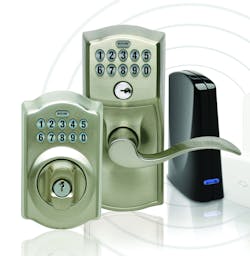
For residential applications, the Schlage LiNK, Kwikset SmartCode® and other lock makers have developed interoperability with home automation equipment including cameras, heating air conditioning, lighting etc. In addition to these features, some locks can notify the owner at what time a specific User Code gained access.
Going beyond networkability, there are lock manufacturers that are beginning to figure out ways for homeowners to better communicate with their locks. Several lock manufacturers are experimenting with social network services and applications to communicate with an electromechanical lock in order to give someone access, make sure the lock is locked, determine who is in the home, etc.
One of the most important and positive electromechanical lock trends is easier programming. Touch screens, voice activated programming and simple commands are replacing “watch the red, yellow and green LEDs and be sure to count the blinks” style of programming. Networked locks are even easier as some of the PC based operating software is becoming more intuitive.
At the present time, electromechanical locks in commercial applications are less than 10 percent. The functionality of new products that will become available is amazing. This is good opportunity for locksmiths to become involved with new technology without having to be a computer programmer, electrician or electronics expert.
With the newer electromechanical locks requiring less power and batteries having increased capacity, there is little need for having to run hardwired power or Ethernet cables. Most of the wireless networked lock manufacturers have available or can recommend the necessary equipment required to setup a network.
Electromechanical locks will become more compatible with other methods of security including sensors and CCTV. Improved sensors will speed entry into facilities dramatically resolving reader issues. Enabling companies to make certain who is entering is who is supposed to be entering.
Most of the networked electromechanical locks have battery condition as part of the operating software. As the batteries in a lock begin to reach replacement, the software can usually notify this condition.
As electromechanical locks continue to evolve, remotes (regular and protected, such as fingerprint ID fobs) will eliminate the need to enter a code in order to gain access. Use of a “Smart phone” will eventually become part of institutional, commercial and residential electromechanical locks. As these phones become more capable, there is good reason for them to become the replacement for providing access, maintaining security and even operating your vehicles.
At some hotels, a traveler can make the hotel reservation, pay for the stay and gain access into the room via “Smart phone,”. without having to go through the check-in or out process.
One important consideration is that more time is required to install an electromechanical lock than to install a mechanical lock. In additional to the time required to prep the door and install the lock, you need to consider the time required to program the lock.
There is an amazing future for the electromechanical lock and communication technology. Relatively soon, you will be able to sell a door lock that will contact you when someone wants to gain access, provide you with streaming video of the person and the surrounding area. Upon approval, pressing a button will not only unlock the door lock, but also turn off the alarm system and lock or unlock interior doors providing the necessary access. Once the person is in the house, the closed circuit television cameras will monitor and record their movements until they leave, deadbolting the exiting door.
A note of clarification. The information included in this article has been obtained from the respective lock manufacturers or their Web Sites. Additional information will have a referencing web site.
FMI
Electromechanical lock manufacturers discussed in this article include:
Alarm Lock Networx – Web Site: www.alarmlock.com
Arrow Lock Revolution – Web Site: www.arrowlock.com
Codelocks CL5000 Lock – Web Site: www.Codelocks.us
Corbin Russwin Access 800®WI1 – Web Site: www.corbin-russwin.com
Digitlocks Inc. ADEL APEX US-1 – Web Site: www.digitlocks.com
Kaba Ilco E-PLEX® 5800 Series – Web Site: www.kaba-ilco.com
Kwikset SmartCode® – Web Site: www.kwikset.com/SmartSecurity/Overview.aspx
Marks USA iQwik LITE – Web Site: www.marksusa.com
Omnilock QAXOM (division of Stanley Works): Search internet browser “Omnilock” for locksmith distributor
Samsung EZON Digital Keypad Deadbolt - Web Site: www.ezonusa.com
Sargent Lock Profile Series v.S2 Locks – Web Site: www.sargentlock.com
Schlage Lock AD-Series Locks – Web Site: www.commercial.schlage.com
Schlage Lock LiNK – Web Site: http://link.schlage.com/Pages/home.aspx
Securitron SABL – Web Site: www.Securitron.com