Cylindrical And Mortise Lock Functions
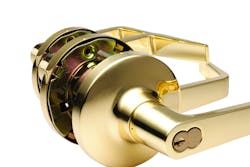
When I first started doing lock work, I was told to be very careful and read the packaging to be certain the lock installed onto the door was the correct finish and operation. My early jobs were restricted to cylindrical and tubular locks. Living in California, we mainly installed Schlage and Kwikset cylindrical and tubular locks. The Schlage factory was in the Bay area and Kwikset was in Anaheim.
Most of my installs at the time were Passage locks, Emergency Key locks (Privacy), All Purpose locks (Entry), and Storeroom locks. The All Purpose Schlage knobset was the A52PD or the A52WD, which is equipped with a ”universal” button. To provide an additional choice for customers, we also sold the A51PD/WD, which is equipped with a turn-button. The difference is whether the inside button would release, unlocking the door when the key or the inside knob was turned. The Schlage A51PD would not release the button when operated by the key or the inside knob.
There were many more “A”, “C” and “D” locks having unique operations in the 1950 Schlage Lock catalog. “A” knobsets could be ordered in 12 lock operations equipped with pin tumbler or wafer lock mechanisms. For example, the A52PD description was “Recommended for ENTRANCE or CORRIDOR DOORS. Rotating either knob will retract latch bolt. Pushing button in inside knob locks outside knob. Rotating inside knob or turning key releases button automatically. Closing door does not release button. Button may be fixed in locked position by rotating to horizontal position. Lock may be opened by key from outside. Inside knob always free for immediate exit. Latch bolt automatically deadlocks when door is closed.”
The extra duty construction “C” and “D” locks could be ordered choosing from 25 operations. The “C” knobsets mechanism is constructed of non-ferrous metals throughout. Spindles and latch bar are of Monel metal; all other parts are of bronze. “C” and “D” knobsets used the same knob and rose designs. However, they were not available with wafer lock mechanisms.
By the time I received my 1979 Schlage Service Manual, there were 22 “A” knobset operations with many of the wafer lock models discontinued. In this manual the A52PD/WD lock operation description was the same as the 1950 catalog.
Unlike mortise locks, cylindrical locks were for the most part interchangeable as the cross bore was usually 2-1/8” diameter at a 2-3/8” or 2-3/4” backset. However, not every lock manufacturer would include a full description of the lock’s operation in their catalogs. This could add uncertainty when it came to ordering a lock if the customer wanted a different manufacturer’s lock. Lock operation could have minimal variation, for example the Schlage A51 and A52 locks.
To resolve this potential problem and expand upon standardization, Builder’s Hardware Manufacturer’s Association (BHMA) became involved with the federal government. Many years prior to the involvement, the Federal Government had developed a series of lock specifications. However, there was no set organization or standardization.
Through their involvement in 1970, the BHMA’s standard for Function “F” numbers was developed. Additional numbers are being added to keep the standard up to date. This voluntary standard was slowly accepted and incorporated by lock manufacturers into their catalogs.
BHMA and American National Standards Institute (ANSI) instituted ANSI Function numbers to describe lock operation. A lock function is the operating features of a particular type of lock that makes it suitable for a specific application. The function is how a lock behaves when operated. The standard was created, with specific ANSI numbers for locks (knob and lever cylindrical), bored dead latch locks (deadbolt), interconnected locks and mortise locks. At this time, electrified locks do not have a function number.
A lock is designated as a part number, name and an ANSI “F” (function) standards reference number where applicable. The manufacturer determines the lock part number and name. Most lock names describe their operation. For example, a Sargent Lock 11G30, Communicating Lock has the ANSI function number F80. Not every manufacturer will make all of the ANSI function number locks.
Every ANSI function number has a description, much like the operation. The function numbering began with mortise locks. The ANSI F01 Passage Mortise Lock description for Marks USA is “Latch by knob/lever either side.” The Sargent Lock description for the ANSI F01 Passage or Closet Mortise Lock function description is “Trim from either side retracts latch bolt at all times.” Both say the F01 function mortise locks do not have keyed cylinders or a deadbolt, and the inside or outside knobs or levers will retract the latch at all times.
Because of the number of mortise lock functions, most lock manufacturers list their mortise locks by first dividing them by keyed and non-keyed. The keyed mortise locks are further divided by single and double cylinder and deadbolt or non-deadbolt.
ANSI function numbers were applied starting with F01. The Passage Function is for mortise locks. A passage function mortise lock does not have either a keyed cylinder or a deadbolt.
Different lock types use different ANSI function numbers for the same function. The passage function cylindrical (bored) lock uses ANSI F75. Both bored locks and mortise locks share some of the same functionality, however they are not identical. For this reason, each lock type, mortise, cylindrical and deadbolts have their own unique numbers for each lock function.
A short list of manufacturer’s lock function, the ANSI function numbers and the manufacturer’s descriptions for cylindrical locks:
When ANSI functions are displayed in a catalog, there is normally a drawing and written description of the lock’s operation. The cylindrical lock drawings indicate if there is one or two knobs/levers or a key or push button extending from each knob/lever. The mortise lock drawings indicate if there is one or two knobs/levers or a keyed mortise cylinder, coin turn or thumb turn on the outside or inside.
The length of the description depends upon the complexity of the locks’ operation.
Having the ANSI Function numbers and the description along with the manufacturers’ information can help find the right lock for the application.