Patented, Proprietary and Restricted Key Blanks and Related Lock Mechanisms
To preface this article, I am not an attorney and the following information is intended to provide a general understanding of the terms higher and high security, key control, patented, restricted, proprietary and other terms used by lock manufacturers and locksmith distributors in regards to “protected” key blanks and keyway lock mechanisms for door lock hardware. Specific information provided in this article has been obtained either from the manufacturers, distributors or from their web sites.
Because I reside in the United States, I will talk about the U. S. patent laws. If you live in a border state, be aware that the U. S. patent laws may not provide protection in a different country. Many patented keyway lock mechanisms and keys have multiple patent protection covering different patented aspects and possible countries.
“Unauthorized key duplication remains the single-most violated security policy in today’s business. Those seeking to have a key copied usually meet with little or no resistance. In fact, nearly all keys can - and will - be duplicated with no questions asked. The stamping of ‘do not duplicate’ presents a challenge to most key cutters instead of a threat…” according to the ASSA Do Not Duplicate, Fact and Fiction about duplicating keys brochure.
As locksmiths, our customers may want or have a higher level of security than offered by conventional door lock mechanisms. For these reasons, it is important that your customers understand the different variations regarding key control and high levels of security.
Key control describes keyway lock mechanisms whose key blanks and locks are not available for purchase through regular locksmith and key cutter distribution channels. For locksmiths, providing a customer with door lock key control requires purchasing keyway lock mechanisms and key blanks with some type of contractual agreement that limits the availability with either a locksmith distributor or lock manufacturer.
Patent Protection
Patent protection for just about all keyway lock mechanisms includes key control that provides protection from unauthorized key duplication. Part of the cost of these patented keyway lock mechanisms is enforcement. “Medeco aggressively acts to protect the security of the consumer by enforcing the legal rights provided by these patents,”according to the Medeco Products catalog 2009.
For this article, I will interchangeably use the terms key blanks, keys, locks and keyway lock mechanisms.
For many locksmiths, key control equals higher security locks. Key control means when you sell a company higher security locks and six keys for their employees, there will only be six keys unless the owner wants to purchase more through the locksmith who sold the locks. No unauthorized duplication because the key blanks are not available to everyone.
Patent protection, restricted and proprietary are relatively easily definable terms. However, each lock manufacturer and locksmith distributor can have its own specific interpretation.
Patented key blanks are legally restricted to those individuals and companies that either own the patent or have made contractual agreements with the companies controlling the patent. Proprietary and restricted key blanks and keyway lock mechanisms may or may not be patent protected.
A United States patent is a set of rights exclusive to the inventor or their assignee for a limited period of time in exchange for a public disclosure of an invention. The patent generally permits its owner to exclude others from making, using, or selling the invention for a period of time from the date of patent application filing. It is the responsibility of the patent holder to protect their patent rights.
There are basically three different types of United States Patents - Utility Patent, Design Patent and Plant Patent. We will concentrate on Design and Utility Patents in regards to lock mechanisms, key blanks and related.
A Utility Patent, also referred to as “a patent for inventions,” is issued for the invention of a new or a new and useful improvement of an existing Utility Patent. Under current law (effective June 8, 1995), utility patents are granted for a period of 20 years from the date the patent application was filed.
A Design Patent is issued for new, original ornamental designs for articles of manufacture. The Design Patent permits its owner to exclude others from making, using, or selling the design. Design patents are granted for a period of 14 years.
Patent owner's exclusive rights have two major limitations. They are “Functionally Equivalent Products” and “Invalidation”. A patent excludes others from making, using, or selling products or using processes that do substantially the same work as the patented invention in substantially the same manner. However, a patent does not protect the patent owner from competition from functionally equivalent products or processes that work in different ways.
For locksmiths, a functionally equivalent product and process that works in different ways are battery operated automotive electronic keys. A transponder requires energy provided by the vehicle to transmit the signal. A battery operated electronic key supplies the power to the circuit board electronics to transmit the signal.
Once a patent has been issued, the validity can be challenged, requiring the individual or company in control of the patent to bring suit. The defendant usually asserts that the patent was not unique and a mistake was made by the U.S. Patent and Trademark Office granting the patent, which does happen.
An interest twist on a utility patent is the owner of the patent is required to pay a maintenance fee to keep the patent from prematurely expiring. The fees are due at 3.5, 7.5 and 11.5 years.
Once a locksmith has agreed to purchase patent protected keys and keyway lock mechanisms, the lock manufacturer has a set criterion for the locksmith to follow to sell the customer additional keys and locks. In many instances, customers must provide identification and proof of employer before the locksmith can cut additional patent protected keys.
Patent protected key blanks usually operate higher security lock mechanisms. However, the KeyMark patented keys and keyway lock mechanism’s specified purpose was key control that can be used with interchangeable/removable cores, mortise and rim cylinders and key-in-knob cylinders. Yale KeyMark cylinders shall contain standard pins, a portion of which, both bottom and top, shall be spooled for greater resistance against picking. “U.S. Utility Patent number 5,176,015 protects Yale KeyMark keys from unauthorized duplication until the year 2011,” says the Yale® KeyMark® Patented Keyway Cylinders catalog.
Some companies need just key control. Other companies want additional entry protection. These companies may want locks that have a second or third lock mechanism or a unique lock mechanism that provides a greater degree of protection in addition to key control.
And then there are companies that want key control, some entry protection and tested protection that comes with the UL437 Listing and/or ANSI/BHMA A156.30. Both of these rating include tests for forced and covert entry. Although ANSI/BHMA A156.30 does reference high security standards, neither UL437 nor A156.30 define a “high security lock.” In addition, neither of these standards is complete, as they do not require tests for key bumping.
“For effective mechanical protection against most forms of attack as well as protection against unauthorized duplicate keys, Medeco3 cylinders are recommended. Security features including hardened steel components, pins that must be elevated, rotated, and interact with a sidebar and a slider, and additional pick resistant features…”, quoted from Medeco Products catalog 2009.
Note: If your customer wants or is required to have UL437 Listed or ANSI/BHMA A156.30 security rated, be aware that small format interchangeable cores cannot be installed. All small format interchangeable cores are not UL437 Listed.
When considering installing a patented lock mechanism, it is important to first examine the opening. If the door, jamb, strike receptacle and surrounding walls provide enough protection, a patented keyway lock mechanism that is UL437 Listed or ANSI/BHMA A156.30 security rated can provide a reasonable level of security.
IMPORTANT: High security locks that offer key control can have a UL437 Listing. However, locks that have a UL437 Listing are not required to offer key control. Also, a UL437 Listing or ANSI A156.30 security rating does not expire.
ANSI/BHMA A156.30 - 2003 includes standards for key control. “To obtain a Level A with regard to key control, key blanks must not be available from a second source, they must be protected by law, and only factory cut keys are provided by the manufacturer only after authorization..,”according to the BHMA New Standard For High Security Cylinders.
IMPORTANT: Patented keys and keyway lock mechanisms only have patent protection during the life of the patent. When a utility patent ends, most lock manufacturers will (protect) continue to follow the same business practices as when the patent was active.
When Patents Expire
Utility patents expire and new and/or “improved” patents replace them. Some lock manufacturers require customers to replace keyway lock mechanisms and keys when a patent expires.
Other companies, for example Schlage, offer an upgrade path on their patented locks. “The Schlage Everest Primus patent expires during 2014. The Schlage Everest Primus XP and the Primus XP patent expires during 2024. This newest key system is the “XP” family. These cylinders have a #7 side pin added to provide more combinating options as well as added security,”according to the Schlage Primus© Service Manual.
“Schlage Primus XP key systems are available in all Classic & Everest (full Size) keyway families. Existing Primus systems can be upgraded to XP with the replacement of one finger pin to the #7-pin and the issuance of Primus XP keys. Current Primus keys, (Everest or Classic) cannot be modified to operate Primus XP cylinders and locks,” according to Schlage.
Patented Key Blanks & Keyways
Patented key blanks and keyway lock cylinders are available from lock manufacturers either directly or through locksmith distributors. Each has their own method of determining access to their product line and who can and cannot purchase product. The larger the area, the greater the amount of product must be purchased to maintain the exclusivity.
Some examples of patented keyway lock mechanisms include:
- Abloy® Protec
- Arrow Pointe Flex
- ASSA Twin Exclusive/Twin V-10/Twin Pro/Twin Maximum
- Bilock
- Corbin Russwin® Pyramid®
- CX5 (formerly Scorpion)
- Kaba® Peaks® Preferred
- Marks Hi-Security™
- Medeco Medeco3/BiLevel/ KeyMark/KeyMark x4
- Mul-T-Lock MT5®/ Interactive®/Integrator®
- Sargent Keso F1/Signature/XC
- Schlage Everest/Everest Primus/Classic Primus XP/ Everest Primus XP
- Yale KeyMark
The patented keyway lock mechanism that permits only the lock manufacturer’s key blank varies from lock manufacturer to manufacturer. For example, the Arrow Pointe Flex patented key design has a pin assembly that extends within the center of the keyway, preventing standard IC keys from entering the core. The Pointe Flex key has a milled opening that accommodates the pin assembly.
The ASSA Twin V-10 uses two rows of pin tumblers and a sidebar to provide two layers of security. The ASSA Twin V-10 uses six pin tumblers and five sidebar finger pins. Top pins use single and double-spool designs and provide pick resistance. Top and bottom pins are of uniform pin stack height that is taller than the pin chambers. To protect against key interchange and unauthorized duplication, the V-10 patented key control has sidebar cuts that must be matched by the finger pins true gates that are raised by the key to different positions. False gates provide manipulation protection. For forced entry protection, the V-10 cylinder and plug use a variety of hardened steel inserts. The pin tumbler portion of the ASSA Twin V-10 key can be originated using standard key originating equipment.
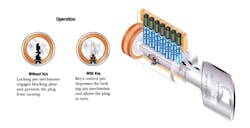
The Corbin Russwin patented Pyramid uses a control pin on the blade of the key to operate a locking pin mechanism. The Pyramid cylinder operates without a proper Pyramid key inserted; the locking pin mechanism engages blocking plate and prevents the plug from turning. With the Pyramid key inserted, the key's control pin depresses the locking pin mechanism and allows the plug to turn. Pyramid lock cylinders are available in high security and security versions. The high security version is certified by Underwriters Laboratories to UL437 standards. Pyramid High Security and Pyramid Security cylinders can be combined on the same master key system and one key can operate both cylinder types. Pyramid cylinders are to be keyed to factory-generated bittings only. Pyramid systems are independent and cannot be keyed into existing and/or conventional systems. Pyramid keys can be originated using standard key originating equipment.
The Kaba Peaks Preferred patented key control system provides protection against unauthorized manufacture or sale of key blanks, cut keys, and pinned cylinders. This six or seven pin system is backwards compatible to Peaks Classic, and requires no special equipment for assembly or to cut keys.
“Kaba Peaks Preferred is built using reliable pin tumbler technology utilizing a patented “peaks” pin as part of the security. The new “peaks” pin has a recess on the bottom that must match the “peak” found on the Peaks Preferred key. If a key without the ”peak“ is inserted, there will be no shear- line created in the cylinder. Therefore, the lock will not open,” says the Kaba Peaks Preferred Patented Key Control System Brochure.
While researching this article, I found that not all lock manufacturers include either the patent number(s) or the date of expiration in their advertising materials. Contact the lock manufacturer to find out what patents are providing protection and the expiration date of the patent that protects the keyway lock mechanism you are interested in selling.
There are generally two method of obtaining patented locks and keys. First, they are purchased by the locksmith, who then decides who can buy them. Second, a large facility can purchase the required amount of product for locks and key blanks that are exclusive to their facility. The locksmith or the facility exclusivity can be by region, area code, zip code, state, time zone, the entire country or worldwide as determined by the lock manufacturer.
For the locksmith, generally, a base level provides access to one keyway. This shared keyway gives a basic level of key control, eliminating key cutters and unauthorized locksmiths.
The next levels provide increasingly limited exclusivity. For example, a locksmith can gain exclusivity to a particular area. The size can vary by population, area code, zip code, state, time zone, etc. For those areas that are less than the entire country, other locksmiths or facilities probably have access to the same keyway, just not in the same geographic area. Depending upon the area, a local or networked locksmith distributor or the lock manufacturer ensures that the contractual agreement is maintained. If the required amount of product is not sold every year, rights can be recanted.
The “not patented” or patent expired restricted and proprietary key blanks for the most part have key blanks and a keyway lock mechanism that is not being used by any other lock manufacturer. The “not patented” lock mechanisms are usually not high security and can usually use standard pin tumblers and key origination by standard key originating machines.
There have been “not patented” restricted keyways for hundreds of years. This is not a new entry for locksmith or large facilities.
Restricted and proprietary key blanks can be restricted to regions of the United States, North America, other countries and combinations or the world. The value of a restricted or proprietary key blank is to minimize the possibility of having an unknowing duplicate made from a “not patented” key blank.
“Not patented” restricted key blanks availabilities are set by the manufacturers and/or the distributors who determine the area and sizes of the restricted region and who can sell them. More than one distributor may be able to sell the same restricted keyway lock mechanism and key blanks. Depending upon the degree of exclusivity, the buy-in and the annual purchase requirements increase in price.
A proprietary keyway is a distributor (or distributor network) wide keyway that only one distributor (or distributor network) can sell. This keyway can also be known as the “National Keyway.” Proprietary keyway lock mechanisms and key blanks have a much higher buy-in and annual purchase requirements.
Restricted and proprietary key blanks come in just about every head configuration. Coined into the key blank head may be the manufacturer, the distributor and/or the locksmith’s name. There can also be proprietary and restricted key blanks that have a neuter bow, with no identifying information. The idea is usually to not make people question the keys.
Depending upon who you are and what the application is for the restricted and proprietary key blanks, there usually is a minimum buy-in and annual purchase requirements. This amount is determined by the lock manufacturer and/or distributor. The greater the degree of exclusivity, the higher the buy-in and the larger the annual purchase requirements.
Restricted and proprietary keys and keyway lock mechanisms have at best a “gentleman’s agreement” degree of security. The mystique surrounding these keys keeps them safe by remaining an unknown commodity.
There is no law making it illegal for other companies to manufacture or sell. Most manufacturers or distributors of restricted and proprietary key blanks attempt to spread out the use of their products. In this way, without a large enough demand for the key blanks, other manufacturers will not be willing to invest the capital necessary. Also, should a lock manufacturer decide to make another’s restricted key blanks and keyway lock cylinders, the offended lock manufacturer could make the competitor’s products, basically ending those restricted keyways. It is rare for a restricted key blank to be manufactured by a competitor.
Prior to investing in a patented, restricted or proprietary keyway lock mechanism and key blanks, there are a number of points to consider. Probably the most important is the length of time remaining until the patent expires. This will be the amount of time you have to sell the patent protected product. Once the patent expires, your customers will have to be notified of the expiration and the options for new patent protection.
If you are considering selling a restricted keyway lock mechanism and keys, determine if any other distributors have the ability to sell your keyway lock mechanism and keys where. Plus, where are other locksmiths who have the same keyway? Find out how much money buys how much exclusivity.
Another point to consider is whether specialized equipment is required to service the patented keyway locks and key blanks. What is the cost of a keying kit and replacement pin tumblers? How are the lock cylinders serviced? What type of key machine is necessary in order to originate keys?
KeyMark keyway lock cylinders and key blanks have three distinct components: an upper portion or blade, a middle ledge, and a unique, lower angled portion or leg. The shape of the key blanks prevents duplication on standard machines. However, to originate KeyMark keys, a code machine with the proper vise jaws is required. I believe that there are three different angles for locksmiths who purchase the KeyMark. I believe the Medeco KeyMark has two available keyways, they are the seven and fourteen degree security leg keyways. I believe the Yale KeyMark has a 10 degree leg keyway. The Security Leg angle is not interchangeable.
KeyMark x4 isMedeco’s latest utility patent protected, key control lock cylinder for small and large format interchangeable core cylinders, conventional mortise, rim and key-in-knob cylinders. “One key will operate interchangeable cores and conventional cylinders. With patents extending through 2027…Keys can be cut using many standard code type key machines such as the A1 Green Machine, HPC 1200 with the B clamp and the CW-90MC cutter and card for cutting Best/Falcon/Arrow, the ITL 9000, and the Pro-Lok Blue Punch,” according to the KeyMark x4 Cutsheet Proof 5.